Phantom Design has a line about carpentry. The California agency compares its people to craftspeople, then closes the thought with a cheerful boundary: “And we don’t make park benches.” Fair enough. But it does have a wooden brush holder in its portfolio, and that small exception makes the company considerably more interesting.
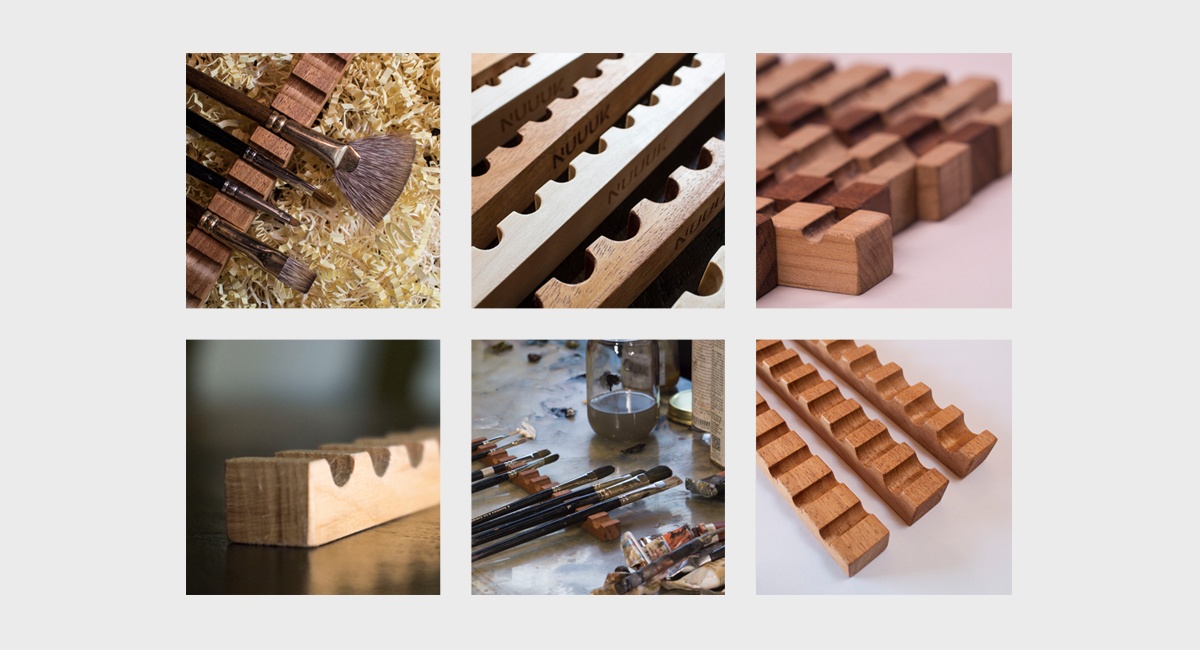
The product is NUUUK, a slotted resting place for paintbrushes and other artists’ tools. Phantom’s team developed the object through prototypes and repeated design iterations, then built a WooCommerce store to sell it. There is something pleasingly literal about an agency that talks about helping creators and also gives their brushes somewhere to sit.
That excursion into the studio supplies a useful way to read the rest of Phantom’s work. The company moves between visual identity, online retail, websites and software, taking on assignments in which an idea needs both a recognizable form and a working mechanism. The deliverable might be a brand, an interface or a piece of wood. The question is what someone will do with it.
A small object with a practical job
NUUUK’s own account describes a sequence of cutting, sanding, machining slots and finishing the wood with tung oil. It also explains a quiet visual decision: the official logo sits underneath, out of the artist’s way. For a branding business, that is an amusing place to put the brand.
The object’s purpose is uncomplicated: organize tools and keep them from rolling around while someone works. Its appeal begins with that familiar nuisance. Seen alongside the agency’s digital projects, the brush holder suggests a habit worth borrowing: identify the interruption in somebody’s day before choosing the form of the solution.
Phantom places its founding in 1999. David Amaral is identified as founder and CEO in public education records, and the firm’s contact page gives a Sherman Oaks address in Los Angeles. Its current offer bundles web design, app development, integrations, UI/UX, branding and marketing. That is a broad menu. Specific assignments do more to explain it than the menu does.
Three thousand ways to string a guitar
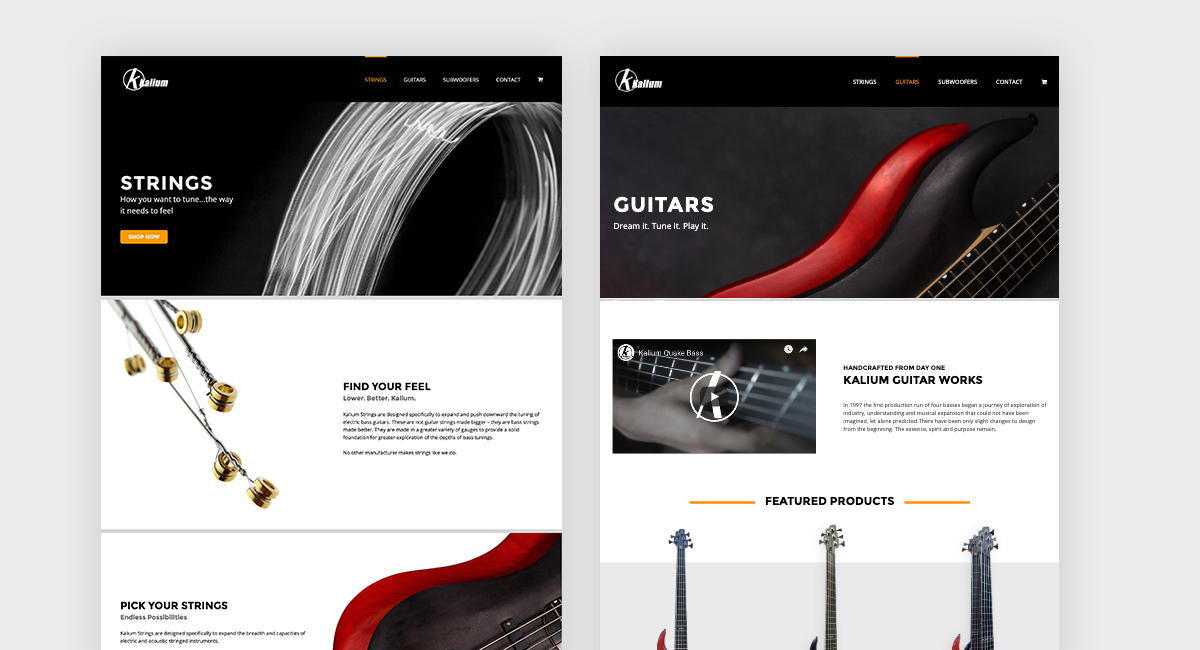
For Kalium Music, the assignment was an e-commerce site for an established maker of guitar and bass strings. Phantom describes a catalog of more than 3,000 string products. Even before discussing colors or photography, that number gives a designer something concrete to think about: how a shopper gets from knowing what they need to finding the right item.
A large specialist catalog makes the relationship between presentation and navigation particularly visible. Photographs can establish character, while product organization has to support the buying task. That is the useful lesson of the Kalium example for a merchant considering an agency: bring the actual inventory into the conversation early. A homepage is only one part of the store.
The KO Spearguns project shows another version of that combined assignment. Phantom reports handling custom illustrations, the e-commerce build, and product and lifestyle photography. In that arrangement, the things being sold, the pictures that explain them and the site that takes the order become parts of the same job. A retailer can commission several connected pieces together.
The audience changes. So does the interface.
Phantom’s work for Boeing concerned “My Energy Usage.” The agency says it designed the graphical interface and developed the frontend of a business-to-business product sold to power companies, which used it for their consumers. It is a specific role within a larger product: the layer a person encounters when trying to understand energy use.
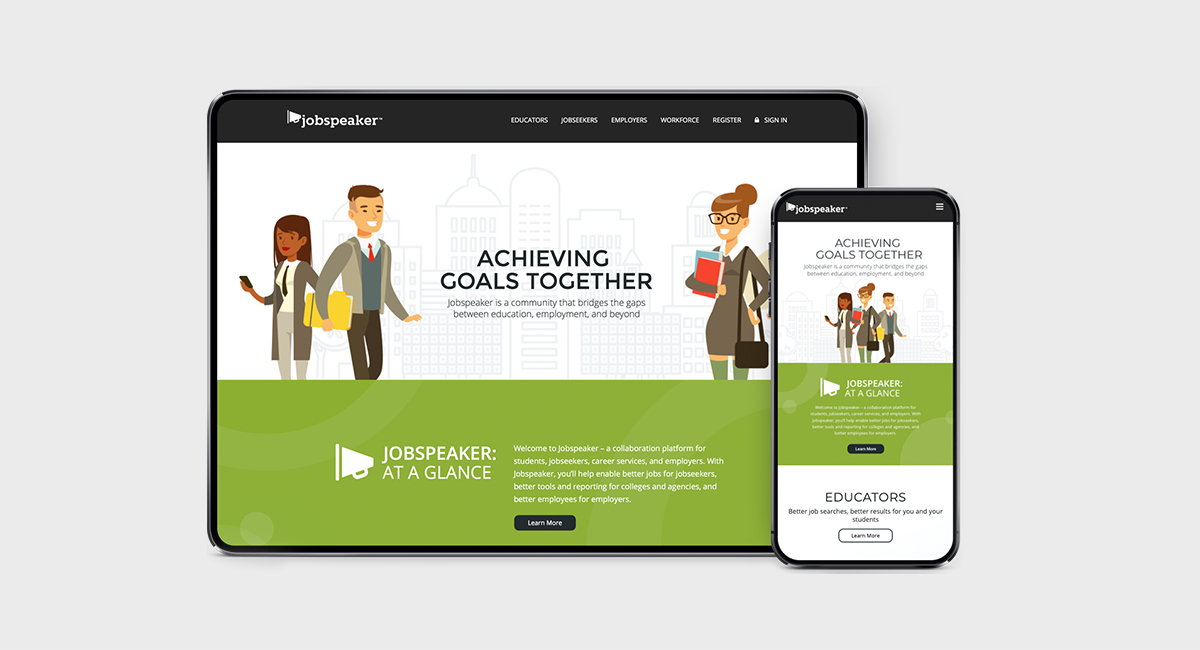
Jobspeaker posed a different communication problem. Its platform connects students, jobseekers, career services and employers. In 2018, it enlisted Phantom to develop a brand centered on community and opportunity. The resulting direction used color and illustration across a redesigned website, marketing materials and video production.
Those audiences have different reasons to arrive, even when they share a platform. The editorial lesson is to examine the people and tasks behind a brief such as “redesign our website.” A student looking for a next step and an employer seeking candidates should not disappear into an imaginary average visitor.
Publication work extends that range beyond screens people click through. For the National Sexual Violence Resource Center and Urban Institute, Phantom describes designing an online PDF presenting a taxonomy for reports received by Uber. Its contribution was publication design. The distinction matters: organizing a research document visually is a different responsibility from conducting the underlying research or determining a company’s response.
A brand has to survive the next page
For Funtastic Media, a business focused on families and parenthood, founder Moses Ruiz brought Phantom into a rebranding assignment. The agency created a new logo and a responsive website. For Mahal, a Filipino American lifestyle brand selling apparel, accessories and stickers, it developed the identity and website. The Mahal portfolio entry lists Phantom itself as the client.
These examples put branding in its working clothes. A visual identity must appear on a page, support a message and remain legible on a smaller screen. The value of combining those jobs is easiest to see at those meeting points, where a logo commission becomes a question about the whole customer experience.
Sjodin Communications supplies a paper-and-screen example. Phantom’s case study describes a 30-page report about sales-presentation mistakes, a double-sided handout and a landing page. Separately, Terri Sjodin publicly thanked Amaral and the team when announcing a new website at the start of 2025. A professional’s ideas need places to live: a report someone studies, a handout used at an event and a website visited afterward.
The 30-day promise needs a defined finish line
Phantom’s services page advertises 30 days to launch and reduces the process to three steps: kickoff, design and development, then launch. The agency’s stated sequence puts strategy first. Its methodology also describes designers and developers working together in one sprint, with support continuing beyond release.
- 01AskKickoff and strategy
- 02MakeDesign and development
- 03ShipLaunch the product
A stated offer, not a measured average across the portfolio.
For a buyer, a short schedule is most useful as a prompt to define the finish line. Which pages or features belong in the first release? Who supplies the copy? Which systems must connect? Who can approve the work? These are practical implications of the offer, rather than a claim about how any particular Phantom project unfolded.
The same logic explains the conditions that would strain it. An unresolved brief, unavailable content or an integration still being investigated makes a fixed launch harder to plan. A team with several approval committees has a different decision process from a founder who can settle a question immediately. The calendar needs to reflect those differences.
“Strategy comes before design, always.”
Phantom Design · Services
Commercially, Phantom’s core offer is commissioned creative and technical work. A prospective client brings a project to the agency; the agency develops the relevant combination of services. The sensible buying unit is a defined scope, including what happens after launch. NUUUK adds a separate, direct product-sale route to this otherwise service-led picture.
From a wooden slot to an AI interface
The Tusk case study brings Phantom into a more recent software category. For client Virtual World Computing, the agency says it led frontend and backend development of Tusk Central AI, bringing models including ChatGPT and Grok into one interface. This is evidence of a product-building assignment, with Phantom describing responsibility on both sides of the screen.
The contrast with NUUUK is entertaining, but it also helps locate the agency in its market. A brand studio may be the alternative for an identity assignment; a software consultancy may be the alternative for an application. Phantom offers those disciplines together. The attraction for a buyer is continuity between what a product says, what it looks like and how it works.
Its portfolio should therefore be read by deliverable. The energy interface demonstrates one kind of work; a retail build demonstrates another. A prospective customer can use those examples to ask for the people, process and responsibilities relevant to their own project, rather than treating every recognizable client name as proof of every capability.
Craftsmanship also needs apprentices
Phantom’s published values emphasize teamwork, initiative and room for individual perspectives. More concrete evidence of its interest in developing people appears in education records. A 2022 Coastline ROP board packet includes a work-experience framework covering design, digital production, software training and student mentoring. Each organization would cover its own associated costs under that document.
December 2023 meeting records describe Amaral presenting on digital media arts internships involving Saddleback Valley Unified and Mission Viejo High School students. In January 2026, Coastline ROP listed Phantom among digital media arts internship sites, this time at a Santa Ana address. EXP also names the company among its summer 2026 internship hosts. These are tangible connections to students learning the work.
That makes a fitting companion to the brush holder. One project gives working artists a useful object; the education relationships give students a way into creative practice. Across the more varied commercial portfolio, the strongest thread is equally concrete: decide who needs help, make the thing they will encounter, and pay attention to how they will use it. Sometimes that thing has a backend. Sometimes it has slots.
Step inside the work
Explore Phantom Design, its portfolio and services, or visit NUUUK.