Twenty-five dollars gets the conversation started. On the 247 Logo Services website, that is the advertised price of a Basic logo package: three custom concepts, one designer and four revisions. It is a small purchase attached to a much larger proposition. Once a business has a mark, it needs places to put it. The same company sells the website, the business card, the packaging and the animated explanation.
The Los Angeles agency has built its public offer around that shopping list. Its name suggests a narrow specialty; its menu stretches across six service families, including mobile apps and digital marketing. The organizing idea is easy to understand: let a business buy connected creative work from one supplier. The revealing details are in the package allowances, where a vague ambition to look professional becomes a count of concepts, pages, revisions and files.
A small price with a long staircase
The $25 entry offer is specific enough to examine. Its advertised turnaround is 48 to 72 hours, and its four revisions establish a boundary. Move to the $75 Start Up logo package and the menu lists five concepts from two designers, unlimited revisions and final files in formats including AI, EPS, PNG and PDF. Those formats matter because a logo eventually has to leave the screen where it was approved.
The next step changes the nature of the purchase. At $125, the Professional logo package adds business-card, letterhead and envelope design, alongside eight logo concepts from four designers. A buyer is now commissioning a small identity system. The listed $425 Gold package goes further, adding a three-page website, stock photos and banners. The logo is becoming the beginning of an account rather than its entire purpose.
Packages differ in concepts, designers, revisions and included assets. Website prices observed September 11, 2026.
This is the commercial logic visible in the menu: make the first task inexpensive, then offer adjacent work. Repeated next-order discounts encourage another purchase. That does not establish how much customers ultimately spend, but it explains how the company presents its services. Its storefront asks buyers to choose a package, start a project or talk through the brief on live chat.
The website is where the brief gets serious
For a new business, a logo can feel like progress because it is immediately visible. A website asks harder questions. What must a visitor do? Who will update the pages? Is the site a brochure, a booking tool or a place to take payments? The agency’s website tiers put different answers at different prices, making the distinction between appearance and functionality unusually concrete.
The advertised $244 Basic Website package includes one HTML page, a banner, a contact form and three revisions. The $394 Start Up package expands to three pages. At $819, the Professional package includes up to five pages and a WordPress content management system. The CMS is a meaningful change: it addresses how the site will be maintained, rather than simply how many pages the designer will produce.
Higher tiers list mobile responsiveness, booking or ordering integrations and optional payment features. The Corporate package, advertised at $3,399, describes 15 to 20 unique pages and options including multilingual functionality and custom forms. These are advertised scopes, not interchangeable websites. A buyer comparing them should trace each feature back to a real customer action and have the agreed functionality recorded in the project brief.
The company’s FAQ gives website delivery a broad window: three weeks to five months, depending on the site’s size, content and graphics. That range is a useful corrective to the quick-turnaround language surrounding logos. It also says the agency can improve an existing site and provide website content. For an established business, the assignment can therefore be a renovation rather than a complete rebuild.
A brand has to survive the donut counter
One image in the branding portfolio is refreshingly literal: a donut protrudes from a printed sleeve against an orange background. The design gives the product a name, a chocolate-drip motif and a place to sit. It is a reminder that graphic design has to function in awkward, physical circumstances. The customer may encounter the identity while choosing a snack, not while admiring a presentation.
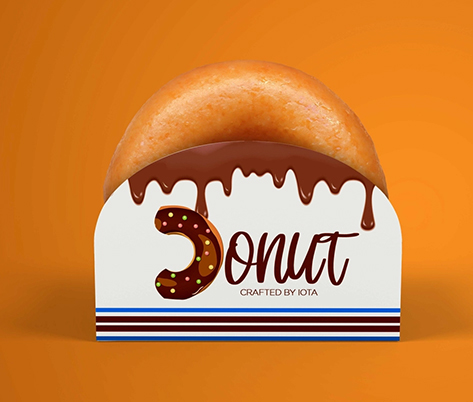
The branding service lists stationery, brochures, posters and packaging. Its $99 Startup Branding package includes two stationery design sets, print-ready formats and, in a pleasingly stubborn detail, a fax template. Elsewhere, the same business advertises AR/VR app development. The span from fax paperwork to immersive software says more about the breadth of its catalog than any futuristic slogan could.
The practical appeal is consistency across those surfaces. A business card, a wrapper and a website can share a recognizable identity even though each has a different job. Combining their production may reduce the number of separate briefs an owner has to write. It still requires decisions about print dimensions, copy, file delivery and where the work will appear. A bundle organizes the commission; the buyer supplies its purpose.
The $994 offer explains the business
The Advance Combo Package is the clearest expression of that bundled approach. Advertised at $994, it combines logo concepts, a CMS website, stationery, final file formats and a dedicated account manager. The website portion lists mobile responsiveness, stock photos, banners and unlimited pages. It brings the company’s scattered services into one recognizable purchase: the materials a business needs to introduce itself.
For the owner who would otherwise coordinate a logo designer, a website developer and a stationery supplier, the appeal is administrative as much as visual. One project can carry the identity through several deliverables. This is an interpretation of the offer, not a measured saving in time or money. Whether the bundle makes sense depends on how closely its contents match the actual assignment.
“We think digitally and we live and breathe design.”
247 Logo Services, About page
The agency addresses startups and existing businesses rather than one narrow industry. Its website lists sectors ranging from food and construction to fashion and health. The strongest reading of that positioning is a generalist creative supplier. Its proposition competes with hiring specialists separately or doing the work internally: a visible menu, a connected set of services and a managed production process.
Video and apps widen the assignment
Animation extends the same idea into moving images. The $499 Basic Video package advertises a 30-second production with a script, storyboard, animation, voice-over and sound effects, plus four-week delivery. The $999 Classic offer lists 60 seconds and five weeks; the $1,499 Premium offer lists 90 seconds and six weeks. The service page also offers 2D, 3D, whiteboard and stop-motion animation.
These packages describe production components, which is useful when evaluating a quote. A business buying an explainer needs more than motion on a screen: somebody has to decide what it says, what appears in each scene and how the sound supports it. The agency’s itemization makes those stages visible. Longer runtime increases the advertised price, while the script and storyboard remain central to the assignment.
The mobile-app page advertises React Native, iOS, Android, custom web apps and AR/VR development. Its published sequence moves from strategy to design, development and launch. Digital marketing adds social media work, search optimization and reputation management. Here, buyers should distinguish the broader service description from individual social packages, whose listed deliverables emphasize profile pictures, cover images and page design. Producing those assets is a defined task within a larger marketing program.
The important moment comes before “approved”
The company’s published workflow begins with a package choice and a design brief, followed by concepts, revisions and final delivery. That sequence offers a practical lesson worth copying: agree on what the work must accomplish before evaluating how it looks. A brief can specify the audience, required wording, intended uses and delivery formats. It gives both sides something more useful than a request to make the design pop.
Approval also has consequences in the published terms. Revisions depend on the selected package, and changes requested after a logo is finalized are treated as a new order. The money-back offer has conditions: the terms exclude refunds after seven days from purchase and identify requested revisions and approval of the primary concept among the exclusions. For websites, approval followed by development also closes the refund route described there.
That makes the decision process part of the purchase. Someone still choosing a business name or seeking agreement among partners may need to settle those questions before commissioning the identity. A project with changing functionality likewise needs a tighter scope than a package title supplies. The useful move is to resolve uncertainty early, while the brief can still capture it.
247 Logo Services makes creative work look approachable by giving it prices and quantities. Its most interesting feature is the path between those purchases: a logo becomes stationery, a website and perhaps an animated pitch. For a business with a clear assignment, that menu offers a straightforward way to organize the work. The $25 catches the eye. What belongs in the brief deserves the longer look.