Before Walmart, there was a clothing business and a rather inconvenient journey. Geraldo Thomaz’s father-in-law had to travel from Macaé to São Paulo to collect orders. Thomaz and his friend Mariano Gomide thought the internet could spare him the trip. Their answer became Vitrine Têxtil, an early attempt to put part of the textile trade online. The name would eventually shrink to four letters. The problem would grow considerably.
That beginning gives VTEX a more interesting ancestry than the usual photograph of a stock-exchange bell suggests. Its founders started with the daily bother of getting business done. Years later, their software would help large companies handle commerce across markets and channels. In between came experiments, thin months and a customer large enough to change how other customers saw them.
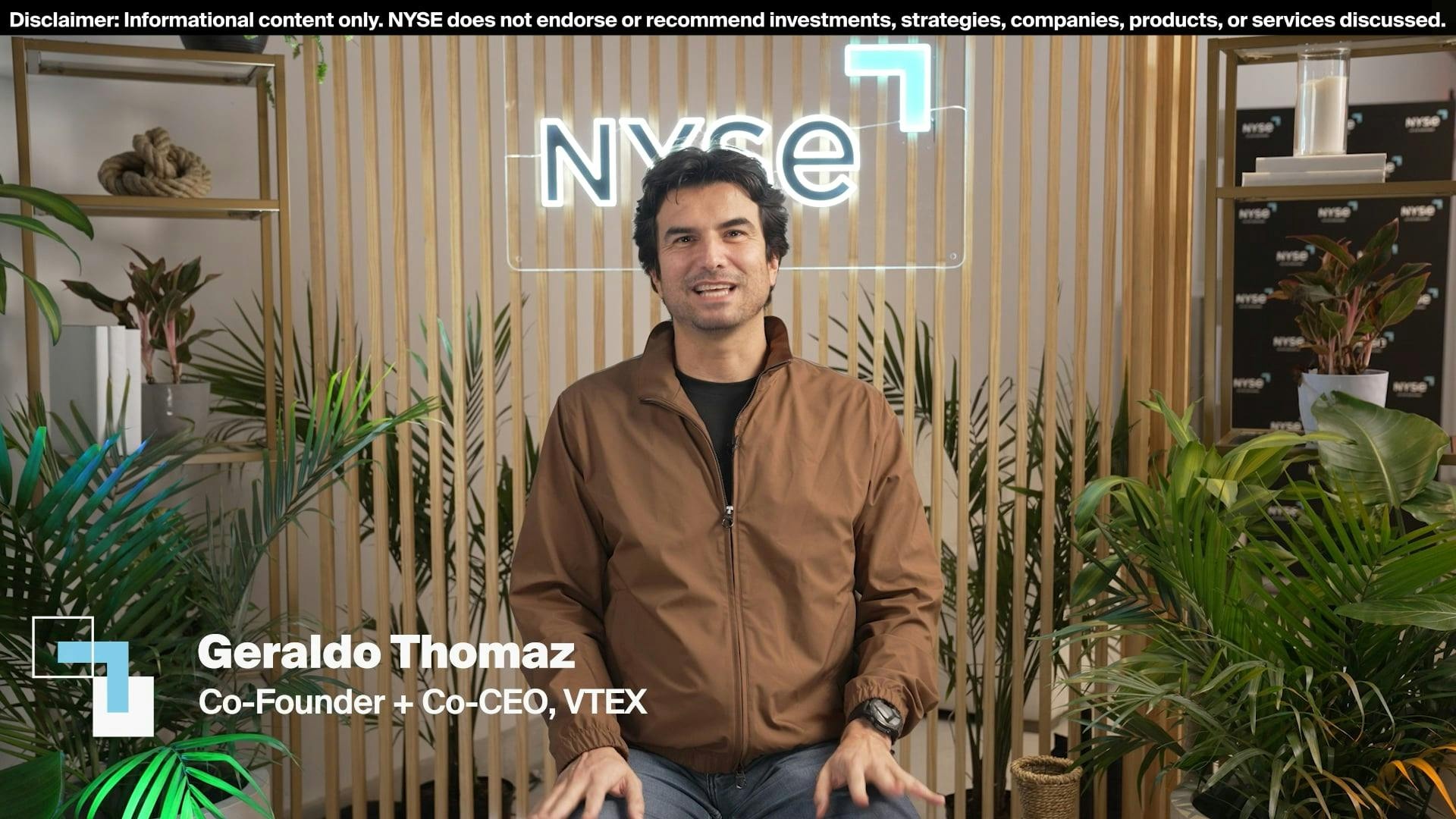
Thomaz, whose full name is Geraldo do Carmo Thomaz Júnior, remains VTEX’s founder and co-CEO. He leads its technology and product work. His career contains a useful complication for anyone fond of tidy business stories: keeping a company alive, finding its market and knowing when to change it are different skills. He has spent more than a quarter-century practising all three.
The education before the company
He grew up in Rio de Janeiro with parents who ran a school. Entrepreneurship was already a family occupation, with its successes and disagreements visible at close range. His later account of that upbringing emphasised resilience. Running something of your own meant continuing through good and bad periods, rather than treating either as a final verdict.
He studied mechanical engineering at the Federal University of Rio de Janeiro. During university, he also worked at Banco Icatu. The combination offered two ways of thinking about systems: how they function, and what happens when money and uncertainty enter the machinery. He had an interest in starting a business before he had settled on precisely which business to start.
Gomide became both friend and business partner. They shared an enthusiasm for spearfishing, a connection the company still includes in its account of their university years. Founding a software company was therefore one of several things they did together. It is a pleasingly uncorporate origin for a relationship that would survive the arrival of corporate governance.
Seven years is a long opening act
VTEX dates its beginning to 2000, just as enthusiasm for internet businesses was meeting an expensive correction. The founders tried to enter a promising new market and found themselves having to earn their way through it. The original textile proposition did not become the engine they needed. They built websites, explored customer-management software and kept looking for a repeatable business.
The early operation was small. Its first years involved a handful of employees and work that brought in enough money to continue experimenting. The distinction between a service project and a product mattered enormously. A project could pay the immediate bills. A product might eventually allow the same underlying work to serve many customers.
That search makes the familiar founding-to-listing timeline look suspiciously smooth. A straight line is easy to draw once someone else has endured the turns. Thomaz’s account includes several initiatives that failed to work as expected. The useful asset was the experience carried into the next attempt, even when the previous attempt had produced little to celebrate.
- 2000Vitrine Têxtil
The textile beginning - 2007Walmart bid
An enterprise opening - 2010SaaS model
A clearer business
The customer who changed the introduction
In 2007, Walmart invited the company to bid for its Brazilian ecommerce platform. Gomide has described the chances of winning as slim. The founders won. For a young supplier, a customer of that size changes the assignment immediately: the software must now satisfy an organisation whose scale makes every weakness more consequential.
Thomaz later named getting Walmart live among his proudest career moments. He remembered two difficult years. That detail is more revealing than the customer logo. Winning the work and delivering it were separate achievements, and delivery required enough persistence to turn a promising contract into an operating business.
Walmart also changed the conversation with the next prospect. An unfamiliar Brazilian software company could now point to work for a recognisable enterprise. Its association with the retailer helped establish the perception that it belonged in enterprise commerce. A reference customer is a wonderfully efficient introduction: somebody else has already asked some awkward questions.
There is a practical lesson here about choosing customers early. The demands of large organisations shaped what VTEX had to build and how it presented itself. Thomaz has discussed the difficulty of moving from a business designed for small customers into enterprise sales later. The first demanding account can become part of the product’s education.
Two people, with room to disagree
A shared CEO title can suggest a permanent meeting. Thomaz and Gomide developed a clearer arrangement. They divided responsibilities so that each could make the final decision in his own area, while still taking advice from the other. The partnership allowed different perspectives without requiring every disagreement to become a contest for control.
The division remains visible. Thomaz has overseen technology and product development; Gomide has overseen growth and international expansion. One works on what the platform can do, the other on bringing it into more businesses and markets. Both are mechanical engineers. Their responsibilities give that common training different outlets.
The friendship matters because the arrangement has had to work through very different versions of the company. The partners knew one another before investors, international offices and a public listing entered the picture. That history does not make difficult decisions disappear. It gives them a relationship in which to make those decisions.
“Life is what happens to you, not what you wish that happens to you.”
Geraldo Thomaz · The J Curve conversation
The revenue they were willing to refuse
By 2010, VTEX had consolidated its model as a software-as-a-service commerce platform. Its software would be delivered as an ongoing service, with infrastructure handled as part of the offering. The company’s account places its initial emphasis on Brazil, followed by expansion across Latin America from 2013 and, later, into the United States and Europe.
The difficult decisions were often about work the company could have accepted. In discussing the pressures of 2014, Thomaz described sticking to SaaS, allowing outside agencies to implement the software and continuing international expansion. Each choice could limit immediate revenue while supporting a business that could grow beyond the founders’ direct involvement.
Giving implementation work to partners is a particularly revealing example. Doing the work internally might produce another invoice. Enabling others to do it could help many more customers adopt the product. For a founder accustomed to finding enough work to survive, handing some of it away requires a different idea of progress.
The same tension runs through customisation. A customer’s request can be sensible and lucrative while taking the product toward a special case. A platform business has to decide which requests improve the shared system and which turn it back into a succession of individual jobs. Thomaz’s product role sits directly inside that argument.
The bell brings another job
VTEX listed on the New York Stock Exchange in July 2021. Thomaz had also become co-chairman of its board in 2019. The engineer who helped create the product now had a public company to explain, with investors, employees and customers listening for different things.
He has described that transition as a change in the CEO’s work. Communicating the company’s direction becomes a recurring responsibility. A falling share price can affect people inside the business even when their daily work has not changed. Helping employees understand the company’s condition and longer-term plans becomes part of protecting their ability to do that work.
In conversations about going public, he has stressed preparation before the listing and operational discipline afterward. Reporting routines and predictability need to exist before the roadshow. Once listed, the organisation still has to build products and take considered risks. The market supplies a price every day; it supplies considerably less help deciding what an engineer should build next.
A founder asks whether his company has a future
In April 2026, Thomaz publicly acknowledged asking whether VTEX had a future with AI. It is a striking question from the person responsible for its technology. Cheaper, faster software development challenges an established supplier to explain what customers will still need from it. His answer involved changing the product and concentrating the organisation’s attention.
At VTEX Day, the company presented an AI-centred suite spanning commerce, customer experience and advertising, alongside an AI Workspace. The ambition was to let businesses use agents and natural-language instructions to manage more of their operations. For Thomaz, this was a change to the operating core of the product, rather than a separate experiment at its edge.
He also said the company was pausing its acquisition pace to focus on that transformation. Buying another business could distract from rebuilding the existing one. It is an instructive reversal of the usual growth narrative: there are moments when having the capacity to buy something makes the decision to concentrate harder, and more valuable.
By August, he was describing work with early AI Workspace customers and a waiting list of more than 100 enterprises. He also said the company was not yet reporting an operational or financial contribution from that product. The distinction keeps an ambition attached to its actual stage of development. A waiting list is an invitation to deliver.
VTEX reported 3,100 active online stores serving 2,200 customers. Customers and stores are different measures.
The scale is now far removed from the textile beginning. Yet the work still returns to an ordinary commercial question: how can a business serve its customer with less friction? Thomaz’s career has progressed through several answers, each useful until the market demanded another. The next answer has to earn its place in the same practical fashion as the first: by helping someone get the order through.