In 2007, Walmart invited a small Brazilian software company to bid for its local commerce platform. Mariano Gomide de Faria and his co-founder, Geraldo Thomaz, entered a contest they considered unlikely to win. They won. Seven years after starting VTEX, the two mechanical engineers had a customer whose name needed considerably less explaining than their own.
It is an appealing place to begin a founder story: the improbable contract, the door opening, the future suddenly looking less theoretical. Mariano gives the years before it a less ceremonial description. The founders wanted financial success. Capital was scarce. Their task was to keep the business alive. The ambition acquired a grander vocabulary later.
That frankness makes him interesting company in an industry whose origin stories can sound as though they were approved by a motivational calendar. He has spent more than two decades selling the future of commerce. Yet his account begins with the familiar wish to do well, followed by the rather less glamorous requirement to find someone willing to pay.
Born as a business in 2000, VTEX would reach the New York Stock Exchange in July 2021. Twenty-one years is enough time for a company to outgrow several fashionable explanations of how companies grow. Mariano stayed. So did Geraldo. Their shared chief executive title became a durable feature of the enterprise they built together.
A mechanical engineer takes the long route
Mariano graduated in mechanical engineering from the Federal University of Rio de Janeiro. Software offered him a different kind of machinery: systems through which products, payments and orders could move. He and Geraldo were college friends before they were the co-founders of a publicly traded company. The partnership has lasted across changes in technology, geography and ownership.
In a later podcast conversation, Mariano recalled working at a bank at 22 and deciding to combine Brazilian engineering with the expanding internet. His explanation was as much about where the work came from as what it did. He wanted a technology company that could show the capabilities of engineers from Brazil to customers elsewhere.
The early timeline resists the pleasing compression of startup folklore. VTEX operated in Brazil for roughly twelve years before entering Argentina. Its expansion across Latin America began in 2012, including Colombia, Chile and Peru. The company had accumulated experience before it accumulated countries. There was plenty of time for confidence to meet an invoice.
His present responsibilities reflect the outward-facing half of the founders’ partnership. Mariano oversees global growth, including marketing, sales, delivery support and go-to-market operations. Geraldo has overseen the product and engineering side. Mariano also became co-chairman in 2019. The arrangement puts the problem of winning customers firmly within a founder’s daily remit.
- 2000Founded with Geraldo Thomaz
- 2007Walmart’s Brazilian platform bid
- 2012Expansion across Latin America
- 2016Mariano moves to London
- 2021VTEX lists on the NYSE
Brazil was a beginning, not a waiting room
There is a conventional sequence for ambitious businesses: win the home market, then consider the world. Mariano objected to the waiting. Brazil could offer scale, but he saw no reason to treat domestic consolidation as a prerequisite for operating abroad. In 2016, he moved to London as VTEX pursued Europe and the United States.
Expansion, in his telling, depended on people who could take responsibility for the company’s name in each market. A distant founder could not substitute for local ownership. Delegating meant finding partners who could share in the future, with enough authority to represent the business when its founders were elsewhere.
Moving also placed him closer to the people he needed to persuade. The international ambitions of a Brazilian company can look straightforward on a map. In a sales meeting, they encounter assumptions about who builds enterprise technology and who merely buys it. Mariano has repeatedly described the work of challenging those assumptions.
The stock market listing gave that argument another form of evidence. VTEX began trading on the NYSE on July 21, 2021. Looking back the following year, Mariano said the company had prepared for the IPO for four years. He saw public-company status as a credential when approaching customers unfamiliar with a software supplier from Latin America.
A listing bell lasts a few seconds. A customer’s evaluation lasts longer. His reflections on the IPO are striking for how quickly the ceremonial achievement becomes part of a sales problem: how to establish trust before a buyer has decided that your country of origin tells them everything they need to know.
2000 → 2021
A public debut with a long private history.
The engineer who picked a fight with complexity
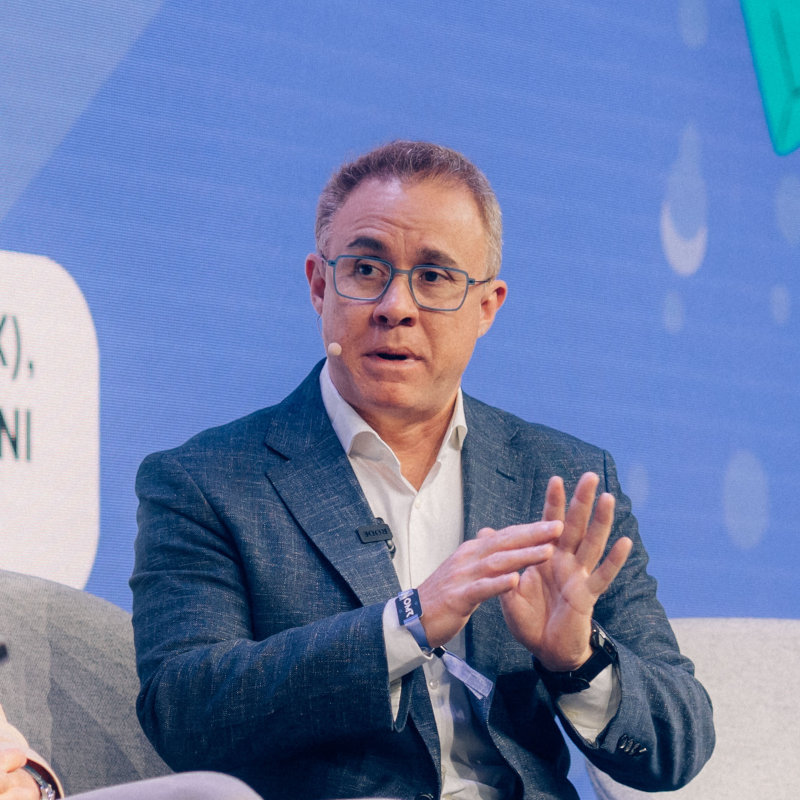
There is another obstacle Mariano likes to challenge: the idea that sophisticated commerce must require an elaborate collection of software. At ShopTalk in 2022, he described businesses paying for technology whose assembly could become a project of its own. His objection was practical. Retailers needed systems that helped them trade without becoming full-time custodians of the connections between systems.
“When the middleware is your main software, you’re in trouble.” The line is short enough to remember during a long implementation meeting. It also explains a recurring theme in his public appearances. The connecting tissue should not become the main attraction. A shopkeeper has other things to worry about.
By March 2025, the complaint had acquired a title: The MACH Mirage. MACH refers to microservices, API-first, cloud-native and headless approaches to software. Mariano challenged the costs and operational burdens of assembling separate tools into a commerce system. His targets included repeated data, fragmented workflows and vendor relationships that grew faster than the usefulness of the whole.
VTEX suspended its membership in the MACH Alliance. The decision made the disagreement public and attached a business consequence to it. Mariano’s proposed alternative, pragmatic composability, allowed modular choices where they created value while keeping essential capabilities connected. For someone selling a commerce suite, the commercial interest is clear. So is the willingness to pick an argument with an industry movement.
The disagreement reveals a useful tension in his character as a public executive. He is an engineer by education and a seller by responsibility, arguing that technical elegance should answer to operating results. His language can be combative. The proposed test is plain: can the people running the business use the system, and does the expenditure earn its place?
Magic Johnson, then back to the shopping basket
The public-facing work has included a more personal sort of persuasion. Ahead of VTEX Connect Live in New York in January 2024, Mariano invited people to see him interview Magic Johnson. He called Johnson a childhood idol. He had already shared stages with Barack Obama, Lewis Hamilton and Richard Branson, but this invitation carried the enthusiasm of a fan.
There was an autographed jersey in the pitch. Even a founder who talks about architectural simplicity can appreciate a little theatre. The moment supplies something a corporate biography tends to edit out: a grown executive looking forward to meeting someone whose achievements mattered to him before his own job title existed.
He also teaches and lectures, with public appearances including UNCTAD eCommerce Week and involvement with the EICOM Institute. In the founders’ IPO letter, education appears as part of the company’s intended social contribution. The same person who must persuade a retailer to change platforms also spends time explaining how commerce itself is changing.
“When the middleware is your main software, you’re in trouble.”
Mariano Gomide de Faria / ShopTalk conversation, 2022
A concierge for the impatient customer
By late 2025, Mariano was publishing a more sweeping argument about AI. His whitepaper From System Integrators to System Operators proposed that firms paid to connect enterprise software would increasingly operate businesses using AI agents. The distinction concerned who did the work, how it was priced and what customers would buy from a technology partner.
The proposal remains a forecast. Its significance for his story is the direction of travel: after years of criticizing the effort spent assembling software, he was imagining a services industry reorganized around running it. The familiar integration project, measured in human hours, would have to justify itself against a different way of delivering the outcome.
At OMR in May 2026, he described another change he expected: shopping interfaces moving toward conversation. Brands would need to consider how they appeared in dialogue, alongside the images and advertisements they already produced. He called the broader idea a concierge economy, where assistance continued through the customer’s experience after buying.
For a shopper, the appeal is easy to picture. Explaining an intention can be less work than translating it into the right filters and product pages. Whether retailers deliver that convenience depends on the unromantic machinery behind it. An agreeable conversation still has to meet stock, price, payment and delivery. Mariano’s consumer vision returns him to the plumbing.
In July 2026, he pushed the economic argument further, predicting that AI would raise the profitability expected of successful businesses. He explicitly separated those market predictions from guidance about VTEX. “Operational efficiency right now is a strategy, not a tactic,” he said. It was a warning about competition, rather than a promise that installing a new tool would settle the matter.
What he wants the next founder to inherit
Mariano’s larger ambition reaches beyond the next software sale. He wants Brazilian engineering to carry an international reputation that makes the following company’s introduction easier. The aspiration is specific: VTEX’s progress should help open a path for ten more businesses. It is a different measure of success from simply adding another market to his own company’s coverage.
There is a connection between that ambition and his teaching. In a 2026 interview promoted by VTEX, he argued that Brazil needed to encourage more young people to choose engineering. Recognition abroad and ambition at home belong to the same project. A country’s technical reputation depends partly on who can imagine themselves contributing to it.
His career offers an unusually patient example of an impatient idea. The company took years to expand, years to prepare for a listing and decades to build its standing. Along the way, Mariano kept questioning the proposed order of things: when to leave home, how much software a retailer should assemble, what work a technology company should remove.
The Walmart bid is still a useful way to think about him. A small company entered a room where its chances appeared thin and found a way to be taken seriously. More than twenty years after VTEX began, Mariano is still working on that introduction. He would like the next Brazilian founder to spend a little less time explaining why they belong in the room.
Follow the conversation
Mariano’s public profiles, writing and conversations.