Boris Lokschin had a management preference before he had a business. At ten, he wanted to be his own boss. His grandmother remembered him saying so. By nineteen, he had started his first company. Some children announce that they will become astronauts; Lokschin appears to have been thinking about the reporting structure.
The ambition sounds straightforward. The career that followed has required rather more flexibility. He built commerce businesses, worked inside a large technology consultancy, and co-founded Spryker with Alexander Graf. Along the way, being the boss became a question about which decisions to keep, which to delegate, and which assumptions to throw away.
He described Spryker in 2021 as his third self-founded commerce technology company, following two businesses he had built and sold. That history gives his enthusiasm for experimentation a particular texture. Starting again was already part of the job. A company could be an achievement and still be a chapter.
The useful thread through his story is a willingness to revisit the machinery underneath an apparently successful arrangement. An online store can work while its software makes every alteration painful. A senior recruit can have an impressive past while struggling with an unfamiliar future. The awkward question is when yesterday’s solution begins charging rent.
Before the platform, the plumbing
Before Spryker, Lokschin founded and led Symmetrics, an ecommerce services business. He later ran an international ecommerce team at CGI, working with brands including Zalando and Mars. This was the side of digital commerce where a purchase on a screen had to connect with the systems behind it.
His earlier company, CMS, began during his studies in Hannover as an online marketing and search optimisation consultancy. It expanded into IT consulting and ecommerce offerings, then exited to Symmetrics in 2006. Even at that stage, the work was moving from attracting a visitor towards improving what happened when the visitor arrived. The storefront and the machinery behind it were already drawing closer together.
His professional history describes responsibility for more than sixty people across three locations, alongside budgets, delivery, product plans and business development. The list is a useful corrective to the glamour of the founder title. Somebody still has to make the project arrive, account for its cost, and explain the consequences when it does not.
That background helps explain the kind of business Spryker became. A shop window is only one part of commerce. The less photogenic work includes getting different systems to cooperate and accommodating the particular rules of a customer’s business. Those rules rarely become simpler because the sales presentation has ended.
Spryker dates its founding to 2014. Its early work included a marketplace project with first customer Siroop. The company released its commerce operating system in 2016 and reached one hundred employees in 2018. A partner training programme followed in 2019. The chronology moves from building software to building the organisation around it.
- 2014Spryker founded
- 2016Commerce OS released
- 2018100 employees
- 2020$130M Series C
A shopping basket with a complicated life
The business Lokschin helped build concentrated on transactions with more moving parts than a conventional retail checkout. In a January 2025 podcast conversation, he discussed how Spryker’s work on complex commerce had drawn it increasingly towards business buyers, manufacturers and distributors. Complexity was becoming the addressable problem.
The product argument is modularity. In a 2022 conversation with Phillip Jackson, Lokschin explained how a business could choose capabilities suited to its needs rather than accept every component of a single software suite. Search is one example: two businesses need not have the same requirements simply because both sell things online.
But he also put a limit on the promise: “You need to have the underlying infrastructure.” Selecting components still leaves the work of making them operate together. A collection of attractive parts can be an expensive collection. The connections determine whether it becomes a useful machine.
This is where his services background and his platform argument meet. Flexibility has a practical cost. Somebody must understand the transaction well enough to decide which elements should change independently and which must remain connected. The appeal of modular software rests on making later decisions easier without making today’s operation fall apart.
One transaction. Different moving parts.
The money had a job to do
In December 2020, Spryker raised $130 million in a Series C round led by TCV. Existing backer Project A had been involved since 2014. For Lokschin and Graf, a German commerce software company now had the resources to pursue a broader international business.
An investment announcement can make the story sound finished. In their year-end conversation, the founders addressed a more useful detail: almost all of the money went into the company. It would support expansion and hiring. The distinction matters. Capital in a business is a set of obligations wearing a celebratory headline.
Lokschin also described the United States as central to enterprise software ambitions. He wanted more than a cheque from an investor; market understanding and connections mattered. Expanding into America would mean selling in a market where the value of a product had to come through clearly.
There was a revealing adjustment in how Spryker thought about geography. Its earlier American plans had included a New York office and management relocation. By 2021, Lokschin was describing a remote-first organisation with colleagues working across more than forty countries. The intended market remained. The proposed way of reaching it changed.
Capital for the company’s next decisions.
Round led by TCVAn interview on a moving river
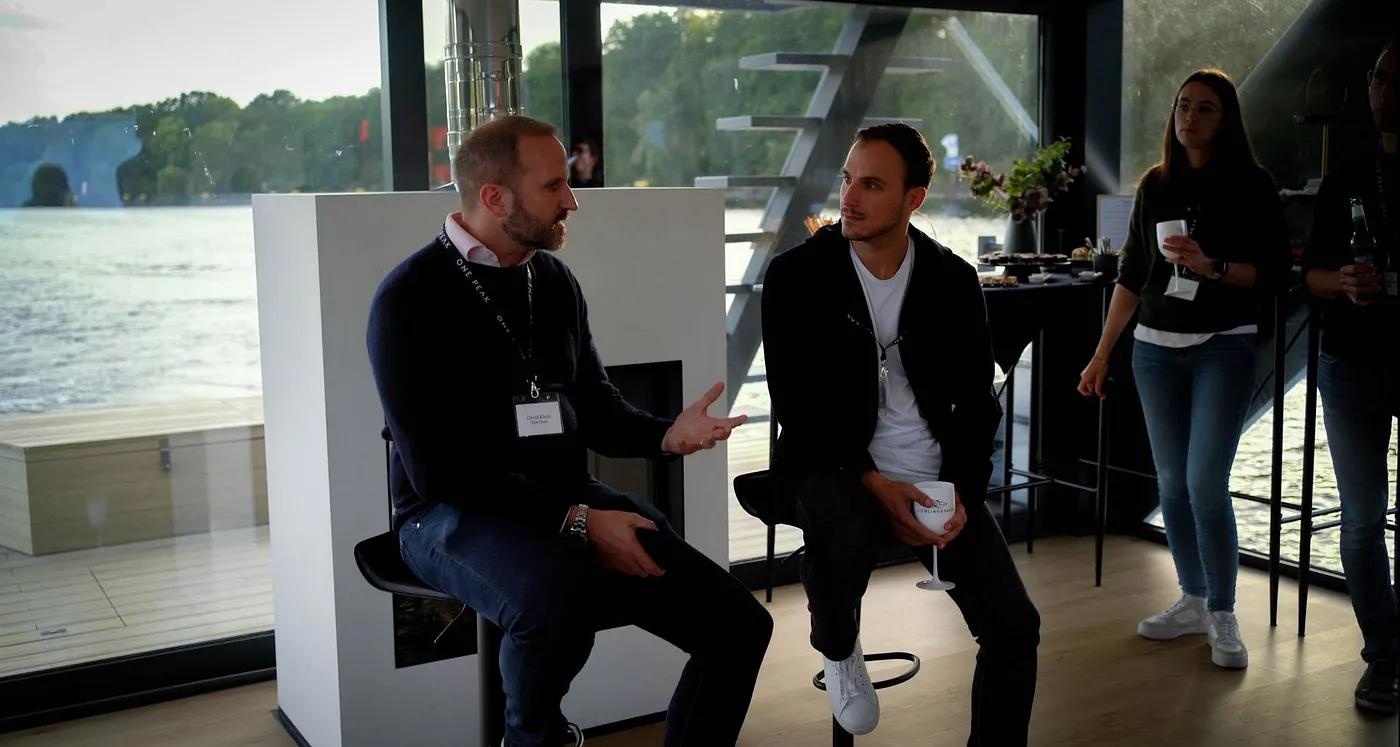
In 2023, Lokschin joined One Peak’s David Klein for a conversation with software founders aboard a boat on Berlin’s Spree. The setting supplies a pleasingly literal backdrop for his argument about experience. A career can take you a long way; it cannot promise that the water ahead resembles the water behind.
His hiring advice placed weight on future potential. Senior arrivals can deliver early improvements from familiar experience, then encounter problems beyond that store of knowledge. He wanted to know how candidates would think several years ahead. His own helpful early executive hire was a CFO, who released mental capacity for other work.
The company also gave recognised cultural contributors a veto in hiring panels, and used equity to retain people whose impact warranted it rather than treating seniority as the only qualification. These are concrete choices about authority. A founder who began by wanting to be the boss was describing ways to distribute influence.
The wider question is how a company keeps its judgement fresh as it grows. Hiring for a completed history is comfortable because a résumé is inspectable. Hiring for the ability to learn requires more imagination. It also asks the founder to accept that the next useful answer may belong to somebody else.
Cars, catalogues, and everything after checkout
Spryker’s later work made the scope of that original commerce argument easier to see. In June 2024, it announced a collaboration with SDVerse, the automotive software marketplace developed by General Motors, Magna and Wipro. The marketplace would connect companies buying software with those selling it.
This is a different proposition from putting a familiar consumer product into a basket. Automotive companies need to discover software offerings and weigh whether to build or buy. The announced project aimed to improve visibility and procurement, while retaining room to adapt. Here, an ecommerce platform was being used to organise a market for the ingredients of a vehicle’s digital life.
By August 2025, another release addressed what happens after the initial sale. Spryker’s Self-Service Portal brought together account dashboards, asset and entitlement management, and account-specific pricing. Order Amendments gave buyers more control after purchase. Much of the opportunity lay in work that a retail conversion chart might barely acknowledge.
These examples give substance to Lokschin’s stated aspiration at EXCITE 2023: “Power the world’s sophisticated transactions”. His keynote discussed industrial goods, consumer packaged goods, automotive, wholesale and manufacturing, as well as models including subscriptions, maintenance and auctions. The ambition was to widen the kinds of commercial relationship the platform could support.
The organisation developed alongside the proposition. In 2023, Elena Leonova moved into the senior vice president of product role, while Eric Schreiner became chief customer officer. The business needed people responsible for the product and for customers’ continuing experience of it. In November 2024, Spryker was recognised as a Leader in Gartner’s Magic Quadrant for Digital Commerce.
“Power the world’s sophisticated transactions”
Boris Lokschin / EXCITE 2023
A founder title that now needs a date
Lokschin’s place in that history is as co-founder and founding co-CEO. The operating leadership has since changed. Spryker announced in August 2025 that he would step back from operational CEO duties, with Stefan Ropers joining as CEO that September. In July 2026, Sebastiaan Verhaar became CEO and Ropers moved to executive chairman.
The distinction keeps the story in the right tense. Founding a company is a durable fact. Running its daily operations is a role with dates attached. Spryker’s current chapter continues under another chief executive, with a sharper stated focus on enterprise B2B and purchasing experiences involving artificial intelligence.
Through the earlier chapters, Lokschin repeatedly returned to what a business should be able to change. He argued for software that could accommodate unfamiliar transactions, recruits who could learn beyond their previous jobs, and expansion plans that could survive a different working arrangement. Each involved spending less emotional capital defending the first plan.
The ten-year-old’s wish was to choose his own boss. The adult’s work became more interesting: helping organisations keep room for choices they could not yet name. A business needs enough structure to function and enough give to accommodate the next awkward request. Lokschin made a career in that narrow, productive space between the two.