A purchase order is an unlikely place to look for a personality. Iyad Aldalooj has put quite a lot of his into one. The co-founder and CEO of penny. talks about enterprise software with the impatience of someone who suspects that a complicated working day has been made unnecessarily complicated by the tools meant to help.
Before procurement, there was Careem. Before Careem, there were engineering degrees in Nebraska. Before any of that, there was Qatif, in Saudi Arabia’s Eastern Province. The journey gives him several ways to look at a business: through its operations, through its users, and through the distance between a promising idea and something another person will actually use.
His chosen subject lacks the immediate charm of a ride arriving at your door. A purchase requisition rarely inspires affection. Yet the work behind it touches budgets, suppliers, approvals and the ordinary question of whether someone can get on with their job. Aldalooj has decided that this is a problem worth spending years on.
01 A long way from Qatif
In his account of childhood, home was Alqalaa, an old castle in Qatif. On school bus trips, classmates teased him about living there. He remembers parents who supported their children and a household conscious of its limited money. It is an unusually unvarnished beginning for a founder’s public biography.
He later left for the United States on a scholarship. In his memory, the opportunity is tied to an incongruous newspaper picture of King Abdullah holding a bag of potato chips during an American visit. The small, funny detail stays with him alongside the much larger change in his prospects.
The educational record that follows is substantial: a civil engineering bachelor’s degree from the University of Nebraska-Lincoln in 2012, a master’s in the same subject in 2015, and an MBA from Bellevue University in 2017. A leadership certificate from ESADE followed in 2022. His education crossed disciplines as well as borders.
He also tried business while studying. His own F6S profile describes building an American e-commerce startup during college and growing it to sales in the millions. Shopping, selling and the machinery connecting them were part of his working life well before penny. The later career would move the transaction inside an organization.
Nebraska-Lincoln
Bellevue
Careem
penny.
02 After the ride arrived
At Careem, Aldalooj served as a general manager and marketing director in Saudi Arabia. He was there during the period that culminated in the company’s sale to Uber. It gave him operating experience inside a regional technology business that had reached a much larger stage.
When he appeared on The TWENTY30 in October 2024, his conversation ranged across that journey, fundraising, and Saudi Arabia’s developing technology ecosystem. The outlook was long term: building a company while contributing to the country’s wider ambitions for technology and entrepreneurship. He had also become involved in the Saudi Leadership Society and Misk’s 2030 Leaders Program.
There is a useful tension in the move from ride-hailing to procurement. Consumer software trains people to expect a task to make sense on a small screen. Work introduces policies, exceptions and colleagues with different permissions. The human being holding the phone, however, has not suddenly acquired a taste for confusion.
On Let’s Talk Product, the conversation about penny. included its evolution from a B2B marketplace into procurement software, and the idea of a repeatable product in enterprise selling. Those are consequential distinctions. A marketplace connects parties. A procurement system must also help a company decide how those parties can do business.
Transactions in 2023, as reported in 2024.
03 The expensive business of starting
Penny was founded in 2020. Its four co-founders were Iyad Aldalooj, Majid Aldalooj, Mohamad Ibrahim and Hemadri Seelamsetty. The company’s early job was to put buying activity into a shared system, bringing requests, supplier quotations, purchase orders and payments into a more coherent process.
Aldalooj’s account of the beginning is refreshingly inconvenient for anyone selling the romance of a quick launch. Large companies needed a product that worked. Building enough of it to enter the market required money before the company could demonstrate the sort of product institutional investors wanted to see. Early angel backing helped bridge that gap.
A $1.35 million seed investment was announced in September 2020. In January 2022, penny. announced a $5 million seed round led by Outliers Venture Capital, with participation from investors including Shorooq Partners, Hambro Perks’ ORYX Fund, Wamda and Class 5 Global.
“Enterprise systems don’t have to be dull and boring.”Iyad Aldalooj · January 2022
The line is funny because the standard has been allowed to sink so low. Nobody would sell a consumer application by promising that it would eventually become tolerable after sufficient instruction. At work, patience often arrives bundled with the salary. Aldalooj’s product argument asks what happens when a software company stops treating that patience as an unlimited resource.
04 The supplier gets a vote
His procurement argument becomes more specific when he talks about suppliers. In a 2024 interview, he distinguished between employees, who may be required to adopt an internal system, and suppliers, over whom a buyer has less control. Getting both groups to participate is part of the product’s job.
That makes ease of use a commercial consideration. A buyer can have a carefully organized process, but another business still has to answer the request. Every awkward login or unclear instruction sits between the organization and the information it needs. The external participant has a working day of their own.
In his 2023 conversation with James Meads, Aldalooj discussed the importance of bringing consumer-style usability into enterprise tools. He also connected procurement digitization to governance, control and efficiency. The attraction is understandable: companies want clearer rules without making every ordinary purchase feel like an application for diplomatic immunity.
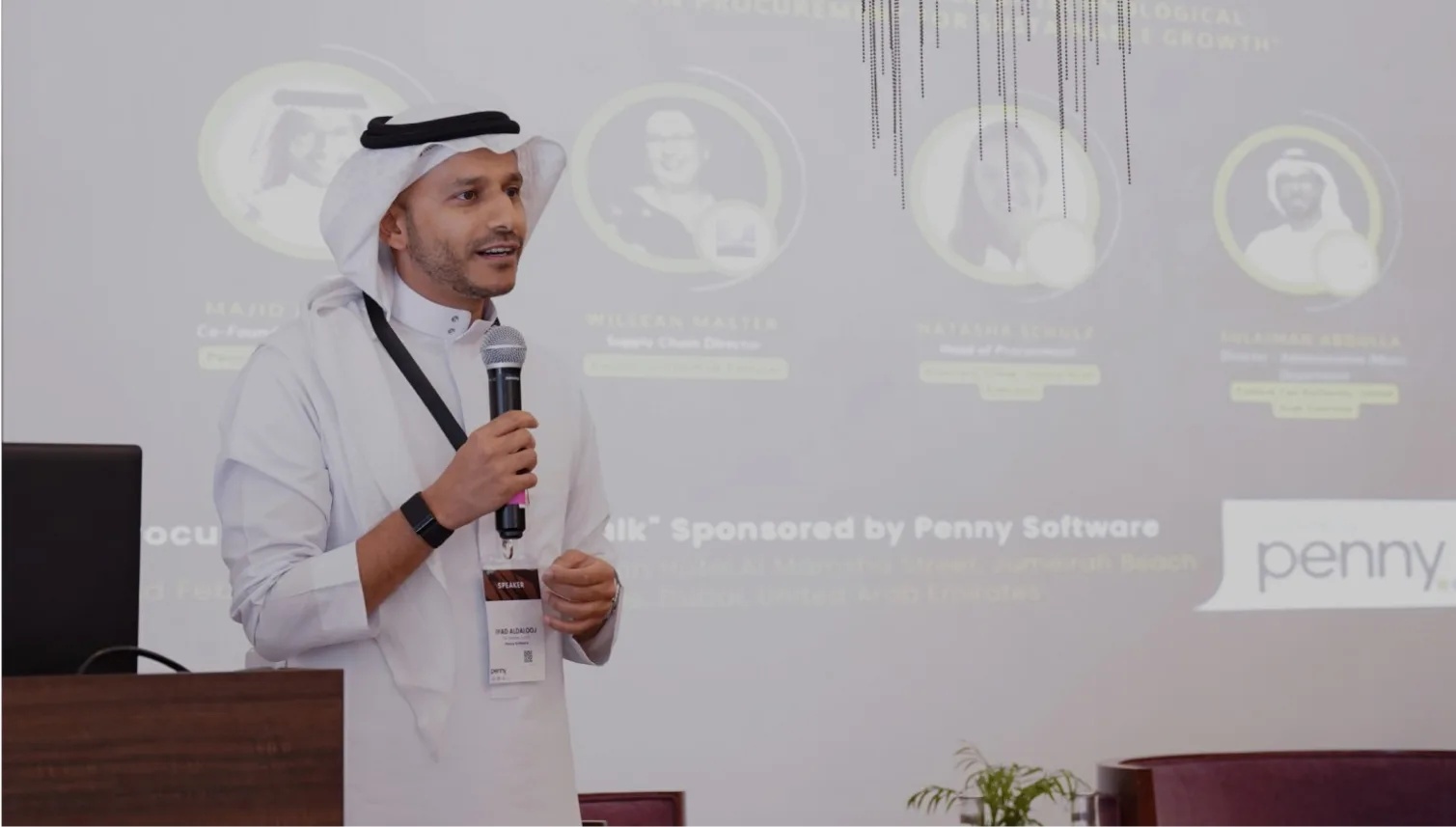
He has also argued for accessible systems for smaller businesses. In 2021, he described work with AHAD on a mini ERP intended for SMEs, emphasizing affordability and ease of use. The audience was different from a large enterprise, but the concern was familiar: the barriers to adopting software can become a problem of their own.
05 A founder does the hiring arithmetic
Aldalooj’s interest in reducing friction extends to management. In a November 2023 essay, he proposed a personal framework he called the Caliber Ratio. Its premise was that professional delegation depends on the capability of the person hired relative to the leader hiring them.
A hire who needs constant correction can consume the very time the leader hoped to recover. His framework uses multiplication to illustrate the possible effect on a team. He also makes clear that this is an idea developed during a long flight, rather than an established research model.
The caveat is part of the appeal. Founder commentary often dresses a passing thought as a universal law. Here, the question is useful without requiring the arithmetic to explain every organization. Does the new arrangement allow people to do better work? Or has the organization simply created another place for work to wait?
06 Saudi roots, a wider market
The international ambition has been present since penny.’s early years. In his 2023 discussion with Monsha’at, Aldalooj described a desire to build a software brand in Saudi Arabia and take it abroad. Customer satisfaction remained an immediate priority alongside the plans for business development.
In September 2026, he returned to the larger question in Arabic: how can Saudi technology companies expand globally? He argued that a substantial, attractive domestic market can encourage founders to postpone looking elsewhere. Products and operations can gradually become defined by the needs of that one market.
He distinguished businesses that build standalone technology products from those whose expansion requires substantial new operations or market-specific adaptation. His argument favored investment in products capable of serving customers across borders. It was a view about the kind of technology economy Saudi Arabia could build, as well as the future of an individual startup.
How do you build something in one place that makes sense to someone working somewhere else?
07 More service in the software
His July 2026 writing takes on the argument that AI threatens the traditional enterprise SaaS business. He emphasizes trust, domain knowledge and the difficulty of organizational change, while arguing that customers will expect more tailored service. The essay includes a description of penny.’s move toward service-based pricing and customization.
The tone is pointed, occasionally mischievous, and very much that of an operator with an opinion. He wants enterprise systems to do more useful work with their data. His January 2026 procurement writing similarly places more emphasis on strategic sourcing, supplier relationships and business value as transactional work becomes automated.
There is another possible future in his public remarks. After meeting Saudi students at UC Berkeley, alongside founders Osama AlRaee and Julie Barbier, he wrote of wanting to become a teacher one day. For someone who has spent so much time explaining how work could be arranged differently, a classroom seems a plausible destination.
For now, there are customers, colleagues and suppliers. The unglamorous transaction remains a revealing test of his ideas. Someone needs to buy something. Someone else needs enough clarity to say yes. Somewhere between those two people, Aldalooj is trying to make the day a little easier.