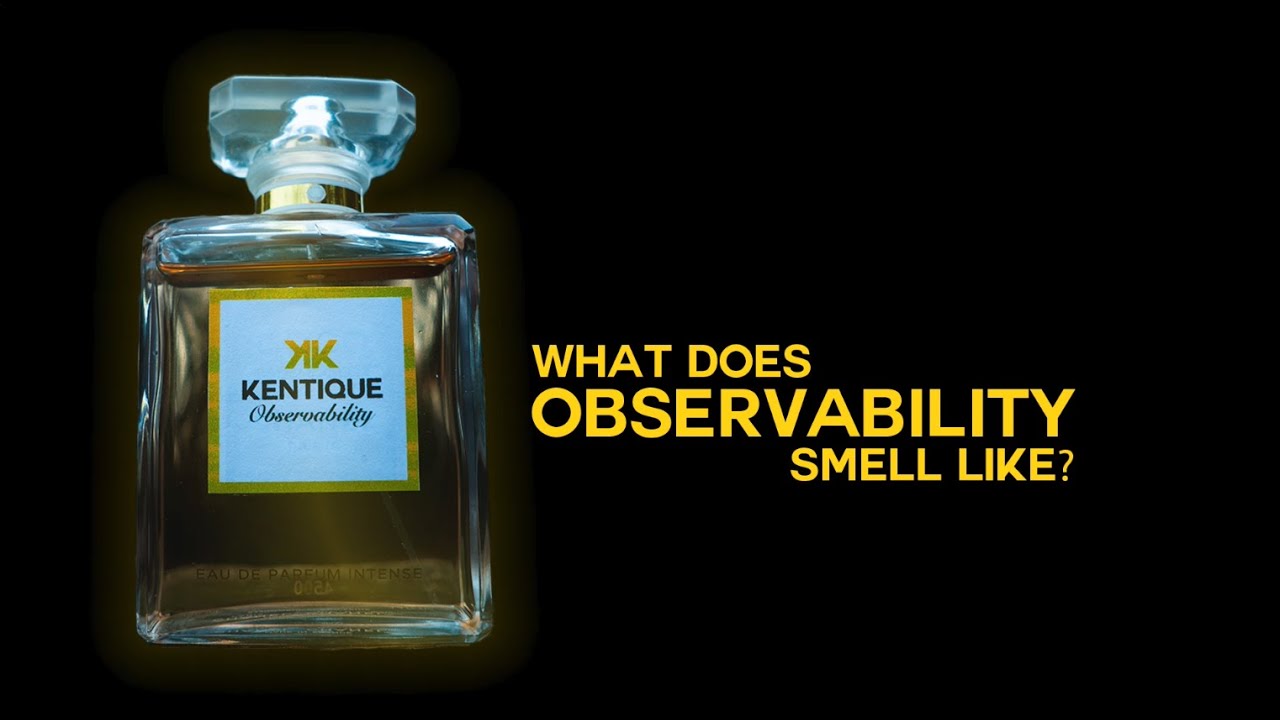
The bottle sits against a black background, square-shouldered and amber, with the grave confidence of something sold between duty-free leather goods and regrettable sunglasses. Its label says Kentique. The question beside it is equally poised: What does observability smell like? This is how a network intelligence company introduced itself to people responsible for clouds, containers, routers and the countless invisible arrangements that keep modern life from displaying an error message.
The fragrance did not exist. The predicament did. Kentik was known among service providers and large telecommunications companies, but it wanted a larger place in the enterprise market. That meant speaking to cloud engineers, security teams, platform engineers and infrastructure leaders already surrounded by vendors making similar promises in similar shades of blue. David Klein, Kentik’s chief marketing officer, reached for a perfume ad.
Kentique, released in 2023, borrowed the monochrome ardor of luxury fragrance commercials and applied it to telemetry. Clouds danced. Reliability acquired an essence. The whole performance was absurd, but the product message remained intact: Kentik connects data from networks, cloud environments, containers and data centers so teams can understand what their infrastructure is doing. A joke carried the technical freight.
The joke has homework
Klein’s public career is a tour through software that performs essential work without giving a marketer much to photograph. At ClickTime, where he became director of marketing, he wrote about time tracking, billing and operations. At Lightstep, he ran marketing for an observability company built for distributed software systems. ServiceNow acquired Lightstep in 2021. Klein joined Kentik in 2022, bringing more than a decade of technology marketing into another category concerned with finding answers inside complicated machinery.
He studied Global Studies at the University of California, Santa Barbara. The degree is a pleasingly broad prelude to a career spent translating narrow technical detail for varied groups. At Kentik, those groups do not share a single relationship with the network. A veteran network engineer may regard it as the center of the universe. A cloud-first developer may notice it only when something breaks. Klein’s task is to respect both views without flattening either one.
“It’s strange to talk about comedy and marketing in the same breath, but it’s like they’re the same in that what matters is deeply understanding your audience.”David Klein
That sentence is the hinge. Kentik’s creative work is not an escape from product marketing. It depends on it. Klein has described a two-sided operation: research the personas and use cases in depth, then allow the team to experiment with ridiculous projects. Security, cloud compliance and troubleshooting each become a prompt. What is painful here? What is recognizable? Where might the truth become funny without turning the audience into the punch line?
The team brings engineers into the process. A premise that amuses marketers but irritates practitioners has failed before the camera appears. Klein has also said comedy must avoid punching down. Once the idea passes those tests, execution becomes a matter of pace. In the perfume video, visual punch lines arrive quickly. The edit does not linger to admire its own cleverness. Infrastructure people have incidents to investigate.
Ideas arrive in two kinds of rooms. Full-team sessions happen occasionally and give anyone permission to throw out the wild thing. Smaller meetings with the creative group move faster: puns, references and half-built concepts go into the air without demanding immediate dignity. One session produced a calendar assembled from network-engineering memes. Another entertained the image of a wrestler shouting about the cloud. The point is not that every notion deserves production. A brainstorm works partly because most notions are allowed to remain notions.
Later, the team can bring the useful chaos back to a list of customer problems. Cloud troubleshooting goes on the board. Security follows. For each one, the group asks what is funny, what is not, and which recognizable frustration can support a story. This return to the use case prevents creativity from becoming an ornamental department. The joke must eventually report for work.
Small bets, strange bottles
The production story is almost offensively sensible. Kentique took about three or four hours to shoot and perhaps half an hour to an hour of preparation. David Hallinan, who led content for Klein’s team, directed, edited, produced and helped write it. When they needed a label for the bottle, he drew one, printed it and attached it. They shot with a digital SLR. The lack of ceremony was a feature.
Cheap experiments change the politics of imagination. A campaign that requires a studio, a large crew and a precious budget arrives in the world burdened by expectation. A bottle label made at home can simply try to earn attention. Klein has said higher-production ideas should earn their right to exist. Until repeated evidence supports the larger bet, the small team keeps moving.
Kentique followed another oddity: a Kentik infomercial performed in the style of late-night television, complete with an offer to call “1-866-GO-KENTIK” and instructions to visit the World Wide Web with Netscape Navigator. Before release, the company screened it for roughly 200 employees at an all-hands in Phoenix. The room laughed. The internal response gave the team a useful first signal, not a guarantee.
The infomercial also produced a neat executive anecdote. A founder called while Klein was filming and asked what he was doing. Klein said he was busy making an infomercial. Asked what for, he answered Kentik and ended, by his recollection, with some version of “Don’t worry about it. It’ll be good.” Trust, in this case, sounded wonderfully close to mischief.
Attention with a ledger
Klein does not pretend a joke abolishes measurement. He divides the evidence into quantitative and anecdotal signals. Views and completion rates matter. So do the messages that reveal how work travels: an investor hearing about the video from someone else, an AWS partner reaching out, an employee receiving it without having sent it first. One former customer emailed after a video reminded them to reconnect with Kentik.
He is cautious about demanding a direct revenue figure from a brand video. Enterprise purchases rarely proceed from fragrance parody to signed contract in one elegant spritz. Awareness belongs inside a larger system, alongside expert content, product education, sales conversations and distribution. The comic video opens a door. The technical substance must still furnish the room.
Earn attention
Surprise, pace, a familiar cultural form and a line worth repeating.
Keep the truth
Use cases, audience knowledge, technical respect and a product claim that survives the gag.
This balance matters because Kentik’s brand also carries serious work. Its experts analyze internet routes, outages, security and access across conflicts and national borders. Klein has spoken about the difficulty of holding that work beside something willfully silly. His answer is not a tidy slogan. He treats the tension as unfinished brand design: one company must accommodate consequential analysis and a perfume bottle without making either feel false.
The restraint is revealing. Boldness, in Klein’s account, comes with responsibilities. The creative team must understand a diverse global audience. Humor is tested. The brand’s range is considered. The product remains present. He is willing to make the odd thing and equally willing to ask what the odd thing means once it belongs to the company.
The person behind the telemetry
His own manner is dry, quick and lightly self-mocking. His LinkedIn summary reads, “Ever so slightly more complex than a hybrid network.” When a podcast host asked about summer, he named time with his family and daughter, then joked about axe throwing and aggressive mountain climbing before conceding that they went to the beach and colored. He favors Ocean Beach near San Francisco’s Outer Richmond, even though the Pacific water is cold enough, he said, to make you feel alive.
Coffee receives fewer conditions. He will drink the artisanal kind or what he calls junk coffee. It needs only to be hot and caffeinated. His film tastes include horror: he has publicly named Hereditary, Event Horizon and the first half of The Descent among his favorites. That last qualification, crisp and oddly precise, sounds like a marketer’s edit.
By 2026, Klein remained Kentik’s CMO as the company increasingly described its field as network intelligence. He shared updates involving AI-assisted incident triage, modern network monitoring and detailed traffic-cost analysis. The vocabulary evolves, but his underlying assignment remains familiar: explain systems that are both indispensable and hard to see.
The transferable lesson is less theatrical than the work. Know the audience closely enough to recognize its private frustrations. Make the experiment inexpensive enough to preserve courage. Put the actual product inside the entertainment. Watch what people do, not merely what the dashboard counts. Then try again.
Somewhere in that process, a bottle of observability appeared. It smelled, one assumes, of warm server racks, cold Pacific air and coffee of highly negotiable quality.