Consider the person who walks into a shop and says, “I need something for a hot afternoon wedding.” A good salesperson hears an occasion, a climate, perhaps a small anxiety about getting it wrong. A product catalog hears almost nothing. It has a fabric composition, a size chart and a stock number. The dress may be perfect. The description has failed to introduce it.
This is the gap DaVinci Commerce wants to occupy. The enterprise software company, formerly Jivox, is trying to make product information useful inside AI shopping conversations. Its older business helped brands manufacture personalized advertising at scale. Its newer proposition is more intimate: give the brand a useful answer when a shopper asks a question.
- Two connected jobs: automate commerce campaigns and build branded AI shopping experiences.
- An established customer base: named users include Nestlé, Diageo, Giant Eagle and Nordstrom.
- Two different clocks: campaign activation is advertised in minutes; storefront deployment takes weeks.
- The interesting wager: product context could matter as much as product specifications.
The first traffic jam was a production queue
Before there was a conversational storefront, there was the rather less romantic business of making another ad. A retailer wants a different product, an updated price, a new audience, a different format. Each change looks small. Together, they can keep a creative team occupied long after the promotion should have started.
Giant Eagle supplies a concrete example. Its published case study describes manual creative builds, custom templates and approval delays. The retailer already possessed first-party customer data. The difficulty was turning that information into enough useful advertising, quickly enough.
The response was to connect product feeds, automate creative variations and use pre-approved templates for supplier campaigns through Leap Media. DaVinci’s case study reports an average 54% lift in click-through rate and 67% faster launches for new offers. These are reported campaign results, rather than a promise that every retailer will see the same improvement.
Reported average CTR uplift
Reported faster offer launches
The transferable lesson is wonderfully pedestrian. Decide which parts should repeat. Approve them. Let current data supply the changing parts. A designer should not have to renegotiate the existence of a price field every time a price changes.
The bottle did not need another resize
Diageo’s experience makes the production problem easier to see. Its portfolio spans 37 brands and more than 60 markets. A bottle image, promotional price and disclosure must fit retailer requirements, audience choices and local conditions. The campaign is an assembly problem as well as a creative one.
DaVinci’s account describes an initial Prime Day test across seventeen brands, followed by expansion across retail media networks. Brand guidelines and retailer requirements were embedded in templates; feeds supplied product details. The vendor reports a 76% reduction in production costs and launch speeds improving by up to fifteen times. The detailed case describes supervised activation readiness of one to four days, down from roughly fifteen.
That distinction matters. Production savings measure work removed from an operating process. They do not tell a buyer what the software contract costs. They also suggest a sensible adoption sequence: prove the workflow during one commercial event, then widen the deployment. A successful pilot earns expansion more convincingly than a beautifully animated slide.
A new name for a changing shopping habit
DaVinci Commerce began as Jivox in 2007. Its founder, Diaz Nesamoney, had previously co-founded Informatica and founded Celequest. Across those businesses, the recurring interest was data: integrating it, analyzing it, making it serve an application. Advertising supplied a particularly visible application. The output was something a customer actually saw.
IQ DaVinci was publicly introduced for commerce media in September 2023, with Giant Eagle among its early users. The original self-service sequence was select, preview, launch. In January 2026, Jivox took the DaVinci Commerce name and announced strategic financing backed by Saama Capital and technology executives including Amit Singhal and Sohaib Abbasi.
The announcements describe a response to commerce media complexity and the arrival of conversational shopping. It is a plausible progression: software that already connects products, audiences and creative assets has useful raw materials for a shopping assistant. The interface changes, and the old integration problem acquires a new audience.
“AI is becoming the new storefront.”
Diaz Nesamoney, founder and CEO / March 2026
The catalog learns some manners
The current offering has two broad sides. Commerce Marketing handles content production, personalization, compliance checking and activation. Agentic Commerce handles discovery and the shopping experience that follows. A buyer can start with one and add the other, according to the company’s current product description.
The discovery side centers on Product Context Memory, a product knowledge graph. Reviews, social discussion, lifestyle content and other context supplement catalog attributes. Product Discovery Insights examines gaps at the level of a particular product and prompt, then feeds an enrichment process and re-measures the result.
That is a more specific ambition than asking whether a brand appears in AI answers. Does the right item appear for the right need? The useful unit is the match. A product can be widely known and still be absent from the conversation in which it would help most.
- 01 / MeasureFind gaps for products and prompts.
- 02 / EnrichAdd relevant, supported context.
- 03 / PublishDeliver machine-readable content.
- 04 / Re-measureCheck whether discovery improved.
The differentiation is the intended connection between diagnosis and action. A dashboard alone leaves somebody with homework. DaVinci wants the same system to identify the gap, change the underlying content and check the outcome. Whether that earns a purchase still requires another measurement.
A conversation with somewhere to go
Agentic BrandStore supplies the experience after discovery: product listings, lifestyle material, ratings, reviews and paths to purchase inside a visual, brand-controlled interface. The company also offers a website shopping agent powered by the same underlying interface. Shoppers can ask follow-up questions rather than return repeatedly to a filter menu.
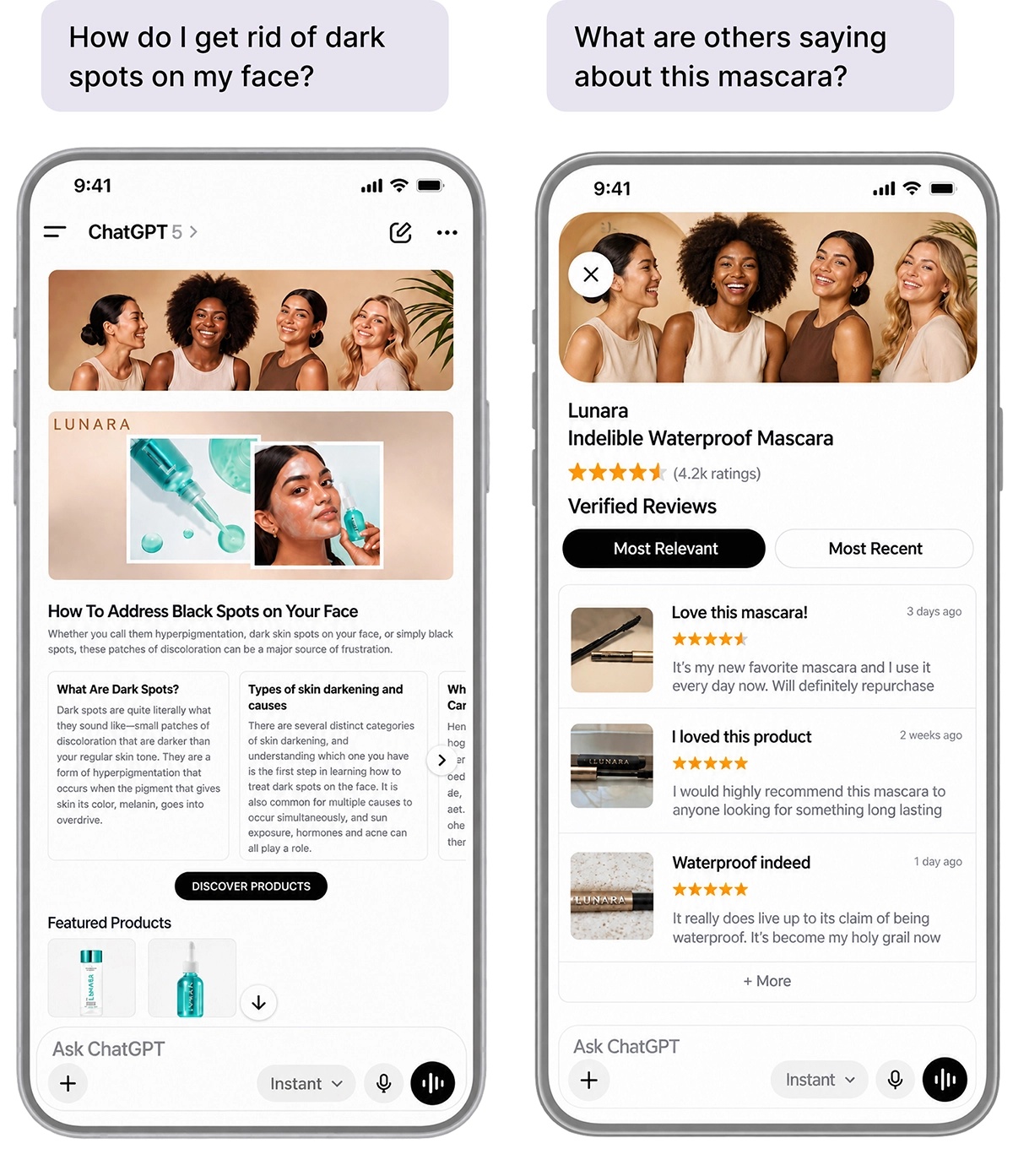
For a brand team, the attraction is a place to present approved knowledge and imagery. For a shopper, the value depends on getting a useful answer. Those interests overlap when the assistant explains fit, material, availability or a genuine trade-off. They diverge when a helpful conversation becomes a brochure wearing a chatbot’s hat.
The June 2026 Enterprise release describes content enrichment, compliance checking, integrations and multilingual options. Its stated storefront configuration window was approximately two to four weeks, with platform approval potentially adding time. Coverage also differs by surface: a ChatGPT storefront app, enriched discovery feeds and an assistant on a brand’s own website are different delivery routes.
Enterprise software needs enterprise plumbing
In March 2026, Accenture Ventures invested and Accenture Song became a strategic partner. Accenture’s announcement places the work across discovery, merchandising, checkout, fulfillment and loyalty. That breadth explains why this company sells to enterprises through demonstrations and sales conversations.
The commercial model is B2B software. BrandStore’s announced packages range from a base discovery offering to Standard and Enterprise versions. Its customers bring catalogs, rules and systems into the relationship. The buyer is paying to operate a connected process, with configuration and governance forming part of the practical work.
A competitor may solve one piece very well: creative production, AI visibility or a custom shopping assistant. DaVinci’s market position depends on joining those pieces. An enterprise assessing it should examine the handoffs between tools as carefully as the appearance of the tools themselves.
The answer is only as good as the shop behind it
The sensible way to copy this approach is to begin with one category and a set of real shopper questions. Check whether the product information can answer them. Establish which claims are approved, where stock and prices come from, and where a purchase goes. Measure a baseline before changing the content.
There are conditions under which the approach will disappoint. Stale inventory produces a fluent invitation to buy something unavailable. Sparse reviews give enrichment little to work with. Unsupported claims remain unsupported after a machine repeats them. A broken checkout handoff can squander an excellent recommendation. These are operational implications of the proposed workflow, rather than claims of documented DaVinci failures.
The company’s interesting insight is that the product feed has become a sales conversation’s backstage crew. It must know more than the object’s name. It must help explain why the object belongs in someone’s life. The hot-afternoon wedding shopper was asking for that all along.
Step inside the conversation
Explore the company website, BrandStore product, Commerce Marketing and company blog.
Read the Giant Eagle case, Diageo case and Accenture partnership announcement. Watch the Diageo case-study video or browse DaVinci’s YouTube channel. For the founder’s perspective, visit his Jess Larsen interview.