At Myer, the Australian department store, a swimming costume can arrive in the search box wearing several disguises. A customer types “togs.” Another prefers “swimmers.” A third asks for “bathers.” The merchandise has not changed. The language has. For a search engine, that small difference can become a surprisingly expensive social embarrassment: a shop full of things announcing that it has nothing.
- FirstSpirit gives enterprise teams tools to create, reuse, and publish content across sites and channels.
- Fredhopper handles product search, recommendations, and merchandising, with room for human judgment.
- Digital quality and accessibility combine automated checks with specialist services.
- New owner: Rezolve AI completed its Crownpeak acquisition in December 2025.
Crownpeak has spent much of its life working on the distance between what a business possesses and what a customer can actually reach. Sometimes the missing connection is a synonym. Sometimes it is an inaccessible page. Sometimes it is a marketing team with a perfectly good campaign and no practical way to publish it. The company sells the machinery that makes those connections less awkward.
The shop knows the product. Does it know the word?
Myer’s scale makes the vocabulary problem consequential: its published Fredhopper case study describes more than 68 million annual searches. The retailer needed results that could accommodate colloquial language and a wide catalog. Fredhopper’s AI search was used to improve relevance, reducing the chances that a shopper’s perfectly reasonable expression would meet a blank screen.
The case study reports a 93% reduction in searches returning no results, a 14% increase in “add to bag” actions, and an 11.8% increase in ecommerce conversion. These are vendor-published customer results, rather than a promise about every store. Still, the pattern is revealing. Search quality belongs in the discussion of sales, because a customer who cannot find a product has little reason to admire the warehouse.
There is another kind of waste hiding nearby. Harvey Nichols’ Fredhopper story describes better synonym management and adjustments based on shopper behavior. It also reports a 92% reduction in manual redirects. A retail team can spend its day teaching an engine how people talk, or spend more of it deciding what to sell. Crownpeak’s product-discovery proposition includes that second dividend: less repetitive maintenance for the people running the shop.
The campaign waiting in the IT queue
Publishing has its own translation problem. In a FirstSpirit customer story, an unnamed American outdoor retailer had an established commerce platform but cumbersome content operations. Marketers and designers supplied the material; IT made the pages. Routine changes passed through reviews and handoffs. The site could process a purchase more readily than it could accommodate a fresh merchandising idea.
The retailer selected FirstSpirit to work with IBM WebSphere Commerce and retain existing investments. Marketers gained a combined view of product and promotional content, reusable templates, previews, and scheduled campaigns. The detailed case-study calculation puts the previous work at about 13 IT hours per weekly page update, or 676 hours annually. Its summary rounds the homepage saving to 675. The useful lesson is the location of the expense: between the teams.
“too hard to get live and too hard to manage”Jim Howard, recalling the web content management products that preceded Crownpeak
Howard and co-founder Carl Sutter started Crownpeak in 2001 after working with installed web content management systems. In Howard’s account, those systems had become obstacles to digital marketing. Their response was to deliver content management as a service. That origin gives the company a practical preoccupation: someone should be able to run the website without inheriting a second career in maintaining its machinery.
A portfolio assembled around friction
Crownpeak’s present shape came together through deals. In 2016, it merged with ActiveStandards and announced a $50 million investment from K1. Content delivery gained digital quality management: a way to monitor and enforce standards around the material being published. The quality product remained available separately, an important detail for businesses that already had a CMS.
The e-Spirit acquisition in 2021 brought FirstSpirit into the portfolio, broadening its content-management offering and international reach. In October 2022, Crownpeak acquired accessibility consultancy ilumino after a two-year partnership. That deal joined automated scanning to human expertise, testing, and remediation work. In December, the Attraqt acquisition added ecommerce search, merchandising, and recommendations.
Digital quality
FirstSpirit CMS
Accessibility + discovery
New parent
The products address related work, but they are distinct. FirstSpirit is the content-management side: create and organize material, then deliver it where it belongs. Fredhopper is the discovery side: help a customer navigate products and let a retailer shape their presentation. Digital Quality Management checks the experience for problems. The portfolio’s appeal is that a large business can approach these jobs together without pretending they are all the same job.
Automation with somebody at the controls
Fredhopper’s merchandising tools include manual arrangement, ranking rules, and the ability to boost or bury products. Those controls matter because relevance is only one consideration in retail. The product a shopper is likely to appreciate still has to fit the retailer’s campaign and commercial priorities. Automation becomes more useful when the people accountable for the shop can intervene.
FirstSpirit’s hybrid approach also serves two constituencies. Editors need usable tools for managing the experience; developers need ways to deliver content into different environments. Crownpeak competes here with enterprise CMS products such as Adobe Experience Manager Sites and Sitecore XM Cloud. Fredhopper overlaps with discovery specialists such as Algolia. Crownpeak’s distinctive proposition is the combination of these capabilities with quality and accessibility work, rather than a claim that every rival lacks them.
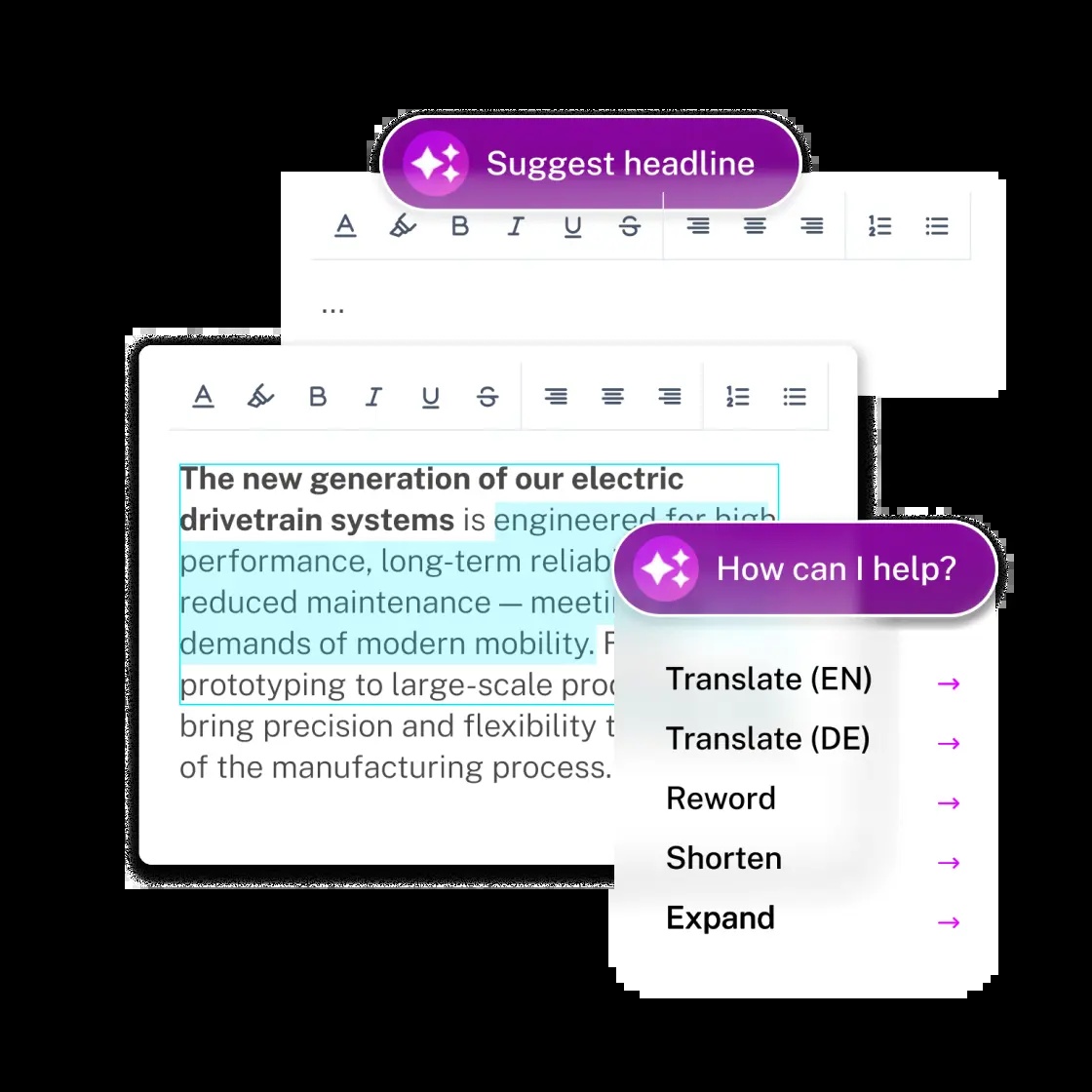
The FirstSpirit AI Suite launch in August 2024 introduced content, analysis, and image assistants. Its stated ambition paired generation with governance. That pairing is sensible: increasing the volume of text also increases the amount a team must review. An editorial assistant earns its place when it saves work across the publishing process, including the checking.
Integration is another part of the offer. Fredhopper’s native Shopify app launched in August 2025, developed with Underwaterpistol, bringing search, recommendations, and merchandising into that platform. Patchworks provides a separate route for connecting product and commerce data across systems. These are practical answers to a procurement question: how much existing equipment must a company disturb to get the new capability?
The price of an installed audience
On December 5, 2025, Rezolve AI completed the acquisition of Crownpeak. The SEC filing sets out initial consideration of $90 million, subject to adjustments: $50 million in loan notes and approximately $40 million in shares. The announcement also described approximately $150 million of assumed debt. That debt is separate from the headline purchase consideration.
$90m initial total, subject to adjustments. Approximately $150m assumed debt was announced separately.
Rezolve’s announcement projected roughly $70 million in 2025 revenue and described more than 400 enterprise deployments. For the buyer, Crownpeak offered an installed audience for conversational commerce. That is a strategy and an expectation, rather than evidence that every customer has adopted the new parent’s products.
The acquisition had a pleasing historical loop. Rezolve CEO Daniel Wagner had founded and taken Attraqt public. Now he was buying a company that had itself bought Attraqt. “I know the technology and I know the customers,” he said. In enterprise software, familiarity can be an asset almost as tangible as code: knowing the systems is one task; persuading an organization to change them is another.
Count the handoffs before buying the cure
Crownpeak sells enterprise software and related services, with implementation and support supplied through its own teams and partners. A buyer needs to evaluate the subscription alongside integration, migration, training, and ongoing operating work. The savings in a customer story are useful starting points for a business case, provided the buyer measures its own starting position.
The copyable habit is to count the friction first. How many searches end empty? How many people touch a page before it goes live? Which accessibility problems recur after each release? Pick a workflow, establish a baseline, and assess whether the proposed change removes work or relocates it. A good demonstration should resemble the buyer’s Tuesday afternoon.
The fit is narrower for a small site with a modest catalog and uncomplicated publishing. A search layer also depends on usable product data; a CMS depends on people agreeing how content should move; an accessibility scanner needs a process for fixing what it flags. Crownpeak’s story is most persuasive where those responsibilities already exist and have become difficult to coordinate. The clever part is making that ordinary work move.