Frister Haveman had access to the databases. That was part of the problem. In consulting and private equity, he could see how much work remained after the subscriptions had been paid: cleaning financial information, identifying owners, mapping industries, working out which company had bought which other company. The information business had supplied the ingredients. Someone still had to spend the afternoon cooking.
He and Nicola Ebmeyer recognized the same irritation from different desks. Haveman was working in private equity; Ebmeyer was at McKinsey, serving a private equity client. Their conversation about the difficulty of getting useful information on private companies became the starting point for Gain, which they founded in Amsterdam in 2018. It is an origin story with an unusually recognizable villain: a task that keeps returning to your desk.
Today, Haveman is Gain’s co-founder and co-CEO. The business, previously called Gain.pro, connects private-company intelligence with research tools and deal workflows. Its ambitions have expanded considerably. The original question remains small enough to fit into an ordinary working day: why does getting a usable answer take so long?
A customer before he was a founder
Haveman came to that question through consulting and investing. His earlier employers include Bain, Gilde and Bridgepoint. He holds a master’s degree in Finance from the University of St. Gallen, and his professional life has included Amsterdam, Munich and London. This was a founder entering a market whose working habits he already knew.
That experience gave the product an immediate test. Would it help someone doing the work he had done? A database can contain plenty of material while leaving its user to reconcile company names, ownership and financial periods. For a deal team, the burden sits in those connections. The person assembling them may be highly trained, expensive and perfectly capable of more interesting work.
Ebmeyer brought her own experience of that burden. Their partnership joined two people who understood the customer’s problem before they had a product to sell. The company began in a small Amsterdam office. Within about six months, it had its first paying customers. The pitch could draw on a recognizable complaint, which is a useful advantage when selling something people must make room for in their existing routine.
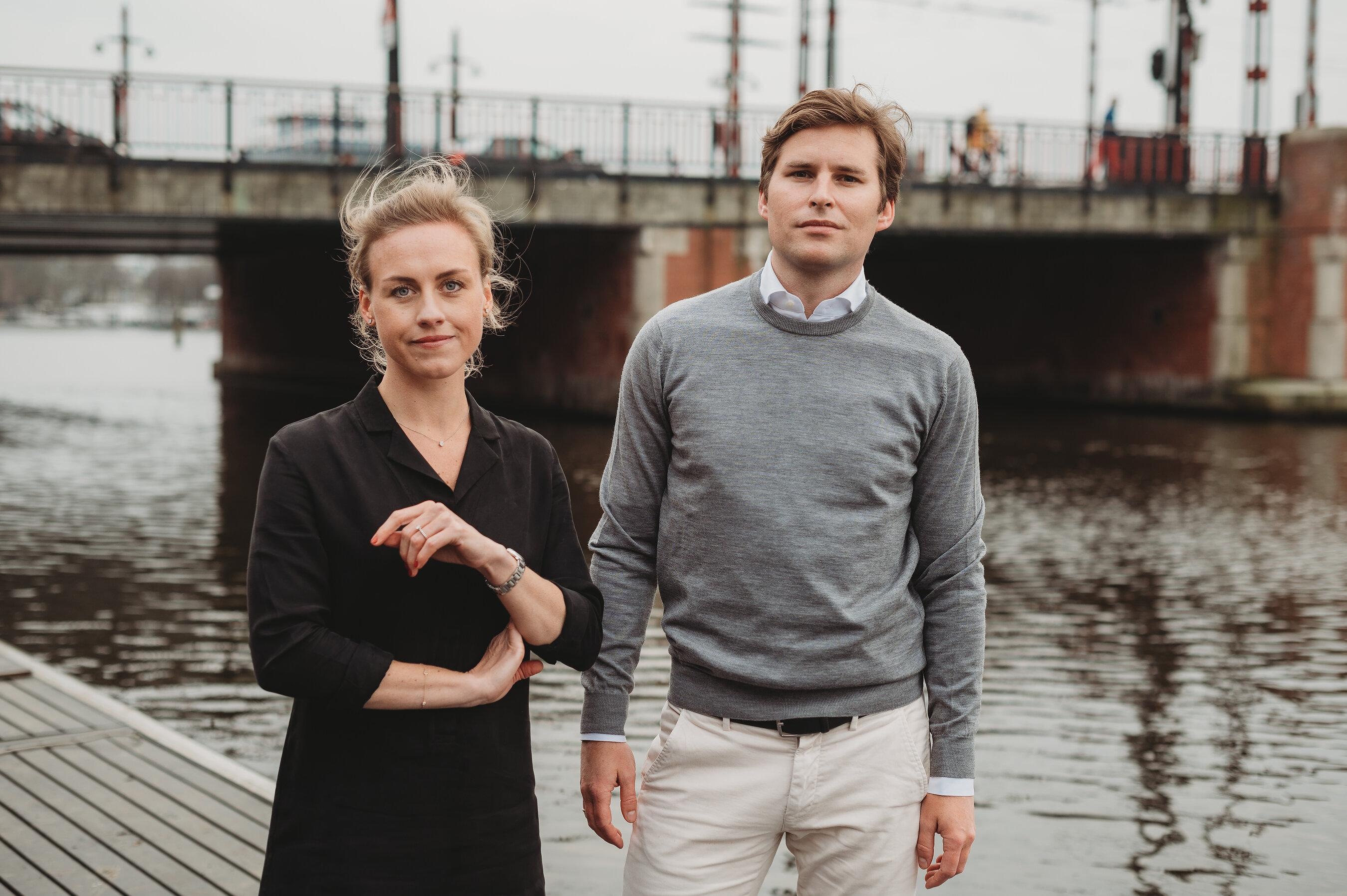
In May 2022, Gain announced that total investment had reached $10 million. The backing included industry participants, a European family office’s investment arm, and the company’s founders, management and employees. Haveman drew attention to a useful overlap: investors were also users of the platform. They could examine the proposition from both sides of the subscription.
“Coming from the industry ourselves, we truly needed a better solution.”
Frister Haveman · May 2022
By October 2023, the business reported 250 employees and more than 150 clients. Those figures mark a change in the founders’ job. A research annoyance had become an organization with researchers, engineers, commercial teams and customers who expected the answers to keep arriving.
First, count the companies
One of the more revealing items in Haveman’s public work is a guide to a question that sounds almost too elementary to ask an investment firm. How many companies could you invest in? In 2022, he wrote an eGuide on defining the total addressable asset pool, or TAAP. The abbreviation has the tidy confidence of a consulting slide. The underlying question earns its place.
A firm may have a clear description of its preferred investment and a less clear view of how many businesses actually fit. Defining the pool makes that preference usable. Geography, size and other criteria turn a general appetite into a set of companies that can be researched and approached. It also gives the team something against which to assess its coverage.
universe
criteria
asset pool
The argument reaches beyond making a list. Knowing the pool informs how a firm organizes origination, gathers data and chooses its systems. It asks investors to apply some of the discipline they expect from a portfolio company’s sales operation to their own search for deals. Before chasing market share, it helps to know what counts as the market.
This is a useful clue to Haveman’s approach. He is interested in the passage from an investment idea to the work required to pursue it. A strategy needs names, records, filters and updates. Somewhere in that procession, even an elegant thesis will need a properly maintained list.
A toolbox, with the lid kept on
Haveman’s enthusiasm for technology comes with a qualification. In October 2024, discussing AI, he argued that inflated expectations could coexist with real practical value. His compact description of the technology was “it’s a tool in the toolbox”. For someone selling software that uses AI, this was a refreshingly workmanlike place to put it.
He identified legal due diligence and finding investment targets as useful applications. At the same time, he warned about excessive attention to AI when firms still had other technology to adopt. Customer relationship systems, external data and a firm’s own internal information all needed work. The newest tool would be operating inside that larger arrangement.
His argument suggests a practical order of questions. What is the task? What information does it require? Where will the result go? Only then does it become useful to ask which part a model can handle. A demonstration may finish with an answer on a screen. A working process has to carry the answer into somebody’s next decision.
Gain’s September 2024 partnership with Intapp addressed that journey. Mutual subscribers could access Gain.pro intelligence inside DealCloud, combine it with their own deal records and update company information within the workflow. An integration is less theatrical than a talking machine. It can be considerably more convenient on a busy Tuesday.
The company beneath the sector label
Haveman also remains involved in the questions investors ask of the underlying businesses. In his webinar on organic growth in Europe, he examined where growth could be found despite the continent’s slower economic expansion. The framing gave weight to differences between individual companies, alongside the familiar exercise of comparing sectors.
That distinction matters to the kind of research Gain sells. An industry classification provides a starting point. The financial history, ownership and circumstances of a particular business supply the detail that can change an investment discussion. A sector can be appealing while leaving many questions about a company inside it unanswered.
His public appearances cover both the technology and the dealmaking. In November 2023, he spoke at a London executive breakfast covering topics including AI in valuation and sourcing. In October 2024, he joined Ardian’s Paris conference panel on adopting AI in asset managers’ operating models. The DealMAX 2025 agenda listed him as moderator of a discussion about continuation funds, secondary funds and NAV loans.
There is also room for a more mischievous question. In a LinkedIn post about software’s growing role in private equity, Haveman described an office conversation prompted by the data: could the contrarian response to AI be a return to real assets? It was posed as a question, and it is worth keeping it that way. The technology founder was considering an investment world in which tangible assets might acquire a different appeal.
That small exchange gives his public commentary some texture. The business he leads belongs to the software economy. The investors he serves have to consider what that economy changes elsewhere. Looking at both sides of the table is part of staying useful to them.
The subjects connect a founder with the industry he serves. Holding a company, selling it, finding another target and organizing the supporting information are parts of the same professional world. Haveman’s move into software has kept him close to those conversations.
The homework gets a larger desk
In February 2026, Gain.pro became Gain. Its wider proposition was organized into four areas: data, integrations, AI workflows and enterprise controls. Haveman described the need for a connected system. The ambition now extends across sourcing, research, collaboration and execution, with the original company-information problem sitting inside a larger working environment.
- 01 / GainDataThe intelligence
- 02 / GainConnectThe integrations
- 03 / GainAgentThe AI workflows
- 04 / GainControlThe permissions
The distribution also widened. In March 2026, Gain’s proprietary research reports became available on the Bloomberg Terminal, covering private equity in the United States and Europe. The company building its own integrated platform was also bringing its work into an established one. Research is more useful when it can reach the desk where the question is being asked.
By October 2026, Gain described an organization of more than 500 employees, including nearly 300 analysts. Its account of the news operation gives a concrete view of the human role. Automated systems assemble evidence, produce a factsheet, draft text and check claims against supporting information. Verification runs three times with majority voting. Analysts retain the authority to publish.
Evidence → factsheet → draft → repeated checks → human sign-off
Simplified view of Gain’s published news workflow, October 2026.That arrangement fits the practical streak in Haveman’s earlier remarks. Faster processing still requires someone responsible for the result. His company’s larger ambitions depend on maintaining that relationship between speed and scrutiny. The hours saved have value because a professional can use them to investigate, speak with people and make judgments.
There is a pleasing circularity to the story. Haveman began as a customer of information products, doing the work left over after the purchase. He now helps lead a business selling relief from that very routine. The test remains close to the desk: whether the next person with a difficult company to research gets to the useful part of the afternoon a little sooner.
Follow the work
- Gain · official website
- Frister Haveman · LinkedIn
- His guide to the addressable asset pool
- Watch · Finding Growth in Europe
- AI, expectations and the practical uses
- The 2022 funding announcement
- Gain and Intapp’s DealCloud partnership
- Gain’s 2026 rebrand
- The Bloomberg Terminal announcement
- Inside the news verification workflow
- More about Gain