Kent Mackowiak had a small question and a large software problem. In Gain’s published Bain Capital customer story, the private equity analyst describes using Grata to find companies, PitchBook for deals, and separate news tracking to fill in the gaps. The answer existed. Getting it required a miniature research expedition.
“The real problem wasn’t a lack of data, it was that nothing was connected,” he says. That distinction explains Gain better than its preferred description, the “Private Markets Super App.” A company can have plenty of information and still make its employees act as the wiring.
- The job: help deal teams find companies, understand ownership and screen opportunities.
- The wager: connected records and research workflows beat another isolated database.
- The evidence: Egeria reports about two-thirds less time building sector maps and long lists.
They had already done the homework
Gain’s founders came from the desks they hoped to improve. Frister Haveman and Nicola Ebmeyer had careers at Bridgepoint and McKinsey before starting Gain.pro in 2018. Their complaint was familiar to anyone who has assembled a market map: access to data providers did not remove the tedious work of turning scattered material into a usable picture.
Private companies make this especially awkward. Their disclosures vary across countries, financial periods and accounting conventions. An ownership change might appear in one place, a useful filing somewhere else. Collecting these fragments is a task. Establishing that they describe the same business is another.

In May 2022, Gain announced that cumulative investment had reached $10 million. Backers included industry participants, a European family office’s investment arm, founders, management and employees. The money was intended to expand coverage and product development. A company-republished 2023 MT/Sprout feature subsequently put cumulative funding at €20 million. These were resources for building a research business, with people as well as software.
The connections are the product
Consider an investor exploring a niche industry. A useful starting list needs more than company names. Who owns each business? Has it acquired competitors? Which investor backed it? Which advisors handled earlier transactions? Gain links these relationships so a company profile becomes an entrance to a wider market.
Its February 2026 rebrand organized that proposition into four parts. GainData supplies the intelligence. GainConnect brings it into existing systems. GainAgent handles AI-assisted research workflows. GainControl supplies permissions and governance. The structure tells you what Gain wants to become: the place where research moves into action.
- 01DiscoverFind the relevant companies
- 02ConnectOwners, deals, advisors
- 03AssessFinancials and market context
- 04ShareBring findings into team workflows
The practical detail is the Intapp partnership announced in September 2024. Customers with both subscriptions can access Gain intelligence inside DealCloud. That matters because a research result has a second life: someone must put it into the system the deal team actually uses.
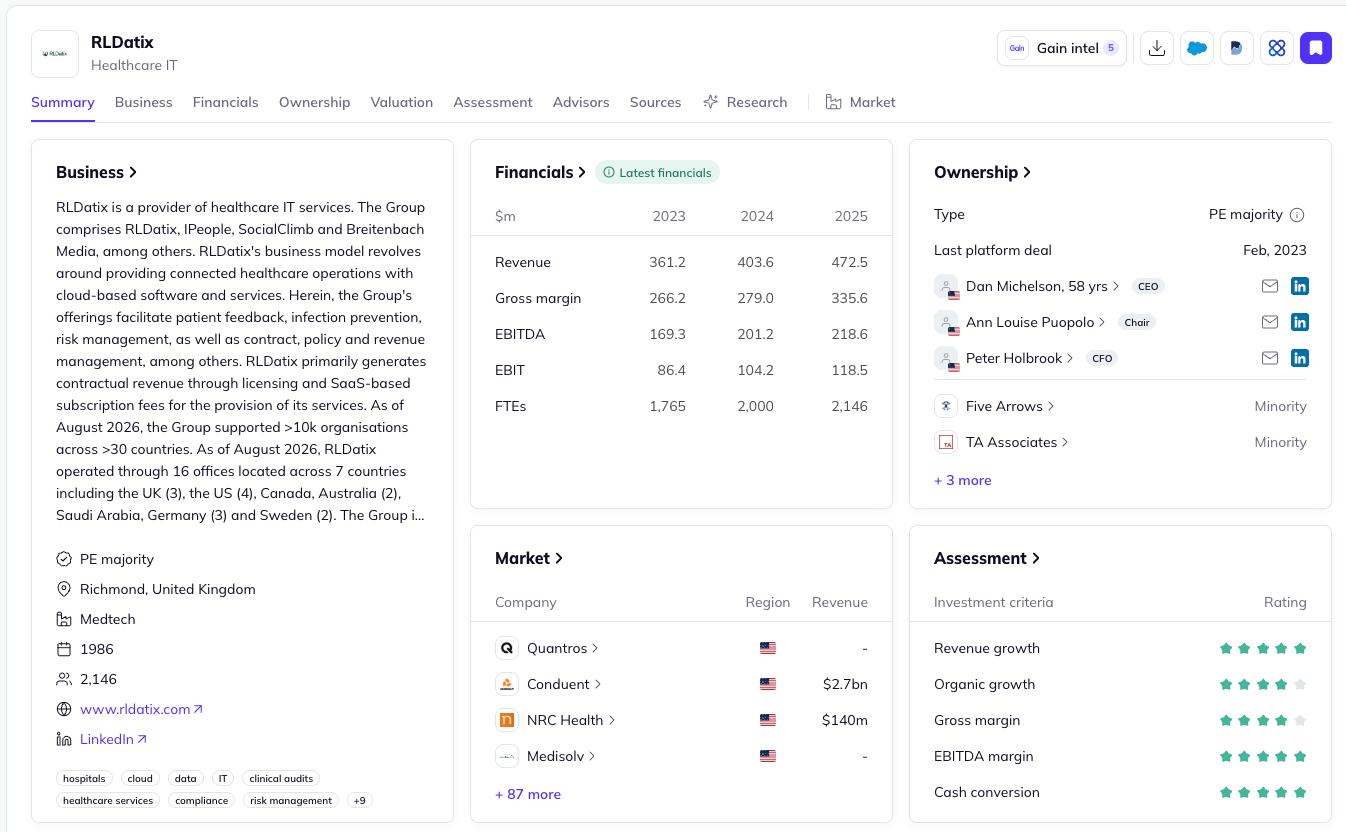
Gain competes with tools including PitchBook, Grata and SourceScrub. Its claim to a place in the stack rests on connected intelligence, human research and workflow integration. Buyers should test that proposition on their own sectors. A compelling interface cannot compensate for missing coverage of the businesses a team actually needs.
A clock, rather than a victory lap
Egeria supplies the more concrete test. The private equity firm describes previously gathering and checking information across files, spreadsheets and other tools. It chose Gain after looking for private-company, sponsor and deal information together. Its use cases include target lists, inbound screening and monitoring potential buyers.
Relative effort, indexed to 100 before adoption. Customer-reported reduction of about two-thirds; not a controlled benchmark.
Egeria reports saving roughly half a day per week per investment professional on research and screening. The recovered time goes toward investment theses, targeted origination, deeper analysis before investment committee discussions, and portfolio support. That is a useful outcome because it describes a change in the workday.
The important detail in the Bain Capital account is the trial. The team evaluated Gain against work it already understood, then chose it for the connections between records and the ease of finding information. That is a more demanding test than asking whether a demonstration looks quick. A demo follows a prepared route; research starts with an awkward question.
The buying lesson is straightforward: time a recurring task, run a trial, and compare the usable result. Include validation and CRM entry in the clock. Subscription spending buys little if analysts must reconstruct the answer afterward. The commercial offer is enterprise SaaS; an individual customer’s economics depend on its agreement and actual use.
These testimonials establish reported workflow improvements. Investment performance requires a longer argument. Faster lists can still contain unsuitable targets; estimated financials still need scrutiny. Teams researching businesses outside the platform’s useful coverage, or needing only occasional basic lookups, may find less value in an integrated subscription.
The analyst still has the last word
Gain’s October 2026 account of its Google Cloud workflow offers a revealing operational detail. Its news process assembles evidence, creates a factsheet, drafts an article, and checks individual claims against supporting material. Verification runs three times with majority voting. Analysts retain publishing authority.
“Private markets don’t need more tools. They need a system.”Frister Haveman / February 2026
The process also rejects drafts that fail substantiation checks. The lesson others can copy is concrete: put evidence checks between generation and publication, then give a person responsibility for the final decision. Automation makes assembling information cheaper. Someone still has to decide whether the assembly deserves to be trusted.
There is a useful division of labor here. Machines can gather candidate evidence and repeat checks at a scale that would exhaust a research desk. People can investigate conflicting accounts and decide what needs another conversation. Gain’s value depends on keeping those responsibilities clear as its coverage grows. More output only helps when readers can still examine the basis for an answer.
In March 2026, Gain’s proprietary research reports also became available on the Bloomberg Terminal. Even a company promoting an integrated app recognizes the value of reaching people where they already work. Its opportunity is to make the trip from question to evidence shorter. The investment decision remains on the other side of that trip.