A smartphone looks finished when you take it out of its box. For the company that designed it, the difficult question arrived much earlier: how do you make the next million behave like the first? Somewhere between a beautiful prototype and a reliable shipment sits Foxconn. Its name rarely gets the large type on the packaging. Its work makes the packaging possible.
- The business: turn other companies’ designs into products that can be manufactured repeatedly.
- The shift: cloud and networking passed consumer electronics in quarterly revenue in late 2025.
- The catch: enormous sales still leave little room for production mistakes.
The product behind the product
Founded by Terry Gou in Taiwan in 1974, Hon Hai began with the unglamorous disciplines of tooling and manufacturing. Today, Foxconn’s customers buy access to an organization that can coordinate components, production equipment, assembly and testing. Apple’s published supplier list places its Foxconn manufacturing locations across mainland China, India and Vietnam. This is a relationship between businesses; consumers meet the results in somebody else’s box.
The distinction matters. A brand can invent a desirable object without wanting to own every factory required to deliver it. Foxconn supplies that missing industrial organization. Its catalog reaches from consumer devices and computers to connectors, networking equipment and servers. Engineering and procurement sit alongside assembly. A production bottleneck may begin in a component specification long before a worker touches the finished device.
Consider the company’s own vocabulary: “time to market,” “time to volume,” and “time to money.” Those are three different deadlines. Getting a product launched does not establish that its output can rise smoothly, or that the effort will pay. Foxconn has made a business of working through the distance between those events.
Three cents on the dollar
Foxconn’s 2025 revenue reached NT$8.1 trillion. Its operating margin was 3.20%. Put another way, every NT$100 of revenue produced about NT$3.20 of operating profit, before financing costs and taxes. You can sell an astonishing amount of hardware and still need to watch the pennies.
This arithmetic helps explain why manufacturing scale is a particular kind of expertise. Small improvements in yield, scheduling or equipment use can matter across a vast production base. Conversely, a delay can tie up expensive inventory while a customer waits. Revenue is an impressive headline; the production system determines how much of it survives.
There are alternatives. Pegatron and Luxshare compete in consumer-electronics assembly; Quanta and Wistron’s wider ecosystem matter in servers. Foxconn’s case rests on the breadth of its capabilities and factory network. Choosing a manufacturer therefore means assessing the particular product, engineering support and production geography. A famous customer list cannot answer every procurement question.
Rehearse the factory
The interesting change is what Foxconn now puts through that system. In the fourth quarter of 2025, cloud and networking became its largest revenue category, passing smart consumer electronics even during the traditional holiday production season. The company associated with phones was finding a larger quarterly business in the infrastructure behind connected computing.
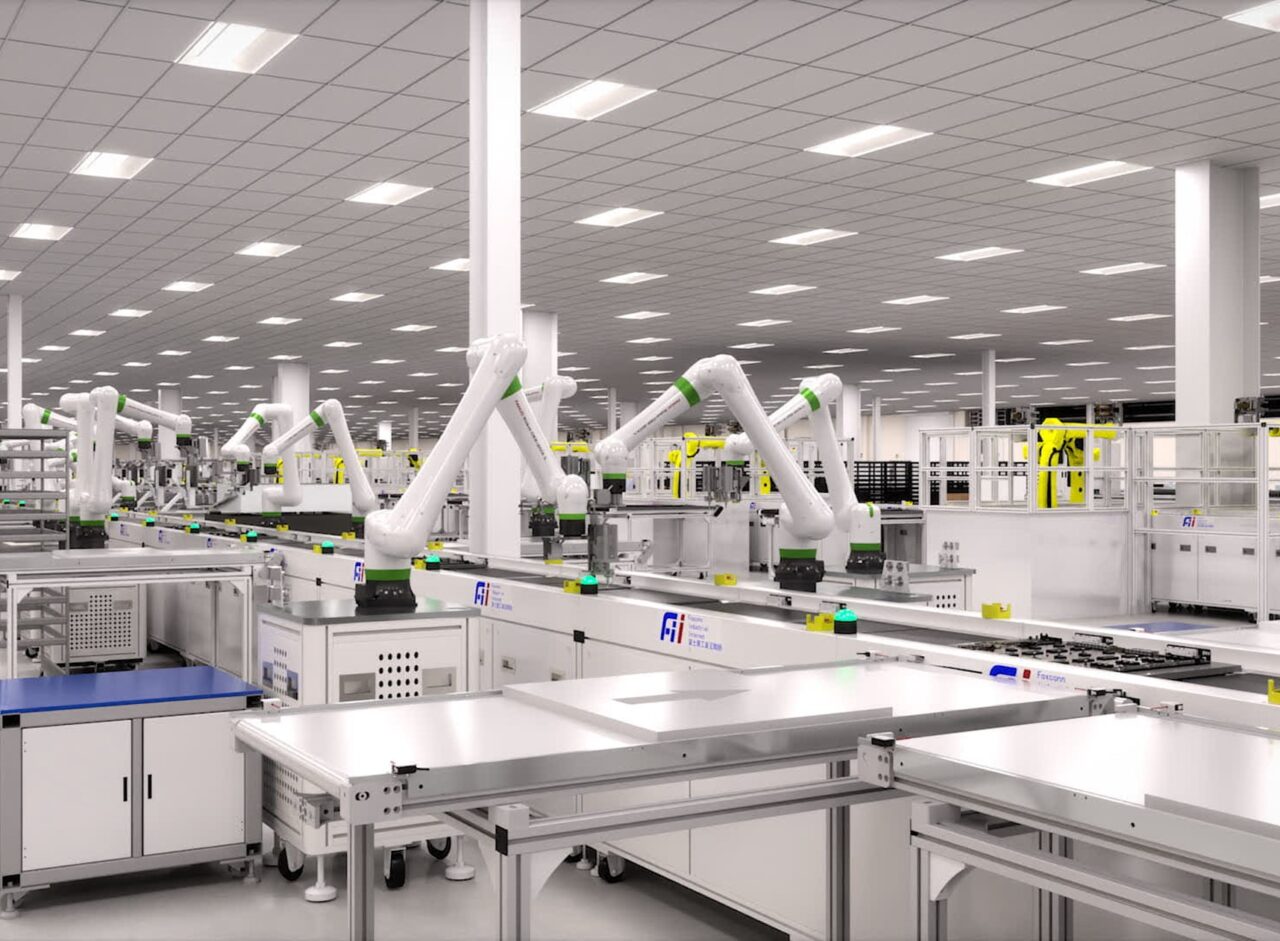
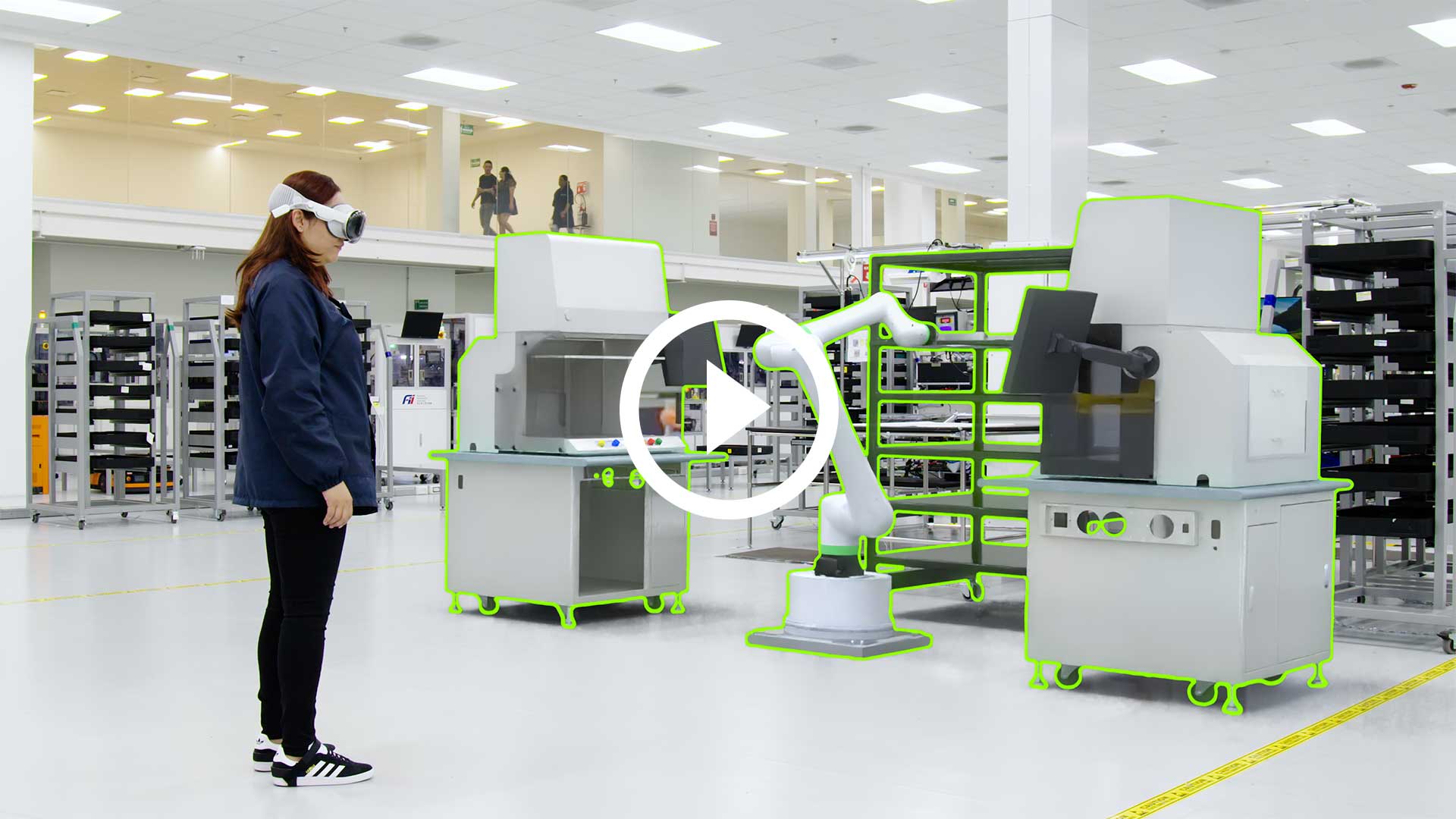
NVIDIA is both a technology partner and part of this manufacturing story. Its account of Foxconn’s Blackwell expansion describes digital twins used to integrate factory layouts and equipment information. Engineers can test robot behavior and camera placement before committing the arrangement to the physical floor. The factory gets a rehearsal.
The practical lesson travels beyond a company of Foxconn’s size: bring the production constraint into the design discussion early. Model an expensive change before making it. Check whether inspection can actually see the thing it must inspect. A smaller manufacturer can borrow that sequence without borrowing Foxconn’s capital budget.
Capacity needs orders, an economical location and enough time to become useful.
Wisconsin meets the spreadsheet
Manufacturing skill has limits, and Wisconsin supplies a useful reminder. Foxconn’s original project promised a $10 billion display-manufacturing investment and 13,000 jobs. The display plan did not materialize as announced. By 2021, a rewritten agreement tied incentives to $672 million of planned investment and 1,454 qualifying jobs.
Foxconn cited economic conditions during the renegotiation. The revised contract also removed the requirement to manufacture a particular product. What failed was the original proposition for that site; a production network could not make its assumptions come true. These figures describe commitments, rather than a final accounting of money spent.
The story continued. A November 2025 amendment supported an additional planned $569 million investment and 1,374 new jobs through 2029, aimed at growing data-infrastructure demand. The distinction between an announcement and an operating result remains essential. Capacity needs orders, an economical location and enough time to become useful.
The line has people on it
Efficiency also has a human ledger. The Fair Labor Association’s final 2013 verification found improvements at three Foxconn factories, alongside continuing excessive overtime and incomplete compliance. That historical finding cannot establish conditions everywhere today. It does establish why an account of Foxconn built only from shipment totals would be incomplete.
The company’s stated values include diligence, integrity and collaboration. The test is whether production schedules and employment practices support them. For a customer outsourcing manufacturing, labor oversight belongs in the specification alongside quality and delivery. Paying another company to make a device does not remove the need to understand how it gets made.
A car with somebody else’s badge
Foxconn is testing how far its approach can travel. In May 2025, Mitsubishi Motors and Foxtron announced an EV supply memorandum: Foxtron would develop the vehicle, Yulon would manufacture it in Taiwan, and Mitsubishi would introduce it in Oceania. Here again, different companies divide design, production and the customer relationship.
A car introduces demands that a phone factory cannot simply wish away. But the question is recognizably Foxconn’s: which parts of making a complicated object can become a shared industrial service? The AI server rack is already providing one answer. The next answer will have to survive the factory floor.