Jure Sola’s account of becoming a founder contains a pleasing shortage of destiny. Asked why he started his company, he offered five words: “Basically I needed a job.” The explanation leaves very little for a motivational poster to do. His previous employer had been sold. He and a partner decided to make printed circuit boards and assembled backplanes. They had little money and needed the business to pay its way.
That was 1980. The company was Sanmina. By October 2025, it was buying the data center infrastructure manufacturing business of ZT Systems from AMD. The distance between those events spans several generations of technology. Sola has spent much of it handling a question that survives every generation: how do you turn somebody else’s ambitious design into something you can actually deliver?
A job that lasted rather longer than expected
His route into Silicon Valley began before Sanmina. Sola arrived in the United States in 1968, aged 17, and earned an engineering degree from San Jose State University in 1972. He worked at Lika, a business making electronic transducers and factory automation control instruments. Before he had his own manufacturing company, he had encountered the business of making industrial equipment.
He co-founded Sanmina with Milan Mandarić. Its early focus was printed circuit boards, followed by backplanes and related assemblies. These are the kinds of products that help other people’s equipment function while rarely receiving an invitation to the launch party. A finished product gets the photograph. Its internal connections generally get a specification.
Sola started as vice president of sales. That detail is useful. The founder’s first formal responsibility was finding and developing business. The factory had to produce something a customer would buy, at a price that let the company continue. Technical capability and a purchase order needed to meet.
Selling the board, learning the factory
In October 1987, Sola became vice president and general manager, adding manufacturing operations to sales and marketing. He was now responsible for both the promise and the machinery expected to keep it. In 1989, he led a management buyout with Morgan Stanley. He joined the board and became president that October. The CEO appointment followed in April 1991.
Sanmina went public in 1993. The sequence matters: sales, operations, ownership, public accountability. Each change brought a wider set of people whose confidence had to be earned. By the time Sola was answering to public shareholders, he had already spent years answering to customers.
The company was expanding as electronics businesses increasingly outsourced production. That created room for a manufacturer able to take on more of a product’s journey. Sanmina’s scope grew beyond its original boards and backplanes. Assembly, testing and logistics became part of a broader service to the companies whose names appeared on the equipment.
There was a commercial logic to moving along that chain. A customer with a complicated product could need help at several stages. Taking responsibility for more stages also meant accepting more opportunities for something to go wrong. Growth enlarged the assignment as well as the revenue.
The merger with a space-age family tree
In 2001, Sola and Sanmina president Randy Furr discussed a combination with SCI chairman and CEO A. Eugene Sapp Jr. The talks developed through calls, meetings and negotiations over the exchange ratio. Behind the transaction was a specific objective: expand Sanmina’s international presence and the range of manufacturing services it could offer.
SCI supplied an unusually long family tree. Olin King founded Space Craft, Incorporated in Huntsville in 1961. The business contributed to the Saturn V program and later made personal computers for IBM. Its history connected space hardware with the emerging trade of building electronics for other companies. Sanmina completed the combination in December 2001.
But acquiring a history is easier than integrating an operation. The combined company faced the aftermath of the technology downturn. Years of restructuring followed. By 2007, its record included five years of net losses, weak margins and falling revenue. Sola’s leadership drew pointed public criticism. The founder’s long tenure included a substantial stretch when the results were difficult to defend.
That period belongs in his story because it changes what longevity means. Remaining associated with a company for decades does not produce a neat upward line. It means carrying the record of the difficult years alongside the early growth, then making further decisions with both still attached.
The corner office, briefly vacated
In October 2017, Bob Eulau became Sanmina’s CEO and Sola moved to executive chairman. The arrangement gave Sola a continuing role with customers and strategy while someone else ran the company. It was a handover of operating responsibility, with the founder remaining close to the business he had helped establish.
Hartmut Liebel subsequently became CEO. When Liebel left in August 2020, Sola reassumed the chairman and chief executive roles. His first CEO period had lasted from April 1991 to October 2017. The return began a second one.
At the time, Sanmina described plans to organize around integrated manufacturing, SCI’s defense business and component technologies. The emphasis was on accountability and making the value of the different operations clearer. Sola returned with an experienced leadership team and a business containing several distinct capabilities. His task was to turn those capabilities into a more effective whole.
A founder’s return can make an appealing closing scene. In this case, several consequential chapters were still ahead. The next decisions would include an Indian partnership and another acquisition that changed the scale and mix of the company.
A handshake is only the beginning
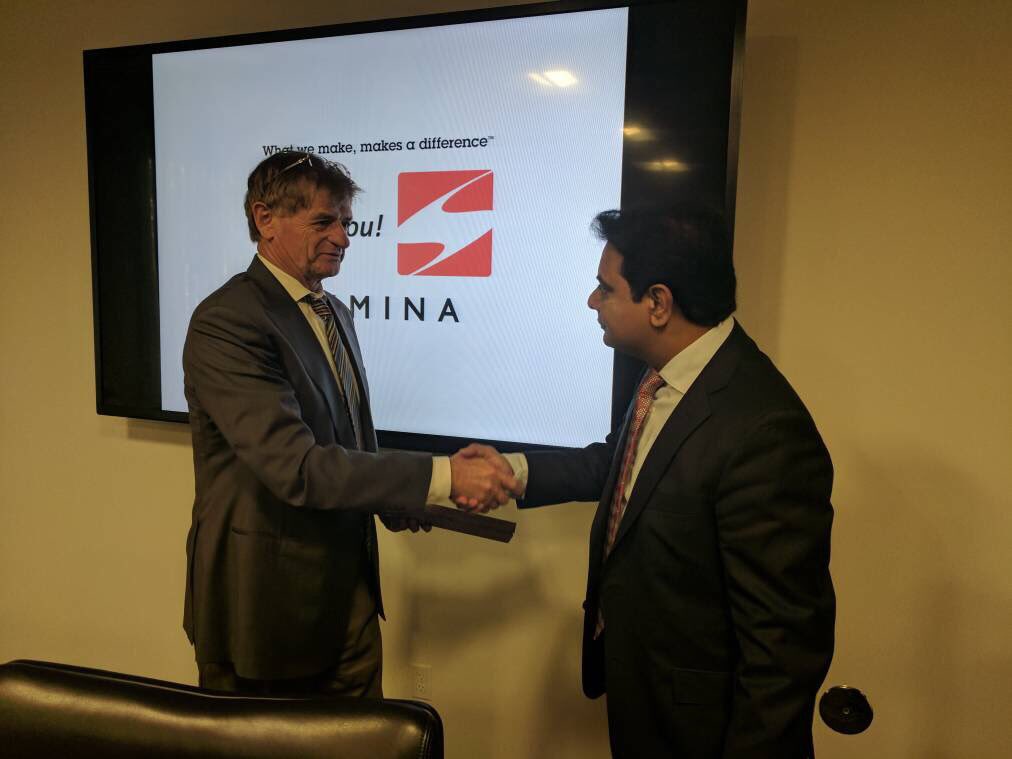
A photograph from May 2017 shows Sola meeting K. T. Rama Rao to discuss electronics manufacturing investment opportunities. The scene is conventional: suits, a handshake, the company’s name on a screen. It captures one part of the work behind an international manufacturing business, where factories sit within relationships with customers, suppliers and public officials.
A separate development came in March 2022, when Sanmina and Reliance announced an agreement to create an Indian manufacturing joint venture. Reliance’s investment would give it 50.1 percent ownership, with Sanmina holding 49.9 percent. The existing Chennai management team would continue to manage daily operations.
The arrangement paired Sanmina’s manufacturing experience with Reliance’s knowledge of India’s business environment. It targeted domestic demand and exports, initially using Sanmina’s 100-acre Chennai campus. For Sola, it offered another way to expand the company’s reach: build around an existing operation, share ownership and keep manufacturing management close to the work.
The cloud acquires a factory floor
On October 27, 2025, Sanmina completed its acquisition of ZT Systems’ data center infrastructure manufacturing business from AMD. The distinction is important: it acquired the manufacturing business. The transaction also established a partnership making Sanmina a US-based preferred new product introduction manufacturing partner for AMD’s cloud rack and cluster-scale AI systems.
ZT brought facilities in New Jersey and Texas, substantial power capacity, liquid cooling capabilities and an operation in the Netherlands. For a company already making boards and mechanical components, the addition extended the work toward integrated systems at scale. The opportunity had a thoroughly physical inventory: buildings, equipment, electricity and people who knew how to use them.
engineering→Boards &
components→Assembly &
integration→Test &
fulfillment
The acquisition followed a fiscal year in which Sanmina recorded $8.13 billion in revenue, up 7.4 percent. It generated $621 million in operating cash flow and invested $142 million in equipment, facilities and technology. Those figures describe the business before the completed ZT acquisition began contributing to the following fiscal year.
At a December 2025 investor conference, Sola stressed the people coming with ZT and the customer relationships already in place. He described a company serving customers over many years, with execution determining whether those relationships lasted. He measured the next phase by the quality of the following month’s shipments.
“We’re just as good as what we ship next month.”
Jure Sola · December 2025
Next month still has to ship
By July 2026, Sanmina reported quarterly revenue of $3.46 billion. Its GAAP operating margin was 6.4 percent; the adjusted, non-GAAP figure was 8.0 percent. Sola described additional customer orders, expanded capacity and progress combining capabilities across core Sanmina and ZT. He also anticipated demand growth through fiscal 2027 and into 2028.
The results provide a dated checkpoint. His comments about later years describe expectations. Keeping those two things separate is especially useful in a business where a large order still has to become a completed shipment. A factory cannot invoice an ambition.
Sola’s career has repeatedly returned to that practical limit. A sales executive learned to oversee production. A company making boards took on systems. A founder handed over the CEO role, then returned. Each expansion changed what he was responsible for delivering.
He began by needing a job. The job now includes helping customers build the infrastructure for another wave of computing. Somewhere between the announcement and the loading dock, the old assignment remains: make the thing work, then make the next one.
Follow the work
- Sanmina’s website and company profile
- Sola and the management team
- The 2005 conversation about building Sanmina
- The ZT Systems manufacturing acquisition
- Third-quarter fiscal 2026 results
- Investor presentations and webcasts
- The SCI merger’s negotiating history
- A critical assessment from 2007
- The 2017 meeting photograph