On his first day at GXO, Patrick Kelleher had somewhere else to be. There was a welcome from the Greenwich team, naturally. But his introductory message on LinkedIn already looked beyond headquarters: the following day he would head into the field, visit sites and meet the people running them. The new chief executive described an itinerary of listening and learning. For someone taking responsibility for a company with more than a thousand facilities, it was a sensible place to begin. A warehouse network can fit on a presentation slide. Understanding one takes considerably more shoe leather.
He became CEO on August 19, 2025, after a career spent inside the same industry he was now being asked to help reshape. GXO had announced his appointment in June. Brad Jacobs, then chairman, was recruiting an operator with experience in engineered solutions, automation and acquisitions. Kelleher arrived with 33 years in global supply chains. His new employer had a large footprint and an appetite for technology. His assignment was to turn those advantages into consistent performance, customer by customer, site by site.
Thirty-three years before day one
Kelleher began his logistics career in 1992. He had studied supply chain in college and started with the business that became part of DHL through its acquisition of Exel in 2005. The continuity matters. His route to Greenwich ran through the ordinary complications of contract logistics: winning work, designing services, operating them and finding the next opportunity. He stayed with the industry while the names above the door changed. There is a particular education in watching the promises made during a sale eventually arrive on an operating floor.
His senior roles broadened that education. From July 2015 to April 2017 he led the Americas business of Williams Lea Tag while it was under DHL ownership. He then served as DHL Supply Chain’s global chief development officer through June 2024. That position brought commercial strategy and business development into view across countries and sectors. It gave him a way to compare markets, rather than treating the circumstances of any one region as the natural order of things.
In July 2024 he became CEO of DHL Supply Chain North America, succeeding Scott Sureddin. The responsibility covered the United States and Canada and 52,000 associates. DHL identified geographic expansion, digitalization and operational performance as priorities. Kelleher reported to the division’s global CEO, Oscar de Bok, and was based in Westerville, Ohio. It was a substantial operating job, followed little more than a year later by the move to GXO. The familiar industry would now come with a different company’s opportunities and obligations.
- 1992Starts in contract logistics
- 2015Leads Americas at Williams Lea Tag
- 2024Leads DHL Supply Chain North America
- 2025Takes charge of GXO
The package that comes back
One useful episode from that North American tenure concerns an unglamorous object: the returned purchase. In January 2025, DHL announced its acquisition of Inmar Supply Chain Solutions. The agreement brought 14 returns centers and around 800 associates into the business. The press photograph shows Kelleher seated beside Inmar Intelligence CEO Spencer Baird, with a yellow network map glowing behind them. It looks like a corporate announcement, which it was. The business behind it was the complicated afterlife of things people had already bought.
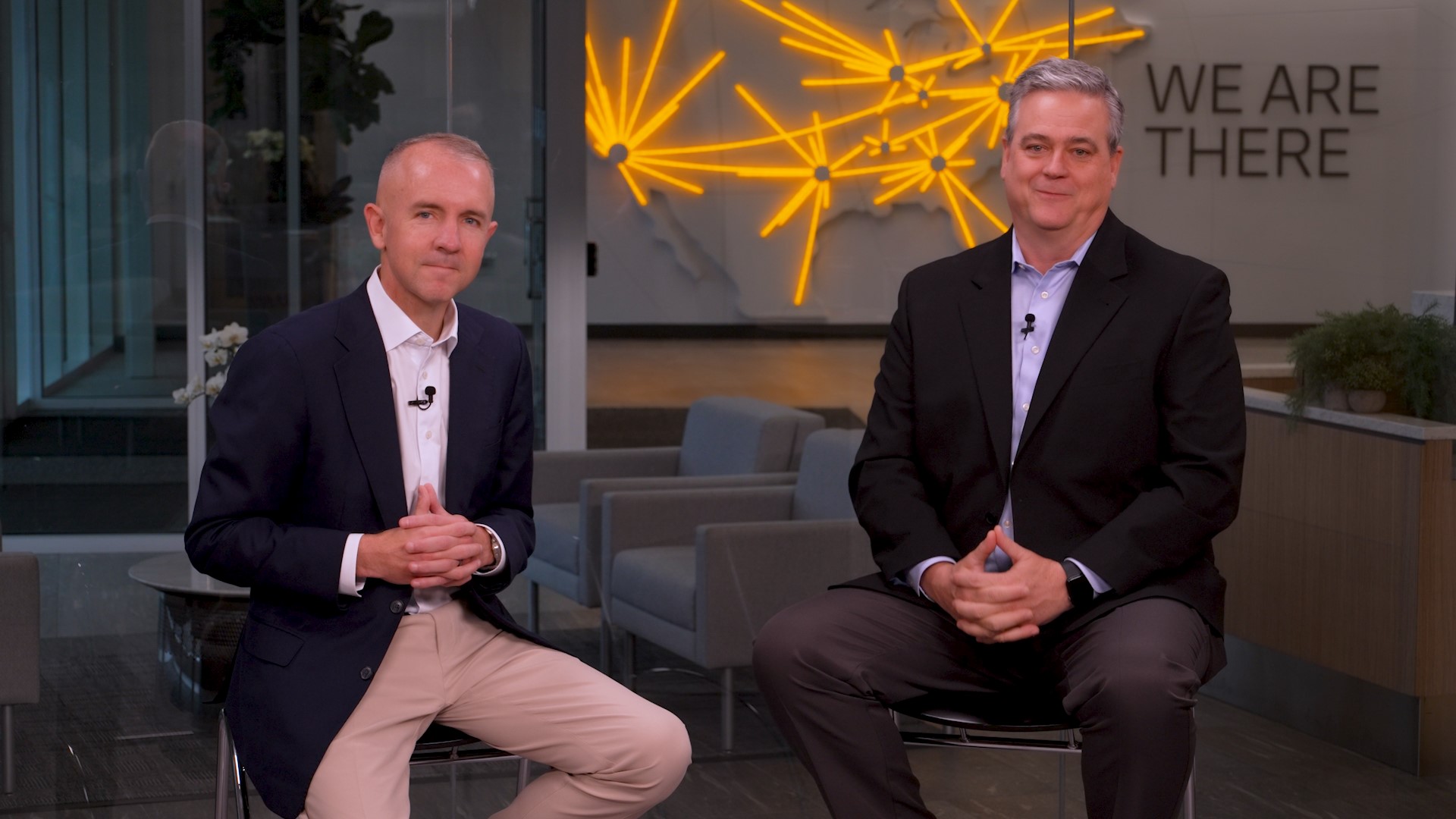
Returns add another set of decisions after the apparent finish line of a sale. Goods must be received, assessed and directed onward. The Inmar transaction expanded DHL’s capabilities in remarketing and supply chain analytics as well as returns processing. Kelleher emphasized the attraction of giving customers an integrated service across their supply chains. The acquisition illustrates the commercial logic of adding a service: find a troublesome part of the customer’s operation, build the expertise to handle it, and make that expertise part of a broader relationship.
That instinct helps explain why contract logistics can be a more intimate business than its industrial buildings suggest. A provider becomes involved in how a customer actually works. It handles details that the customer’s own buyers may never notice unless something goes wrong. A parcel arriving on time is pleasingly uneventful. Making that event repeatable, including when the parcel comes back, is where the operating work lives. Kelleher’s career has been spent close to that distinction between the simple outcome and the complicated system producing it.
A robot still needs a good assignment
GXO’s appointment announcement credited Kelleher with helping advance DHL’s deployment of robotics, including Boston Dynamics’ Stretch robot from 2023. It also said he had overseen four acquisitions in the preceding year. Those details put equipment and transactions in the same frame. Both can expand what a logistics business can do. Both require work after the announcement. Buying capability is a beginning; making it useful across the organization is a separate managerial task.
At GXO, a central piece of that task already had a name. GXO IQ launched on June 26, 2025, before Kelleher took office. Developed by logistics specialists, the platform uses technologies including Google Cloud’s Vertex AI and Snowflake Cortex AI. It coordinates decisions across inventory, picking, packing, shipping and staffing. Its timing is important to his story. He inherited a technology program already underway, along with the responsibility for putting it to work more widely.
The interesting unit here is the decision. A machine may perform one physical action very well, but a warehouse also needs to decide which action comes next. Orders, available inventory and staffing all affect the answer. GXO IQ addresses that coordination problem. This gives Kelleher an operating challenge that is easy to state and hard to finish: introduce useful intelligence into existing operations without losing the reliability customers are paying for. A demonstration can choose its moment. An operating warehouse must deal with the orders that arrive.
On the first-quarter 2026 earnings call, Kelleher described two fronts for AI: customer warehouse and transport operations, and internal functions such as finance and IT. He said eight AI modules had been deployed at a number of sites, while the company was working toward 50 sites on GXO IQ by year end. These were deployment milestones and ambitions, rather than evidence that the entire network had already changed. The distinction keeps the story grounded in implementation, where an operator’s claims eventually have to meet a working day.
The sweater test
His July 2026 interview offered a delightfully concrete glimpse of the robotics agenda. GXO had completed several pilots in which humanoids performed warehouse functions alongside people. The tests included folding a cashmere sweater and picking up heavy car batteries. Those are rather different auditions. A machine that can lift something substantial still has to prove it can treat something delicate with appropriate manners. Kelleher placed the expected investment return between 2028 and 2030. Even in a conversation about futuristic equipment, the calendar and the economics were present.
He also described a balance between standardization and local requirements: an aim of 80 percent standardized solutions and 20 percent tailoring. That is an aspiration, rather than a measured score for every facility. It does, however, make his larger assignment tangible. A global provider wants to reuse what works, while leaving room for the products, customers and conditions that make each operation different. Standardization earns its keep when it helps a team perform a specific job. It becomes less useful when the job must be bent to accommodate it.
Two jobs for the technology team
By September 2026, Kelleher was giving the technology organization a more explicit division of responsibilities. Balaji Rangaswamy joined as chief information officer, reporting to him. Rangaswamy’s remit covered the systems and architecture supporting the business, including data governance, cybersecurity and digital resilience. Chief technology officer Nizar Trigui would focus on innovation: GXO IQ, AI and robotics. The arrangement acknowledged that expanding new tools and maintaining dependable underlying systems require sustained attention of their own.
It is a revealing organizational choice for a CEO associated with automation. The glamorous machinery has familiar companions: enterprise systems, information management and integration. These are unlikely to win a popularity contest against a humanoid folding knitwear. They are also difficult to dispense with. Kelleher’s structure placed the two responsibilities alongside one another, connecting the capacity to innovate with the capacity to execute. His own work increasingly involves arranging the people and responsibilities behind the equipment, rather than simply approving the equipment itself.
Growth gets a name and a reporting line
The commercial agenda was becoming more specific too. On September 28, GXO appointed Dan Davis president of aerospace and defense, a newly created enterprise role reporting to Kelleher. Davis came from FSI Defense, after earlier work at Lockheed Martin and service in the U.S. Army. His assignment covered customer acquisition, partnerships and growth in the sector. GXO had also established a Defense Advisory Board. For Kelleher, expansion into complex industries was acquiring dedicated leadership and a clearer organizational home.
The second-quarter results offered one measure of the business he was running. GXO reported revenue of $3.4 billion, up 4.3 percent year over year, with organic growth of 3.4 percent. New business wins reached $410 million, an increase of 34 percent. These are company results, produced by the organization and shaped by more than one executive. They supply a useful check on the surrounding discussion of technology and strategy. Commercial momentum matters because equipment, expertise and management changes eventually need to translate into work customers are willing to buy.
Making experience travel
In August 2026, Kelleher distilled his view of the industry’s evolution into a short phrase: “today it’s an arbitrage of expertise.” The argument was that a logistics provider’s knowledge had become more valuable as customers faced increasingly complex operations. He described the need to spread successful ideas through GXO’s network, while preserving local customer relationships. Read alongside his early site visits, it gives his leadership story a coherent shape: learn what people know, identify what works, and improve the organization’s ability to use it elsewhere.
“today it’s an arbitrage of expertise.”
Patrick Kelleher · August 2026
GXO scheduled a November 16, 2026 investor day at the New York Stock Exchange, with Kelleher, CFO Mark Suchinski and other executives due to discuss long-term strategy and the financial framework. As of October, that remained ahead of him. The next explanation would have a public stage. The continuing work would be distributed across the network: a returns center, a new customer operation, a team introducing a software module. Kelleher started by going out to meet those teams. His thousand-warehouse problem still depends on what happens when their experience travels.