A warehouse picker has two jobs. One is finding the right item. The other is getting there. Watch a cart move between shelves and the distinction becomes obvious: the picking takes seconds; the journey keeps accumulating. Locus Robotics built its early business around that journey. Its robots carry orders through the building while people concentrate on retrieving products. The clever part is deciding which work belongs to which participant.
- Give the travel to robots and keep people near the picks.
- Coordinate the fleet with software connected to warehouse systems.
- Subscribe to capacity, then add robots when demand rises.
The supplier went away
The company’s founders, Bruce Welty and Michael Johnson, came from Quiet Logistics, a fulfillment operator that used Kiva robots. Amazon acquired Kiva in 2012 and eventually withdrew the technology from outside customers. For Quiet, automation had become a dependency. The supplier’s change of direction turned a purchasing decision into an existential question: how would the warehouse keep working?
In a published interview, CEO Rick Faulk recalled the team searching for a replacement and failing to find one that solved its problem. Quiet invested in building an answer. Locus dates its origins to 2014; Faulk joined as CEO in 2016. The sequence matters. The founders already had a warehouse, customers and goods that needed shipping. Their robot had a job description before it had a sales pitch.
Let the order do the travelling
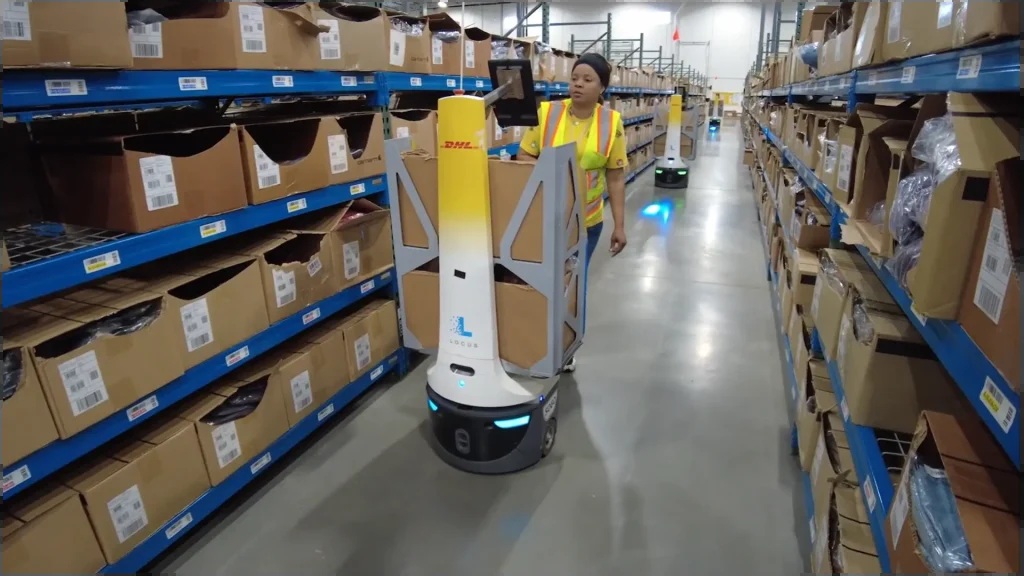
Consider the division of labor. A Locus Origin robot carries containers to picking locations. Its screen guides the associate, who places the required item in the right container. The robot continues through its assignments. A person can serve successive robots rather than accompany one order from start to finish. That changes the unit of work from a long expedition into a series of nearby tasks.
Origin supports an 80-pound payload. Vector handles up to 600 pounds for heavier transport and fulfillment work. Both sit within a broader system covering picking, putaway, replenishment and returns. These are different problems connected by the same inconvenience: inventory must move, and paying a person to push every load is expensive.
Conceptual workflow. The useful handoff is between the journey and the judgment.
The coordinator is LocusONE. It assigns work, manages mixed fleets and connects to warehouse management software. Locus says it integrates with more than 65 WMS and ERP platforms. Its labor-direction features also guide people toward work as conditions change. Navigation gets a robot around an obstacle; orchestration decides whether sending it down that aisle is useful in the first place.
The packing table disappears
A DHL healthcare deployment makes the distinction tangible. In Locus’s published case study, 100 robots supported a pick-to-box process: associates placed products directly into shipping boxes, eliminating a separate packing area. The reported results included 50% fewer quality issues, a 60% reduction in order cycle time and 90% less training time. The workflow lost a handoff as well as some walking.
Ulta Beauty offers a second, different example. Its Locus case study reports a 25% improvement in units picked per hour, 75% less training time and a doubling of the robot fleet during peak demand. Those figures should resist being collapsed into one universal productivity promise. One operation simplifies packing; another needs capacity that grows with the calendar. The same hardware category can earn its keep in different ways.
DHL’s relationship went well beyond a trial. In May 2023, the companies announced an agreement to deploy 5,000 Origin robots across DHL’s network. In June 2024, DHL reported reaching 500 million picks with Locus. Repeated use across a logistics network provides a more substantial signal than a polished demonstration, although it cannot establish the economics of someone else’s building.
A robot, billed annually
Locus sells through Robots-as-a-Service. Its published terms describe a charge per robot per year, billed annually in advance, with a one-time site setup fee. Software, implementation, maintenance and support are bundled. The buyer is paying for an operating system in the physical sense: machines, coordination and the services required to keep orders moving.
“Manual wins on day one, but it loses by day ten.”
Adam Lawicki · VP of Strategy, scale3PL
Quoted on Locus’s Robots-as-a-Service page
The arrangement changes the buying conversation. A logistics provider can assess recurring capacity against customer demand rather than commit immediately to a large equipment purchase. Locus itself still needs capital: its November 2022 Series F raised $117 million at a valuation close to $2 billion. Subscription billing shifts the customer’s spending pattern; somebody still has to build the robots.
For an operator, the copyable lesson is to measure the process before choosing a machine. Record walking, waiting, picking and packing separately. Then test a representative order mix and calculate cost per completed order, including subscription charges and downstream work. This is an evaluation approach inferred from the workflows, rather than a promise of savings. A faster picking aisle has limited value when the queue has merely moved to shipping.
Now the hands are changing
In April 2026, Locus introduced Array, combining mobile robotics with autonomous item picking. Its NeuraGrasp technology is designed to handle varied packaging, including soft and porous items. Origin’s original bargain left manipulation to human hands. Array moves that boundary. LocusONE coordinates the different machines, allowing collaborative and autonomous workflows within the same product family.
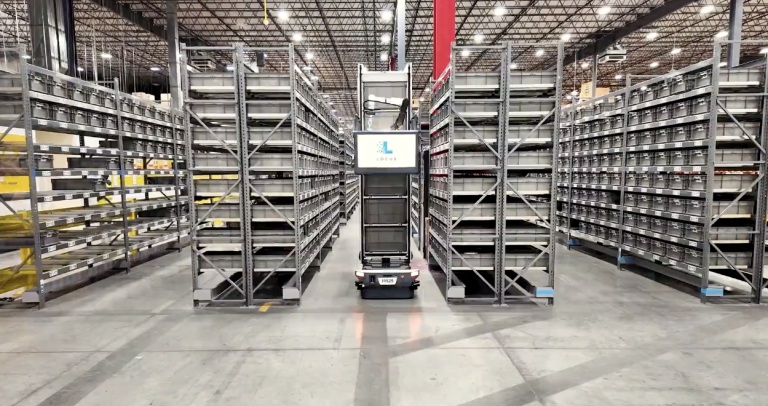
That expansion also sharpens the suitability question. A buyer should test actual products, payloads, connectivity and exception handling. If travel is already a small cost, or the operation cannot keep a fleet busy, the arithmetic changes. Dense storage systems and fixed conveyors solve other constraints. The interesting thing about Locus is its starting question: how much useful work could people do if the order handled more of the journey?