The technician is already waiting. The equipment is somewhere else. On a transport spreadsheet, this is a late delivery. Inside the business, it is paid labor standing idle, a postponed installation and a promise becoming awkward. Pegasus Logistics Group works in that uncomfortable interval between a shipment’s arrival and the reason somebody ordered it.
- Coordinates freight, warehousing and installations for business customers.
- Uses a flexible carrier network, with detailed screening and performance reviews.
- Its useful question: what happens to your business if this delivery goes wrong?
There is an amusing complication: arriving early can be wrong, too. In a July 2026 installation discussion, Pegasus managers describe retail sites with narrow receiving windows. A driver who beats the clock may find a store serving customers, an unavailable installer or nowhere suitable to put the freight. Punctuality turns out to require rather more information than a wristwatch.
A diving trip, then a different kind of company
Founder Ken Beam tells his origin story from Tortola, where he was scuba diving with his brothers. He complained about companies making decisions without enough care for employees or clients. His brothers offered the obvious, inconvenient remedy: start one. Pegasus dates its founding to 1994. In Beam’s telling, looking after employees so they can look after customers became the company’s organizing idea.

The business that followed is a privately held freight forwarder and third-party logistics provider. Its favored territory is the shipment with consequences: sensitive equipment, fixed-time projects and deliveries requiring more than a signature at the dock. The personality is conspicuously sociable. Published values include “Everybody Wins”; the partner program hands out honors to dispatchers. Behind the friendliness sits a fairly demanding operating system.
Flexibility has 140 questions
Pegasus describes an asset-light model. Instead of shaping every customer’s shipment around a large fixed transport network, it assembles capacity through partners. The commercial attraction is choice: different vehicles, handling capabilities and delivery arrangements for different jobs. The difficulty is familiar to anyone who has organized a group holiday. Everybody else’s reliability becomes your problem.
Its published partner process makes that problem concrete. Screening uses a 140-step questionnaire covering security, business processes and cultural alignment. Monthly reviews and scorecards guide workload allocation. Persistent service or billing problems can lead to a lower tier, suspension or removal. Flexibility has an administrative cost: someone must keep checking the people doing the work.
- 01ScreenSecurity + processes
- 02MeasureMonthly scorecards
- 03AllocatePerformance earns volume
- 04CorrectReview + consequences
Customers can combine domestic freight with inside delivery, uncrating, placement and installation coordination. Site surveys and pre-call confirmations address access restrictions before a truck arrives. International services add air and ocean forwarding, transborder movements and customs brokerage. Contract logistics covers warehousing, kitting, fulfillment and ERP integration. Asset recovery handles the less glamorous journey back.

A rate sheet cannot see the whole bill
The customer stories make the market clearer. Confluent Medical used Pegasus for a Costa Rica product launch involving ocean, air and ground freight. Ford Meter Box appears in a separate supply-chain account. These are business relationships organized around operating requirements. Pegasus earns its living configuring and delivering transportation, warehouse and project services around those requirements.
In a February 2026 cost discussion, Pegasus reported that an unnamed multinational medical-device manufacturer cut landed costs by 14% in its first year. The changes involved routing, container utilization and production allocation between Asia and Costa Rica. It is a company-reported example, not a promised saving. The interesting feature is the scope: the intervention extended beyond negotiating a cheaper journey.
A decision framework, not a Pegasus price formula.
The underlying procurement lesson is sensible. A lower transport price can coexist with duplicated inventory, poor loading or unnecessary air freight. For installations, it can also coexist with an idle technician. Comparing proposals requires the delivery window, handling scope, recovery arrangements and downstream exposure. A rate is useful; it is simply a rather small portrait of the transaction.
Twenty times the freight, more need to see it
The April 2023 FourKites partnership announcement reported 20-fold shipment-volume growth over three years. Pegasus began deploying Dynamic Ocean for tracking and predictive arrival times, with broader multimodal visibility planned. That growth figure describes shipment volume, not revenue. The practical connection is straightforward: as movements multiply, finding the exception becomes harder.
By May 2026, COO Heath Shoemaker was discussing AI for document extraction, tracking, rating and costing. His account also puts a condition on the enthusiasm: mature workflows must come first. A system that reveals trouble still needs a person who knows what to do about it.
“I don’t believe AI should be used as decision replacement.”Heath Shoemaker · Chief Operating Officer · May 2026
The next deadline is 2040
Pegasus joined The Climate Pledge on May 7, 2025, committing to net-zero carbon emissions by 2040. Its sustainability program discusses shipment-level measurement, route and load optimization, cleaner fuels and carrier selection. The asset-light structure makes partner influence central: the company’s choices depend partly on what its network can supply. The commitment is a future target, with execution still required.
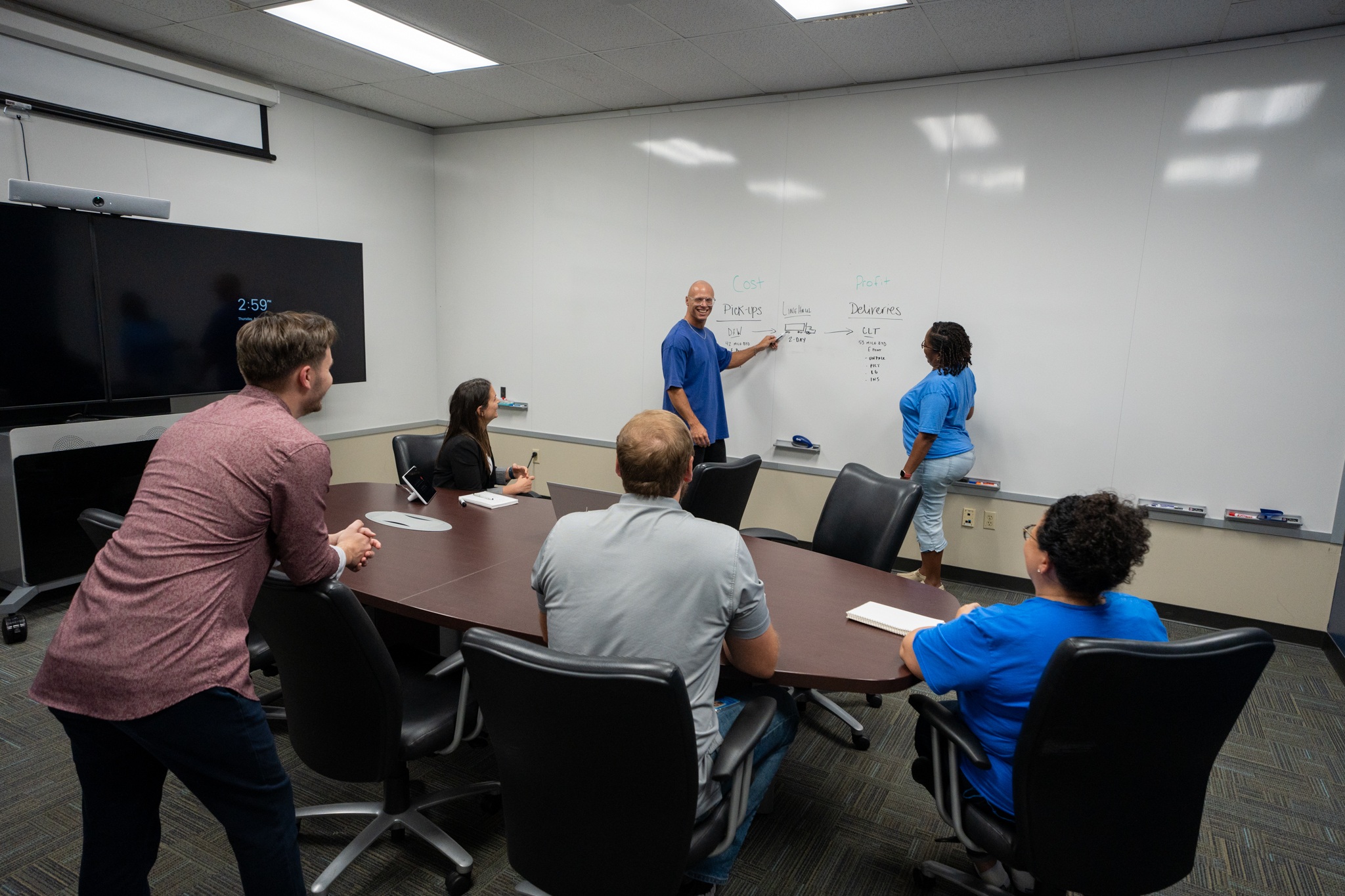
Borrow the questions before buying the service
Pegasus occupies the customized end of a market that also contains global forwarders such as DHL, DSV and SEKO. Its proposition deserves consideration when freight is attached to a launch, a sensitive installation or an expensive interruption. Routine dock deliveries with forgiving schedules may need less coordination. Accurate site information and available partner capacity remain essential; attention cannot conjure a receiving window.
The reader can copy the method immediately. Invite operations into procurement. Define successful delivery through the receiving customer’s eyes. Record the access constraints. Synchronize the installer. Agree who escalates a delay and who authorizes recovery. Pegasus’s most portable idea is that the shipment has an appointment with an entire business. The truck merely carries it there.