Consider a box of LEGO made in Vietnam and bought in Japan. The bricks may fit together beautifully. The journey requires a different sort of assembly: a factory collection, customs documents, storage, a sailing, another warehouse. Each step can work perfectly while the whole journey fails. A container can arrive on time and still contain stock that nobody can release.
- Freight, customs, warehouses: one operation.
- From LEGO to cloud infrastructure.
- CHF 1.1 billion bought Asian expertise.
- More cargo cannot guarantee profit.
This is the territory of Kuehne + Nagel. Founded as a forwarding business in Bremen in 1890 by August Kühne and Friedrich Nagel, the Swiss-headquartered group organises sea, air and road freight, runs distribution operations and manages supply chains. Its useful trick is making separate businesses behave like parts of one system. The customer buys fewer loose ends.
The bricks need another kind of assembly
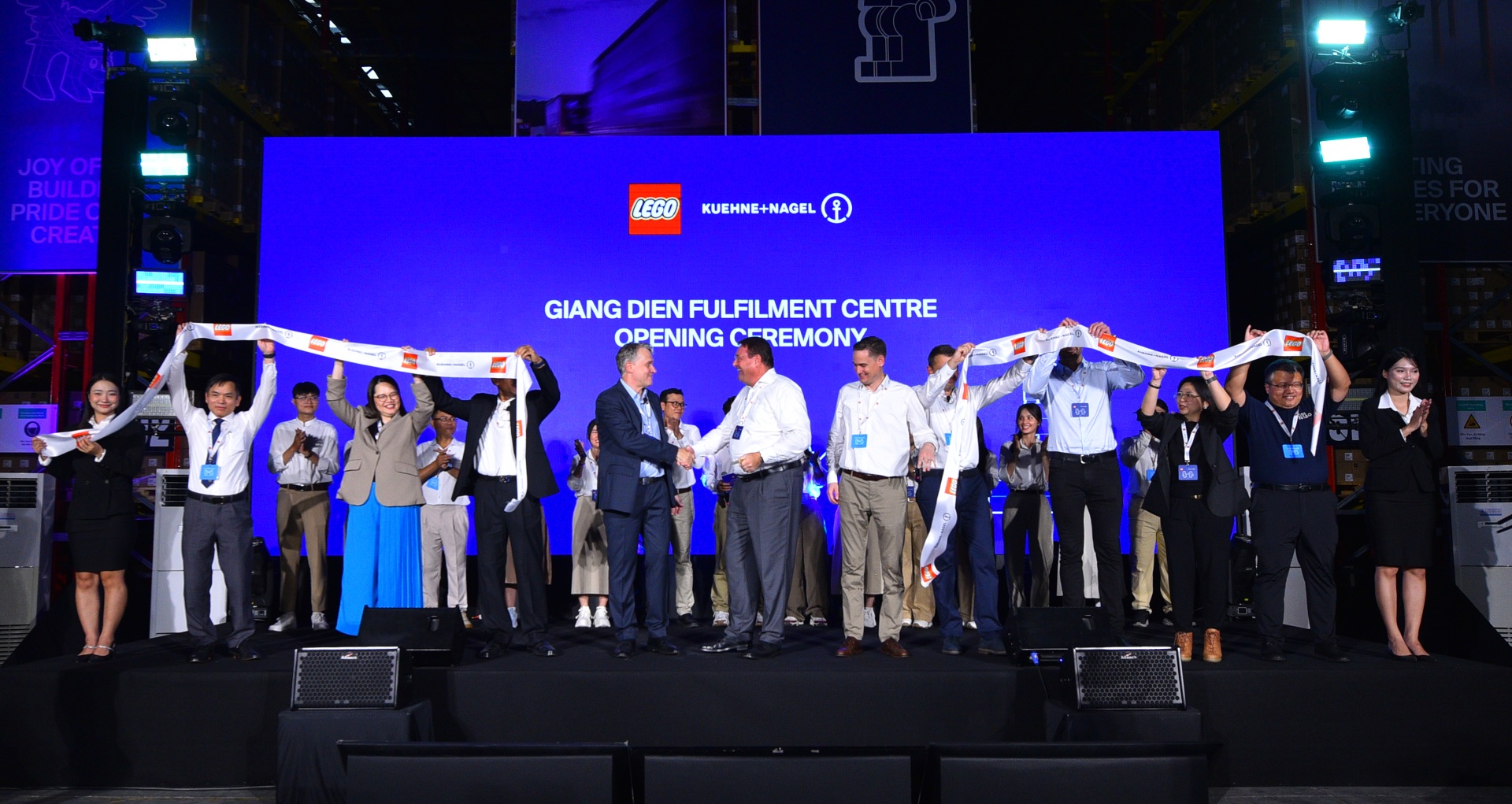
In September 2025, Kuehne + Nagel and LEGO opened a regional distribution centre in Dong Nai, Vietnam. The assignment extended from factory transport through customs clearance and bonded warehousing to sea freight and delivery into local distribution centres. Initial destinations included Japan, Australia, New Zealand, Malaysia and Singapore. This was a regional plumbing job with a very cheerful product.
LEGO’s P. Venkatram described the objective as “a shorter and more agile supply chain”. The opening announcement put the facility at 10,200 square metres, with expansion to 16,360 planned for 2026. The larger operation was designed for 33,000 pallets and more than 150 containers a week. Those were announced plans, rather than proof that every pallet position was already filled.
- 01 Factory
- 02 Customs
- 03 Bonded
warehouse - 04 Sea freight
- 05 Local
distribution
The middleman has a very large desk
Kuehne + Nagel calls itself asset-light. Much of its transport depends on outside carriers, while its own expertise sits in capacity purchasing, consolidation, documentation, handling and coordination. Freight-forwarding revenue includes transport bought from suppliers; gross profit strips out those bought-in services. Warehousing and fulfilment add another income stream. The distinction matters when a large turnover figure makes the business look richer than it is.
The company says it serves around 400,000 customers. Its portfolio reaches from smaller importers to healthcare, aerospace, automotive and technology businesses. In 2025, small and medium-sized customers accounted for half its sea freight volume. A specialist shipping a few pallets therefore belongs in the same commercial picture as a multinational moving entire containers. Less-than-container-load services combine smaller consignments into shared capacity.
Against DSV, DHL Global Forwarding and other large forwarders, the argument is breadth plus specialised execution. That advantage must be earned shipment by shipment: competitors also offer global networks. DSV completed its Schenker acquisition in April 2025, increasing the pressure. Buyers should compare actual routes, customs competence and handling requirements rather than mistake a familiar logo for a delivery guarantee.
The shortcut to Asia cost CHF 1.1 billion
Buying expertise can be quicker than recruiting it country by country. In May 2021, Kuehne + Nagel completed its majority acquisition of Apex, an Asian forwarder with strength on transpacific and intra-Asia routes. The price paid at closing was CHF 1.1 billion, financed with the group’s own funds and approximately 750,000 newly issued shares. Further purchases were subject to performance-based consideration.
Apex brought an established organisation; its management continued running the business. The transferable lesson is fairly specific: acquire the missing trade-lane knowledge, and preserve the people who hold it. It is an interpretation of the deal, not a promise that buying any forwarder will work. The network has to fill a real gap, and customers still need a coherent service afterward.
Buy the missing trade-lane knowledge. Preserve the people who hold it.EDITORIAL OBSERVATION
The volume held. The profit did not.
The uncomfortable evidence arrived in 2025. Net turnover was CHF 24.476 billion, against CHF 24.802 billion in 2024. Reported operating profit, or EBIT, fell from CHF 1.654 billion to CHF 1.242 billion. The business remained profitable, but a modest turnover decline accompanied a much sharper earnings decline. There was no need to invent a dramatic collapse; the accounts supplied a quieter warning.
The annual report describes volatile carrier capacity and rates, currency pressure and higher operating costs. The weakness was profitability, despite continued freight activity. Management responded with structural cost reductions targeting CHF 200 million. This is evidence of a changed operating response, rather than a claim about anyone’s private convictions. More shipments alone would not cure the cost problem.
By the second quarter of 2026, group EBIT had increased 11% year on year to CHF 381 million. Kuehne + Nagel raised its full-year recurring EBIT guidance to CHF 1.35-1.55 billion. Guidance is still a forecast. The quarter’s tech-sector gains included moving Google cloud infrastructure equipment from Asia to the United States. Apparently, the cloud needs quite a lot of ground transport.
Before the ship, a better question
For a customer, the practical entrance is myKN: request quotes, book freight and track shipments. Seaexplorer supplies route comparisons, vessel positions and disruption information, including comparisons of speed, reliability and emissions. A useful habit to copy is choosing the route against several constraints before booking, then watching the exceptions. The cheapest advertised sailing can become expensive once inventory waits at the wrong port.
The next assignments are revealing. A September 2026 Amazon collaboration includes AWS infrastructure construction, equipment deployment and maintenance. A CATL agreement covers battery logistics and transport electrification, including a planned heavy-truck battery-swapping pilot in China. On October 1, Kuehne + Nagel opened a Chennai tech centre, with around 250 experts expected by early 2027. It is adding engineering capacity to a business built around operational knowledge.
Even good coordination has a border
A visibility platform cannot reopen a closed port or manufacture carrier capacity. An asset-light forwarder depends on suppliers, and its low-emission options depend partly on fuel and charging availability. Book and Claim helps customers support lower-emission transport elsewhere in the network; it need not mean their own cargo travelled on that particular vehicle. The accounting mechanism and the physical journey deserve separate questions.
The long history also carries a grave obligation. In a 2015 statement, the company acknowledged transporting property confiscated from politically and racially persecuted people for the Nazi regime. An account of its commercial longevity should include that admission.
For today’s buyer, the sensible test is concrete: specify the cargo, route, deadlines and exception procedure, then compare proposals. Kuehne + Nagel is most useful where those moving parts need to work together. When the journey is simple and a direct carrier meets the requirement, elaborate coordination may add little. The point of a middleman is to remove work you would otherwise have to do.