A transport company can begin with a peculiar restraint: resist buying the transport. In 1976, Leif Tullberg and nine independent Danish trucking companies established DSV as a shared haulage office. The idea was modest enough to fit on an invoice: arrange the movement of goods, collect a small commission. Half a century later, the office has become a global network. The instinct to coordinate other people’s capacity remains.
- DSV sells freight forwarding and warehouse logistics to businesses, from small shippers to multinationals.
- Its Schenker purchase closed in April 2025 at €14.3 billion in enterprise value.
- The test is integration: expected savings are substantial, while some road operations have lost productivity.
01 / A CHANGE OF SCALEAn office before an empire
There is a temptation to tell every large company’s history as destiny. DSV’s looks more like a sequence of purchases that changed what it could offer. The 1989 acquisitions of export transport businesses opened international routes. Buying DFDS Dan Transport in 2000 added a broader logistics operation and stronger access to air freight and overseas markets. A Danish road business was acquiring reasons to think beyond the road.
The organisational response matters. In 2001, DSV separated operations into Road, Air & Sea and the business now called Contract Logistics. Frans Maas, ABX, UTi, Panalpina and Agility’s Global Integrated Logistics business followed. Each transaction added geography, customers or expertise. Schenker, acquired from Deutsche Bahn, made the exercise considerably larger. The point of buying was to extend a working network, then make the acquired operation work within it.
02 / WHAT THE CUSTOMER BUYSBuying the connections
Consider an illustrative manufacturer sending components abroad. The cargo needs collection, a carrier, paperwork, a receiving operation and delivery. DSV can arrange that chain rather than leave the manufacturer to negotiate each handoff. Air freight serves urgency; sea freight offers container options; road services connect factories, terminals and shops. Project logistics handles awkward cargo whose dimensions refuse to behave like an ordinary box.
Goods ready
Coordination
Goods arrive
Carriers provide transport capacity. Warehouses and terminals connect the journey. Simplified illustration.
The distinction is economic. DSV buys transport capacity from suppliers and sells a managed service to customers. Its asset-light model lets it adjust capacity and choose carriers without tying every decision to an owned fleet. Warehouses, terminals, employees and IT still require resources. “Asset-light” is a relative description, rather than a promise that the business can operate from a laptop and an agreeable expression.
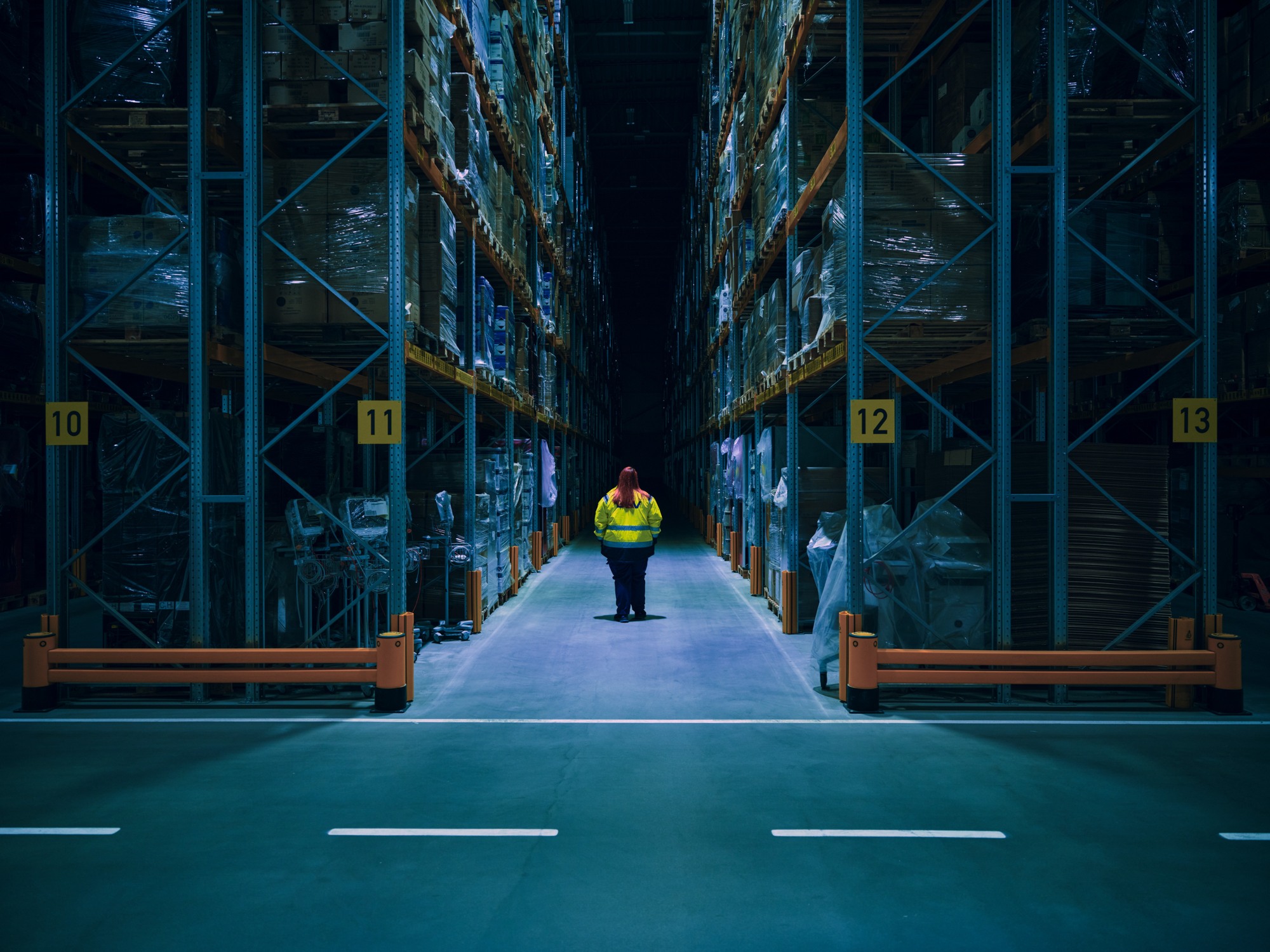
Contract Logistics takes responsibility for storage, handling and distribution. Customers span consumer goods, automotive, healthcare, industrial and technology businesses. They can book and track shipments through myDSV; digital connections help exchange logistics information with customer systems. During the Schenker transition, legacy customers still have separate login paths. A merger can produce a single corporate name before it produces a single front door.
03 / THE PURCHASE AND THE WORKA merger has two bills
The Schenker price deserves precision. At completion, DSV reported approximately €14.3 billion in enterprise value and €11.6 billion in equity value. Those numbers describe different things; neither is a shipment tariff. Financing included an October 2024 share offering that raised roughly €5 billion and a further €5 billion bond issue. This was public-market financing for an acquisition, with dilution and debt attached.
Bars share a scale. Purchase value and integration costs are transaction amounts; synergies are a recurring annual target, not realised savings.
Then comes the second bill: around DKK 11 billion in expected transaction and integration costs. DSV identified overlapping operations, facilities, back-office functions and IT as sources of savings. The initial completion announcement anticipated most integration by end-2028. Faster progress changed the timetable: by February 2026, management expected completion at end-2026 and the full annual DKK 9 billion synergy impact in 2027. The target moved because execution had advanced.
04 / WHERE THE FRICTION APPEARSThe road still needs attention
The July 2026 results supply the necessary complication. More than 60 countries had completed integration or entered the process. Yet some European road operations faced reduced productivity and network difficulties, already highlighted in the first quarter. Volume growth fell below expectations. Management changes and corrective measures followed. This is a documented trouble spot, rather than evidence that the whole acquisition failed.
“The performance in the Road division was below expectations”Jens H. Lund / Group CEO / July 2026 results
For a shipper, the practical implication is to examine the actual lane, local team and service commitment. DSV competes with global forwarders and warehouse operators such as Kuehne+Nagel and DHL; breadth alone does not settle that choice. Its distinction is the combination of acquisition experience, carrier relationships and connected services. That combination helps when handoffs are dependable. Disrupted routes, scarce capacity or a troubled local network can still undo the convenience.
05 / A LESSON FROM THE SHELFWhat the shop shelf knows
A useful counterweight to merger arithmetic is a shop waiting for its delivery. In February 2026, DSV and dm extended their German distribution agreement for six years. It covers more than 2,150 stores. The announcement describes around 1,000 deliveries and 15,000 pallets on an average day. This is the recurring, unglamorous work that makes a network worth buying in the first place.
The copyable lesson is an inference from DSV’s history: give people near the customer room to decide, while making the supporting systems repeatable. A smaller business can apply that discipline without acquiring a competitor. It works best when suppliers are reliable and responsibilities are clear. Where customers require dedicated capacity or integration overwhelms local execution, flexibility has limits. The goods, regrettably, remain unimpressed by the strategy presentation.