Two refrigerated containers needed to reach New Zealand within two weeks. In Houston, the plan met an awkward fact: there was no direct vessel option, and the conventional ocean route would take roughly 45 days. Airfreight offered another possibility, but the customer needed time and cost balanced. Scan Global Logistics had been handed the sort of problem that makes a timetable look like a work of fiction.
- The job: organise freight, storage and the awkward bits between them.
- The method: combine local specialists with a global network of carriers and offices.
- The catch: faster routes cost money; a bigger network does too.
The team collected the cargo, moved it to Los Angeles, transloaded it and put it on a vessel bound for New Zealand. Transit came down to 19 days. That was a considerable rescue, though still beyond the original request. The distinction matters. A useful forwarder improves the available choices; geography does not suddenly take orders from the sales department.
Requested: 14 days. Improvement: 26 days. Delivery still exceeded the request.
The judgment between the bookings
SGL is a freight forwarder. It arranges transport across air, ocean, road and rail, with warehousing, customs clearance, insurance and distribution alongside. Its customers buy a coordinated journey rather than assemble every supplier themselves. The company describes its model as asset-light: carrier capacity is purchased, while employees supply the routing, documentation and judgment that connect it.
The service menu ranges from shared ocean containers to whole-aircraft charters. Project teams handle oversized machinery and wind-energy equipment. Automotive specialists manage vehicle testing logistics. Digital tools let customers book shipments, track milestones, see warehouse inventory and connect shipment data to their own systems through EDI. mySGL provides a single-sign-on doorway into those tools. The software makes information easier to find; the operational service gives someone responsibility for acting on it.
Consider a hospital ship stranded in Las Palmas with generator trouble. MAN Energy Solutions, now Everllence, donated spare parts and booked SGL to deliver them. Regular cargo risked being offloaded during the holiday rush. A trainee, Nicklas Christensen, carried the parts in his hand luggage and handed them over in under 24 hours. Here, the important expertise was knowing which transport procedure could endanger the delivery.
Other assignments reveal different requirements. For Vestas, SGL supervised loading 198 wind turbine blades onto one vessel in 2019. During the pandemic, nearly 40 Polestar 2 cars needed to travel from China to Sweden for test-drive activities. Alternative modes, including road and rail, and daily coordination helped preserve the revised schedule. These customers need people who understand the cargo as well as the route.
Buying the map, keeping the people
The name arrived in 2007, when airfreight specialist Mahé and ocean forwarder ScanAm merged. Mahé’s roots go back to 1975. Modern co-founders Allan Melgaard and Jørgen Jessen had invested in Mahé in 2004. Their subsequent expansion joined complementary services and local networks, giving customers more of the journey under one relationship.
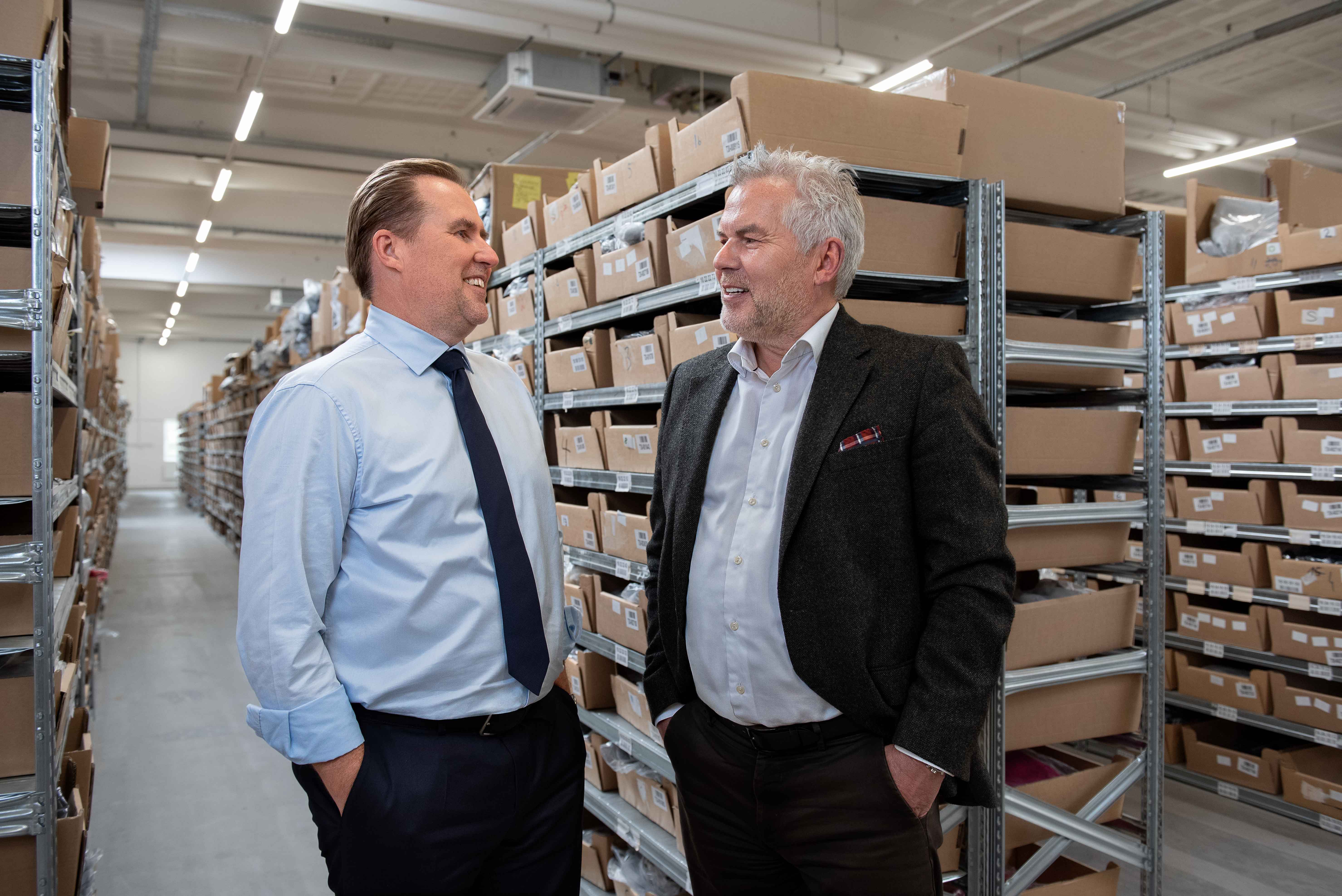
Jessen recalls that the merger was culturally challenging. That experience shaped how the company approaches integration. AEA invested in 2016, alongside the expansion involving US-based TransGroup. CVC became majority shareholder in May 2023, with AEA and management co-investing. The model depends on turning acquired offices into a connected service without losing the local knowledge that made them worth buying.
SGL’s published virtues are Respect, Integrity, Entrepreneurship and Fun. An attractive list, certainly; customer incidents give it something sturdier than typography. In an August 2026 case, a carrier serving Anchorage unexpectedly went out of business. Project manager Maritza Arteaga screened replacements for a tobacco shipment requiring specialised insurance and compliance. According to SGL’s account, the customer experienced no disruption. Freedom to act is valuable when it comes with the expertise to choose correctly.
The financing bill arrives
Expansion has a price with fewer adjectives attached. SGL’s annual report puts the Canadian ITN Logistics Group acquisition at EUR 79 million, financed partly with cash and new senior secured bonds. Fees and expenses added EUR 1 million. The transaction closed on 15 May 2025, bringing additional locations and more than 250 employees.
Group revenue reached EUR 2.526 billion in 2025, while EBITDA before special items rose from EUR 195 million to EUR 219 million. Yet the bottom line remained negative. SGL attributed the financial strain partly to debt refinancing and funding ITN. Asset-light operations still require capital, and purchased expertise comes with a bill.
€94m a year earlier
EBITDA before special items. Volume changes are year on year.
The first half of 2026 sharpened that tension. Air and ocean volumes each rose 14%, but EBITDA before special items fell to EUR 87 million from EUR 94 million. Management emphasised margins, productivity, cash generation and expanding the SME customer base. More shipments can keep an office very busy without making its economics proportionately better.
Borrow the method, price the trade-off
For buyers comparing SGL with DSV, DHL Global Forwarding, Kuehne+Nagel or CEVA, the useful test is specific: who understands this lane, this cargo and this deadline? Ask who can approve rerouting, how backups are selected and what happens when a carrier fails. In the reefer case, the team stressed limiting vendor handovers. Fewer transfers leave fewer opportunities for responsibility to disappear.
A buyer can copy that discipline before hiring any forwarder. Put the deadline, temperature requirements, customs documents and acceptable cost trade-offs in the same brief. Then request an alternative route with its extra handling spelled out. A low freight quote is difficult to judge if the necessary inland leg or storage has been left outside it. SGL’s digital booking and reporting tools support that conversation, but a dashboard cannot choose the customer’s priorities. The reefer shipment illustrates the decision: preserve an ocean-based solution, change the gateway and accept a journey longer than originally requested. The lesson is to make that compromise visible before the cargo moves, rather than discover it when the promised arrival date has passed.
“When too many people are involved, things can go wrong.”Jairo Alberto / Airfreight Team Lead, SGL
The approach suits complex jobs requiring coordination. It offers less obvious value when a routine shipment needs only the cheapest standard service. Alternative gateways require capacity, money and feasible handling; cold cargo adds temperature constraints. SGL’s September 2026 agreement with Cycle & Carriage brings the same practical question to autonomous electric cargo transport in Singapore. A supervised trial is planned for the fourth quarter, subject to final approval. The proof will be an actual route working reliably. That remains the freight forwarder’s examination, whatever is driving.