ASUS has a recurring answer to the question of what a computer should look like: try moving something. Shrink the whole machine. Give it game controls. Add another screen where the keyboard used to sit. The 2026 Zenbook DUO, with two 14-inch displays and a detachable keyboard, is the latest expression of that restlessness. Open it on a table and the ordinary laptop becomes a small, portable workstation. The coffee cup suddenly has competition for space.
That instinct connects products which otherwise look as though they belong to different companies. ASUS sells motherboards to people who enjoy assembling a PC, gaming machines to people chasing performance, and business hardware to organizations that need fleets of computers to behave predictably. The interesting thread is the engineering: taking available computing technology and arranging it around a particular irritation, ambition or budget.
It is a useful way to understand a business whose catalog can feel like an electronics department with its own passport. The catalog also carries a warning for its maker. Every extra hinge, product family and software layer creates another thing that must work after the launch presentation ends.
The little computer that escaped the desk
The company began in Taipei in 1989 with four engineers: T.H. Tung, Ted Hsu, Wayne Hsieh and M.T. Liao. ASUS’s own history places the original conversation in a coffee shop and describes an ambition to build a “small and beautiful company.” Its first work was less photogenic than a modern laptop: motherboards, the circuit boards that let the processor, memory and other components operate together.
ASUS says its early boards reached products from IBM and ALR. That is the important part of the origin story. Before it could persuade shoppers to recognize a name on a lid, it had to make equipment that other computer businesses could use. The brand grew from a component whose success depended on fitting into somebody else’s system.
The consumer breakthrough came with the Eee PC in 2007. A contemporary WIRED review put the 4G model at $399 and described the limits as plainly as the appeal: little storage and a cramped keyboard, packaged in a highly portable machine. This was a computer purchased partly for what it left out. People could buy enough computing for modest tasks without buying a conventional notebook.
The bargain had an expiration date. ASUS ended Eee PC production in 2013 as buyers moved toward tablets and Ultrabooks. Portability remained desirable; this particular compromise became less compelling. The commercial lesson is wonderfully unforgiving: solving a problem once does not give a product permanent rights to the customer.
Selected product milestones. Different shapes, different jobs.
A different front door for every buyer
ASUS now gives those jobs different names. Republic of Gamers, established in 2006, addresses an audience interested in gaming performance and the surrounding equipment. ProArt addresses creators. ExpertBook and ExpertCenter organize its commercial PC offering. Zenbook and Vivobook cover different parts of consumer computing. Those divisions help explain the catalog more usefully than a single ranking of good, better and expensive.
A colorist and a competitive gamer may both want an excellent monitor, but they are buying different outcomes. ProArt’s calibration software lets owners of supported displays adjust brightness, color gamut and other settings. ASUS’s work with Portrait Displays adds another connection to professional color workflows. The value lies in helping a creator trust what appears on screen, whether the task is editing photographs or preparing video.
The money mostly comes from selling physical products through retailers, distributors, business partners and ASUS’s own stores. Enterprise solutions and software services broaden that model. This remains a business where a customer can buy one laptop, a box of components or an organizational deployment. Pricing, purchasing cycles and support expectations change with the buyer.
Its alternatives change, too. A laptop shopper may compare Lenovo, HP, Dell, Acer or Apple. A component buyer encounters MSI and Gigabyte. A handheld buyer looks at Valve and Lenovo. ASUS’s practical distinction is its reach across components and finished machines, combined with a willingness to try unusual formats. That gives shoppers more options; it also makes the exact model more informative than the logo.
Two screens have to earn their keep
The Zenbook DUO turns a familiar office habit into hardware: keeping one thing visible while working on another. A document can sit beside reference material. A call can remain open while notes occupy the other display. In its January 2026 announcement, ASUS specified dual OLED touchscreens, a 99Wh battery system and a keyboard that docks between the panels for transport.
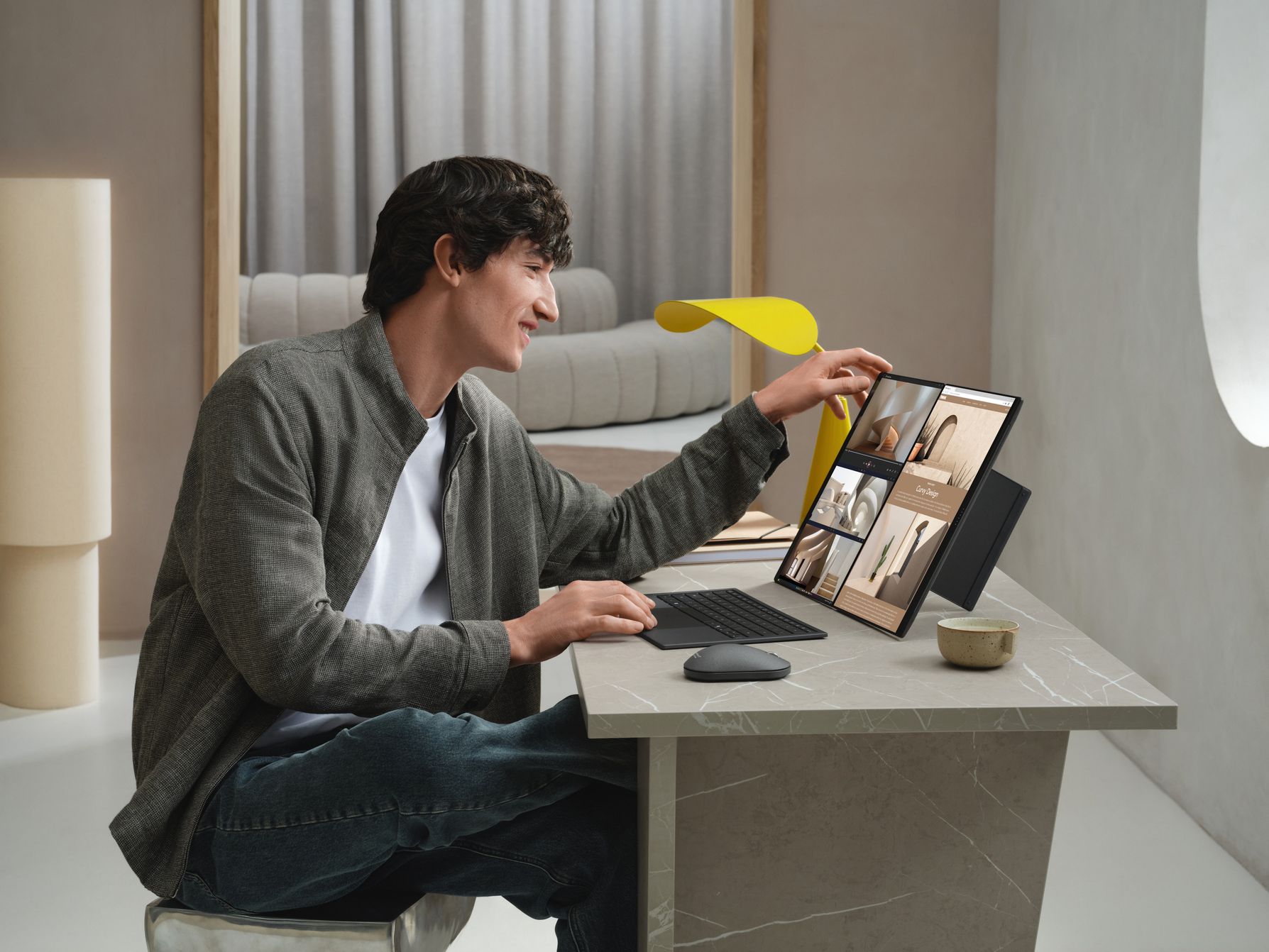
There is a sensible purchase hiding beneath the spectacle. Someone who regularly works away from a permanent desk might value the second screen. Someone whose day consists of one document and a browser may get less from it. The useful comparison is the work accomplished in the space available, including how often the machine must be packed up and carried.
This is also a clue to ASUS’s stated culture. Its careers material describes design thinking around user needs, technical feasibility and business viability, supported by workshops and annual contests. As a method, that is easy to borrow: observe an awkward task, make a working alternative and check whether anyone values the improvement. A prototype can prove that something is possible. The customer decides whether it deserves a place in the bag.
The handheld comes with a software partner
The same logic travels into gaming. With the ROG Xbox Ally family, ASUS and Microsoft combined a handheld PC with a Windows and Xbox experience. Microsoft announced US estimated retail prices of $599.99 for the Xbox Ally and $999.99 for the Ally X ahead of the October 2025 launch. Those are dated launch figures, not a promise about today’s checkout price.
Announced US estimated retail prices, September 2025. USD; regional prices vary.
The partnership distributes the work: ASUS builds the hardware, Microsoft supplies the operating-system and Xbox experience, and AMD supplies the processor platform. The appeal is access to PC gaming in a handheld form. The ownership question is whether the games and services a particular person uses fit comfortably into that experience.
ASUS has used partnerships in less conspicuous corners, too. Intel’s NUC compact-PC business moved to ASUS through a non-exclusive design-license arrangement announced in 2023. Intel later transferred support for NUC 7 through NUC 13 systems in January 2024. In that case, continuity matters as much as novelty: a small office computer needs someone to answer for it after the original supplier changes course.
The awkward part arrives after checkout
Hardware ambition has produced ownership problems as well as interesting machines. For the original ROG Ally, ASUS published a US response to SD-card-reader failures that extended reader coverage and offered reimbursement for qualifying damaged cards. It is a specific example of a small component becoming a large part of the experience.
Service itself needed attention. In June 2024, ASUS apologized for repair communications and service that had fallen short. Its subsequent US updates described clearer repair quotations and better documentation. By June 2026, the program included guided repair assistance for selected notebooks, greater access to genuine parts and pre-shipment photo uploads.
“Our RMA communications and repair services have not consistently met the high standards we aim for.”ASUS Service team · June 14, 2024
The published changes respond to customer feedback; they should be judged by what happens in individual cases. The lesson other businesses can copy is concrete: make covered and chargeable work understandable, preserve evidence of a device’s condition and give people a route to resolve a dispute. An inventive machine still needs an intelligible repair bill. For buyers, regional coverage and model-specific parts access belong in the decision alongside the specifications.
The next shape is a room full of computers
The scale is already substantial. ASUS reported 2025 consolidated revenue of NT$738.904 billion, alongside NT$625.038 billion on a separate-company basis. These are different reporting scopes and should not be added together. ASUS was publicly listed in 1996; this is a mature hardware company, not a young venture-funded experiment.
Group revenue, rounded. Reported March 10, 2026.
On September 3, 2026, ASUS presented an integrated AI-infrastructure approach in Seoul, bringing together computing, networking, storage, deployment software and operational controls. NVIDIA, Schneider Electric and IBM were among the partners involved. The proposed value is less time spent assembling the surrounding system before an organization can put AI computing to work.
That proposition has demanding conditions. Power, cooling, facilities and ongoing operations matter alongside the processors. Buying capacity does not establish that a business has a useful workload for it. ASUS’s expertise in system integration gives it a relevant role, but customers still need to justify the installation against their own work and costs.
The reach now includes healthcare. On September 8, ASUS announced a Medical Fair Asia showcase covering clinical displays and AI-assisted applications, including expansion in Southeast Asia. It is another setting where the company’s familiar skills in displays and computing meet buyers with quite different requirements.
Across these markets, the useful ASUS idea stays recognizable: begin with what people are trying to do, then reconsider the arrangement of the machine. Sometimes the answer is a smaller computer. Sometimes it is two screens. Sometimes it is a rack. The lasting test is whether the arrangement remains useful when the novelty wears off.
Open another window
Explore ASUS products, Republic of Gamers, the ASUS newsroom and Edge Up product stories. For ownership help, visit ASUS service updates and financial results.
Watch the official Zenbook DUO teaser and ROG Xbox Ally product trailer. Follow ASUS on LinkedIn, X, Instagram, Facebook, YouTube and TikTok.