The useful way to understand HONOR is to begin with the thing that broke. It was not a hinge, a screen or consumer demand. It was access. By 2020, export restrictions on parent company Huawei had made chips, software and other technical components persistently difficult to obtain. A phone company can survive a weak camera review. It cannot ship a camera phone without the parts or services that make it work.
Huawei chose the corporate equivalent of an emergency ejector seat. It sold all HONOR business assets to Shenzhen Zhixin New Information Technology, a company assembled by more than 30 agents and dealers. Huawei said it would keep no shares and take no role in the new company's management. The official price stayed private; Reuters reported that sources expected a transaction around RMB 100 billion, then roughly $15 billion.
That is the origin story of the HONOR now headquartered in Shenzhen: a consumer-electronics maker with Android phones at its center, flanked by foldables, tablets, laptops, watches, bands and earbuds. The name dates to 2013, when Huawei created HONOR for younger, online-first buyers. Independence arrived seven years later. It preserved a brand that Huawei said was shipping more than 70 million phones annually before the sale, and gave suppliers and retailers a business worth reconnecting.
The rescueA supply chain bought its own customer
The sale was unusual because the rescue party included the channel. Dealers and agents did not merely wait for a new owner; Huawei said they first proposed the acquisition. Their logic was brutally practical. HONOR represented inventory, store traffic, supplier orders and customer relationships. Allow the brand to wither and everyone around it lost something.
The 2020 survival loop
What changed Huawei's mind was not a fashionable theory about corporate focus. Its statement pointed to the persistent unavailability of technical elements and pressure on the consumer business. Selling HONOR was meant to help channel sellers and suppliers survive. The distinction matters: this was less a breakup over creative differences than a controlled amputation to save a commercially healthy limb.
“This sale will help Honor's channel sellers and suppliers make it through this difficult time.”Huawei statement, November 2020
The strategy worked under specific conditions. HONOR had a recognized brand, real distribution, retained engineers and enough customer demand to justify the disruption. Independence also had to change how suppliers treated the company. A spinout without those ingredients is paperwork with a launch party. If the product has lost demand, the channel is weak, or the constraint follows the spun-out business, a new cap table cannot manufacture a comeback.
The productsHardware is still the receipt
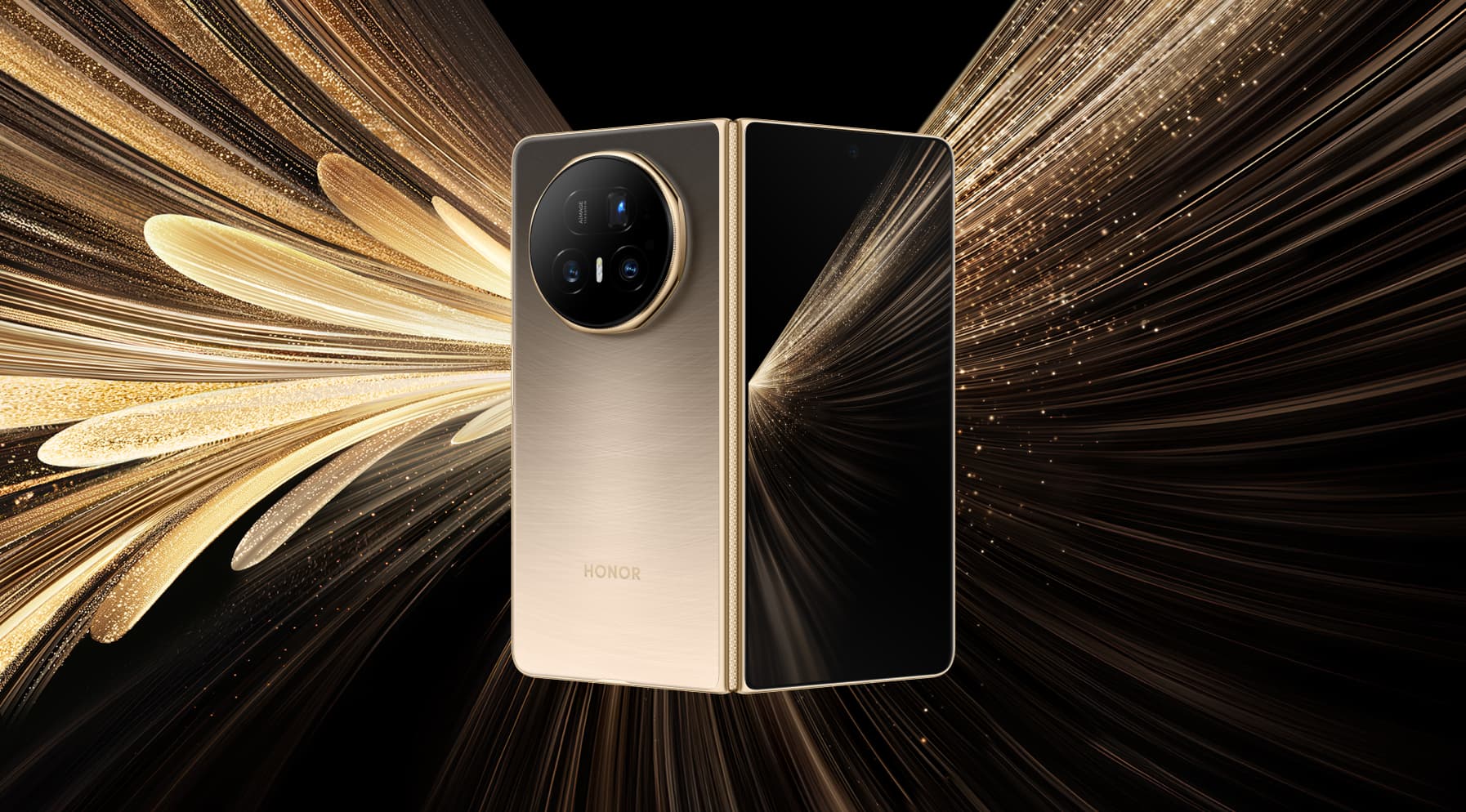
HONOR may now call itself an AI-device ecosystem company, but customers still meet it through a box. The Magic line carries the premium argument: flagship slab phones and book-style foldables with ambitious cameras, bright displays and thin industrial design. The Number series aims for accessible flagships, while X-series models occupy lower price tiers. MagicPad tablets, MagicBook laptops and wearables extend the relationship beyond the phone.
The Magic V foldables best explain what HONOR knows. A folding phone is a negotiation among thickness, battery capacity, hinge strength, screen protection, heat and weight. HONOR repeatedly pushes the thinness side without treating the device as jewelry. Its 2025 Magic V5 paired an 8.8-millimeter profile in one color with a 5,820mAh silicon-carbon battery and IP58/IP59 ratings. In 2026, Magic V6 carried the same design thesis forward.
Its software layer is MagicOS, built on Android for international models. The useful pitch is not that every menu contains “AI.” It is that the phone can summarize, translate, edit photos, understand what is on-screen and pass work among devices with fewer awkward handoffs. Google Gemini supplies a familiar assistant on recent flagships. Qualcomm supplies the silicon and on-device AI machinery. Microsoft matters on the PC side. HONOR's role is orchestration.
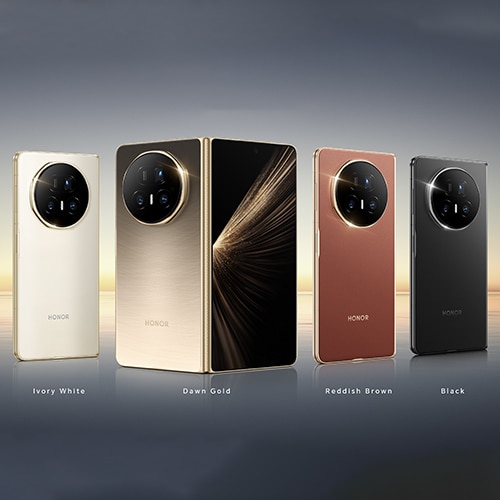
For customers, that can mean a premium Android alternative to Samsung, Google, Xiaomi, Oppo, Vivo, Huawei or Motorola, depending on the market and budget. HONOR's hardware is sold through its websites, carriers, distributors and retailers. The company does not publish a clean revenue breakdown, but the economic engine is device sales. Software and services help retention; accessories and adjacent devices increase the value of each customer relationship.
The crowded middle of the phone market
Indicative 2024 global shipment share ranges assembled by GSMA from major trackers. Ranges vary by quarter and methodology.
That chart explains the strategic pressure. Apple and Samsung operate at a scale HONOR does not. Xiaomi, Oppo, Vivo and Huawei make the Android field ferociously crowded. A vendor in the middle can be squeezed between cheap competent phones and expensive ecosystems with deep loyalty. Thin foldables create distinction, but a hardware trick is copied. HONOR needs a reason for the laptop, watch and tablet to belong together.
The second actAn ecosystem assembled by treaty
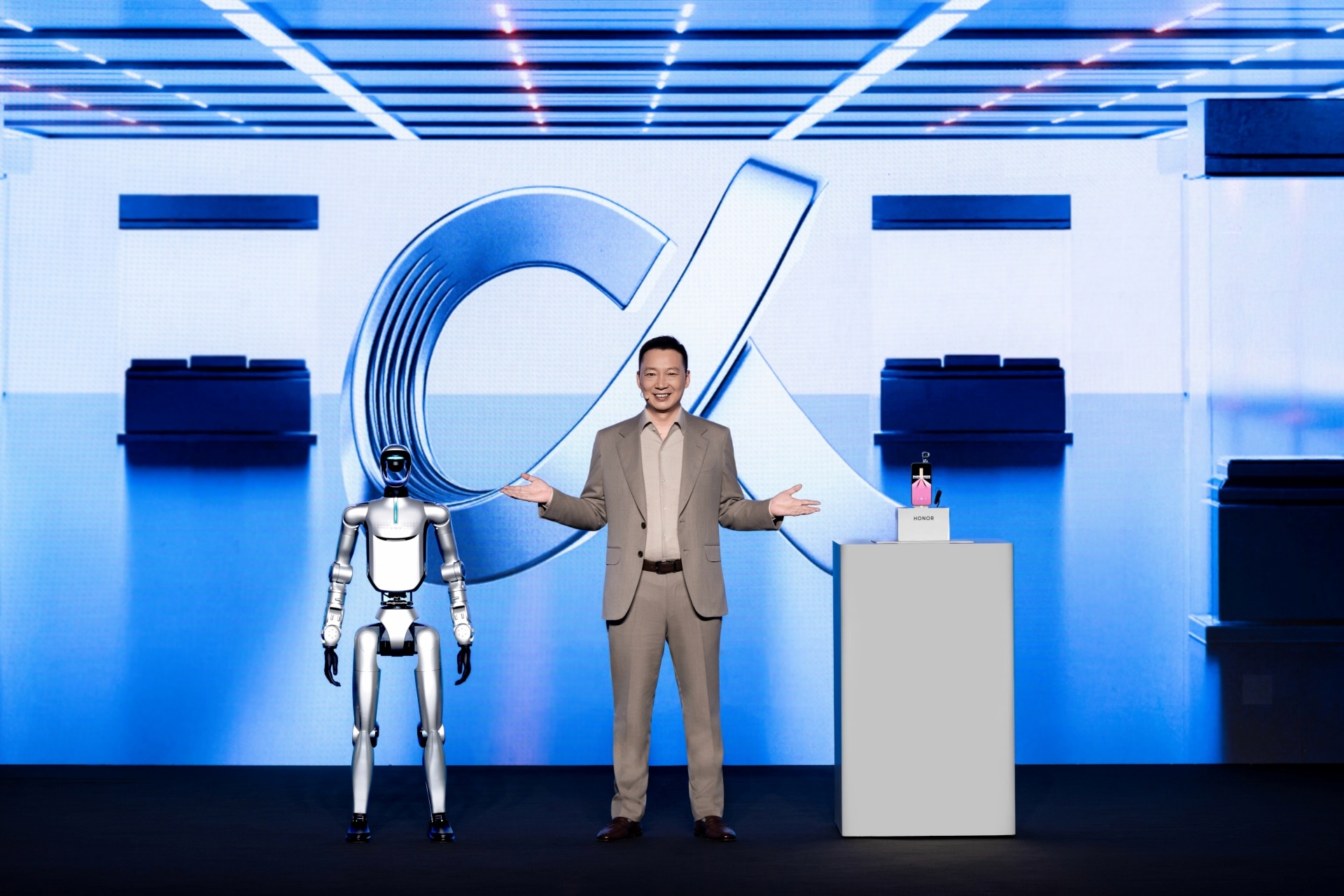
At Mobile World Congress in 2025, HONOR named that reason the ALPHA PLAN. The three-step roadmap proposes a shift from phone maker to AI-device ecosystem company and eventually to a broader intelligent world. The language is grand. The operating choice beneath it is more grounded: build an open system by collaborating with companies that already excel at models, clouds, chips, operating systems and creative tools.
This is how HONOR differs most clearly from Apple. Apple owns the important layers and makes the walls attractive. HONOR cannot reproduce that structure, so it argues that walls are the problem. Google Cloud and Gemini provide AI reach. Qualcomm contributes compute. Microsoft connects the Windows PC. In 2026, cinema-camera company ARRI agreed to bring its image science toward future HONOR consumer devices. Porsche Design adds a premium design halo. Nokia has a 5G patent cross-license.
The strategy is not “we invented every layer.” It is “we made the layers behave like they have met before.”
There is proof behind parts of the pitch. HONOR ships a multi-category portfolio, has made Google AI features visible on devices and has a record of demanding physical engineering. Its seven-year Android OS and security commitment for eligible Magic flagships, beginning in EU markets with the Magic7 Pro, is particularly concrete. Longer support makes an expensive phone easier to trust, reduces the penalty for keeping it and answers a standard criticism of smaller Android brands.
There are also promissory notes. Agentic assistants that act across services, context that moves safely between competing ecosystems and a “Robot Phone” with a movable, spatially aware camera all demand more than a polished demo. They require permissions, privacy, durable APIs, battery discipline and regional service availability. The robot concept is amusing precisely because the camera bump appears to have developed career ambitions. It is still a concept, not evidence of a mass market.
Shipping now
Phones, foldables, tablets, PCs, wearables, MagicOS, Gemini integrations and a longer support policy on eligible EU flagships.
Still to prove
Seamless agency across brands, broad regional parity, a business beyond hardware margins and whether embodied-AI concepts solve daily problems.
The operator's noteWhat another company can steal
HONOR's story does not offer a universal recipe, but it does offer a sharp diagnostic. Find the dependency that can kill the company before polishing the features that merely improve it. In 2020, component access outranked camera quality. Once the existential constraint was named, the ownership structure became a product decision.
The copyable playbook
- Map the whole network. A brand can be worth saving because retailers, suppliers and users rely on it, even when its parent is constrained.
- Make the separation legible. A half-independent spinout would not have reassured suppliers. Huawei publicly said it kept no stake or management role.
- Rebuild with complementary giants. HONOR competes in devices and partners for Android, cloud AI, chips, PC software and image science.
- Turn trust into a product feature. Seven-year support is specific, testable and more useful than another adjective attached to AI.
- Separate proof from prototypes. Thin foldables ship. Cross-ecosystem agents and robot phones still have to earn their nouns.
The playbook fails when independence does not remove the constraint, when the old parent was the only source of trust, when channel partners have no capital or patience, or when suppliers see little volume worth recovering. It also weakens if “open” becomes a euphemism for inconsistent. Customers do not experience organizational philosophy. They experience whether a file transfers, whether a feature exists in their country and whether the phone receives an update three years later.
HONOR's culture statements emphasize consumer focus, hard work, simplicity, openness and innovation. The company reported more than 14,000 employees worldwide by December 2025. That is enough scale to engineer devices and support many markets, but not enough to waste effort pretending it should build everything. The partnership strategy is therefore not just philosophical. It is an allocation choice.
The next test is coherence. HONOR has strategic investors including China Mobile, China Telecom, a CICC Capital unit, Cornerstone, Shenzhen's SDG Group and a channel-partner platform; all disclosed investment amounts remain private. It has also discussed pursuing an initial public offering without announcing a completed listing. Capital can fund research, stores and geographic expansion. It cannot make six devices feel like one.
Where it fitsThe capable challenger with an escape story
HONOR sits in a useful market position: large enough to attempt difficult hardware, smaller than the two global leaders, newly independent enough to move quickly and Chinese enough to face geopolitical questions it cannot design away. It sells to consumers who want Android choice, premium cameras and ambitious industrial design, especially in Europe, China, Latin America, the Middle East and Asia-Pacific. Its limited official presence in the United States remains a ceiling on global mindshare.
Its best advantage is not independence by itself. It is the institutional memory of a giant phone operation combined with the urgency of a company that has already watched an external dependency become existential. That history makes the open-ecosystem language less decorative. HONOR knows what a closed gate costs.
Now it must prove the inverse: that many open gates can lead somewhere coherent. If a Magic phone can make a Windows laptop, a tablet, a watch and partner AI feel like one calm experience, HONOR has a position beyond “another good Android brand.” If not, it will remain a talented hardware maker with excellent hinges and a conference vocabulary. Either outcome is more interesting than the company that almost disappeared in 2020.