A phone costing ₹1,299 is an unlikely place to look for a new chapter in technology. It has no ambition to fill a cinema screen with its camera samples. Its owner can press actual buttons. In May 2023, Ravi Kunwar was discussing precisely such a device, the Nokia 105, and a feature that gave this modest object a different kind of usefulness: access to India’s UPI payments system.
The Nokia 106 4G joined it at a launch price of ₹2,199. Kunwar’s team had spent three to four months working on the payments project with ecosystem partners. The work began with a category that was easy to overlook. He estimated then that India had close to 250 million active feature phones. Those were people already carrying a device, with everyday needs that a better camera would do little to answer.
The attraction of that episode is its scale of attention. An executive can spend his time pursuing the customer who wants another upgrade. Kunwar was looking at the customer whose existing kind of phone could be made more useful. A keypad, apparently, had further business to attend to. For him, the basic phone remained a place to work.
Nokia 105’s announced price when UPI arrived on the device.
A career on both sides of the logo
Kunwar brings a mechanical engineering education and an MBA to a career across Samsung, Nokia, Microsoft, and HMD. His engineering degree is from Manipal Institute of Technology; his MBA in marketing is from BIMTECH. The combination sits neatly beside his work in sales and business operations: understanding a manufactured object, then understanding how it reaches a buyer.
He joined HMD in December 2016 and went on to oversee its Pan-Asia business. Before HMD, he was Microsoft India’s director of sales and marketing for mobile devices and services. His earlier employers also included Nokia and Samsung. These are distinct businesses, with different histories, but mobile devices and their route to market provide a thread through his working life.
In 2023, HMD put him in charge of its Indian operations. He moved from Singapore to India to work more closely with the local business. Sanmeet Singh Kochhar continued handling exports from India within his wider responsibilities. The change brought Kunwar nearer the market that now features so prominently in his plans. A regional title can cover a considerable map; the move gave it a very particular centre.
- Before HMDSamsung · Nokia · Microsoft
- December 2016Joins HMD; later leads Pan-Asia
- May 2023Takes charge of India operations
The price on the box is only the beginning
That same year, Kunwar was addressing another obstacle between a customer and a smartphone. HMD EasyPay, developed with DMI Finance, offered a digital, paperless financing route for Nokia smartphones. In a November interview, he described a process that could start in a retail store, with loan terms adapted to the individual applicant. Affordability was a matter of how the purchase happened as well as what the handset cost.
The arrangement had conditions as well as convenience. Kunwar explained that HMD’s Softlock technology could be activated following payment default, allowing the device to serve as collateral. The programme belongs in his story because it exposes the work behind an accessible price: lenders, retailers, risk controls, and repayment terms. The cheerful price sticker has quite a supporting cast.
By December 2023, he was arguing that wider availability of 5G phones below ₹10,000 would help determine the Indian market’s momentum. He also saw opportunity among people replacing phones bought in 2020 and 2021, including in the ₹10,000 to ₹20,000 bands. His position allowed for different budgets. A useful market strategy has to leave room for the customer whose ceiling stays firmly where it is.
An engineer’s answer to a cracked screen
When HMD prepared to introduce its own smartphones in India, Kunwar gave repairability a place in the pitch. In 2024, he described designs intended to make battery and screen replacement easier. He connected that work to familiar service problems: those two components, he said, accounted for nearly 70 percent of complaints at the company’s customer care centres. It was a claim about HMD’s experience, rather than a measurement of the whole industry.
The Crest and Crest Max 5G arrived in India in July 2024, with announced prices of ₹12,999 and ₹14,999. HMD later listed both in its guide to repairable smartphones and published a dedicated repair guide. That document asks users to prepare the necessary tools and spare parts and work on a flat, clean surface. There is something pleasantly unglamorous about a phone company discussing the state of your table.
Repairability adds another question to the buying decision. How easily can this object return to use when something goes wrong? It makes the ownership period part of the product’s appeal. Kunwar’s commercial argument gives that question a concrete setting: affordable smartphones, customers who need value, and devices designed with replacement of parts in mind.
A reading of the themes in Kunwar’s public work, rather than a product guarantee.
India as a workshop, as well as a market
The manufacturing side of Kunwar’s work starts well before a finished phone meets a retailer. In May 2023, he was calling for India’s mobile manufacturing ecosystem to move beyond locally sourced batteries, chargers, and cables. HMD was engaging global manufacturing partners and suppliers, with Dixon and Lava among the contract manufacturers making its devices in India. He wanted local production to compete against international benchmarks.
In April 2024, he said HMD would consider sourcing semiconductor chips from India if they met its quality and cost requirements. He also described plans to increase local component sourcing from its then-current level of 50 percent. The qualification matters. Manufacturing ambition still has to survive the arithmetic of price and the discipline of product quality.
This makes his India-first language more substantial than a launch location. It includes sourcing decisions, supplier relationships, and the possibility of exports. A phone meant for an Indian buyer can also be part of a wider production system. Kunwar’s role connects those scales: the amount someone can afford at the counter and the economics of making devices for markets beyond that counter.
Cricket, classrooms, and the life of a device
Away from work, Kunwar is an avid cricketer who enjoys mountain travel. Those interests give a little texture to a biography otherwise full of regions and responsibilities. In interviews about leadership, he has described building teams with complementary skills and treating limitations as opportunities to improve. They are his stated principles, and they fit a job dependent on many people doing different things well.
One of HMD’s partnerships also brings cricket into the picture through the Shikhar Dhawan Foundation. Discussing digital literacy in February 2024, Kunwar described device distribution for disadvantaged students, including at NeeV, a learning centre in Gurugram. He said the collaboration had included more than three distribution drives, with Nokia phones and tablets worth over ₹35 lakh, beginning in October 2022.
His account extended beyond handing over hardware. He discussed following students’ learning and teaching responsible disposal of devices and awareness of electronic waste. There is a common concern here with repairability: what happens after the first exciting moment of receiving a phone? In a classroom, the answer involves learning and continuing support. For an owner, it involves keeping a useful object working. Both require attention after the photograph has been taken.
A new name needs an introduction
HMD’s own name has to earn recognition in a market where Nokia’s is already familiar. Kunwar has been involved in introducing that identity through products and campaigns. In a public LinkedIn post about a conversation with actor Sanya Malhotra and presenter Shibani, he discussed the HMD Vibe 5G and the ISSA Vibe campaign. His emphasis there included individuality and self-expression, alongside the device itself.
The marketing has several routes. In April 2026, he described smartphone campaigns using digital channels, OTT, and e-commerce, while feature phone campaigns leaned on print, radio, and local outreach. Retail visibility and in-shop branding also had a role. HMD’s association with Rajasthan Royals added sports marketing to the mix. Different customers encounter a brand in different places; Kunwar’s approach acknowledges that practical inconvenience.
The result is a busy balancing act. Nokia supplies a familiar association, while HMD asks buyers to recognise another name. A retailer’s display, a cricket partnership, and an actor’s campaign serve different purposes in that introduction. Kunwar’s working world includes all of them. Selling a phone involves the moments before anyone reads its specifications.
The language of the next phone
In May 2026, HMD launched the Vibe 2 5G with Sarvam AI integration, a starting launch price of ₹9,499, and distribution through Flipkart. Kunwar said users could interact with the AI in 22 Indian languages, including local dialects and English. The phone also incorporated the Department of Telecommunications’ Sanchar Saathi initiative, which he discussed in relation to digital safety.
The language emphasis gives his earlier feature phone work a new setting. In the payments project, the question was how to bring a useful service to an inexpensive device. Here it is how to bring an interaction closer to the way a customer speaks. The technology is different, but the focus on access is recognisable. Language can be as consequential to usefulness as the network generation printed on the box.
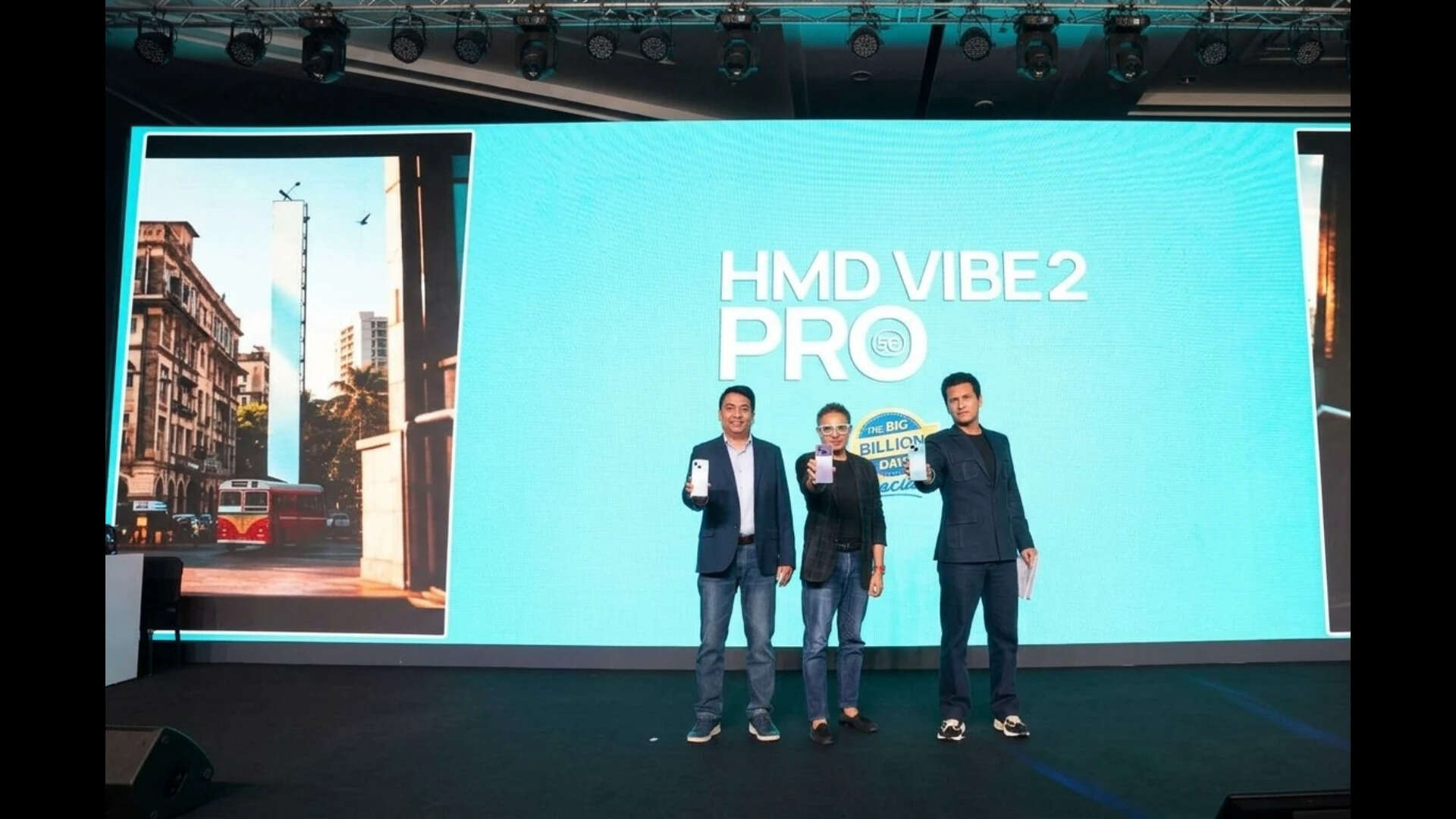
At the Vibe 2 Pro launch in September 2026, Kunwar described an ambition for HMD’s smartphone strategy to be shaped in India and taken to other markets. The immediate focus included the ₹10,000 to ₹20,000 segment. He also stressed that familiarity with Nokia could prompt a first purchase, while the product itself had to earn the next one. A remembered name offers an opening; a working phone has to justify returning.
“Everyone will come up with a spec sheet.”
Ravi Kunwar · September 2026
The customer gets the last word
Kunwar’s career offers a useful view of what happens between an idea for a device and its place in somebody’s pocket. His responsibilities have involved regional expansion, local operations, manufacturing relationships, financing, and brand building. None of those jobs can be completed by choosing a handsome logo. Each puts a different constraint around the product and a different obligation on the team selling it.
His projects also resist a tidy division between old and new technology. The feature phone gains payments. The smartphone gains a repair guide. AI gains Indian-language interactions. Taken together, they suggest an executive interested in the practical distance between a capability and the person who might use it. Each project addresses a different obstacle in the daily use of a device.
The Nokia 105 makes a fitting place to return. Its 2023 price was small enough to disappear beside the cost of a premium handset, yet the project around it took months of coordination. Kunwar’s story lives in such details. The phone may be basic. The work of making it useful can be complicated, and the owner has every reason to expect that work to have been done.