A processor can be a perfectly good processor and still be the wrong processor. Put it beside the wrong motherboard and two expensive purchases become a problem neither product review, read separately, quite explains. Building a computer means buying a collection of relationships: this socket, that memory, enough power, enough room. For the person assembling it, choosing the pieces is part of the pleasure. For a retailer, that pleasure creates an unusually demanding customer.
- Newegg grew around people who wanted components instead of complete computers.
- Its useful tools put compatibility and purchasing in the same place.
- Thin margins and a public returns dispute expose the cost of getting that relationship wrong.
01 The customer wanted the pieces
Before Newegg, there was ABS, which sold assembled computers. Customers kept asking for individual components. The business was organized around complete systems; the requests suggested another business hiding inside it. Fred Chang, Ken Lam and Howard Tong helped create the component retailer that became Newegg. A 2006 Los Angeles Business Journal retrospective put the starting capital at $100,000. Newegg dates its launch to 2001.
The name suited the moment. After the dot-com collapse, an egg suggested a fresh beginning. But the customer proposition was concrete: make the parts available, describe them properly and deliver them. Someone who cared enough to choose a particular graphics card could care a great deal about the specification beneath its photograph.
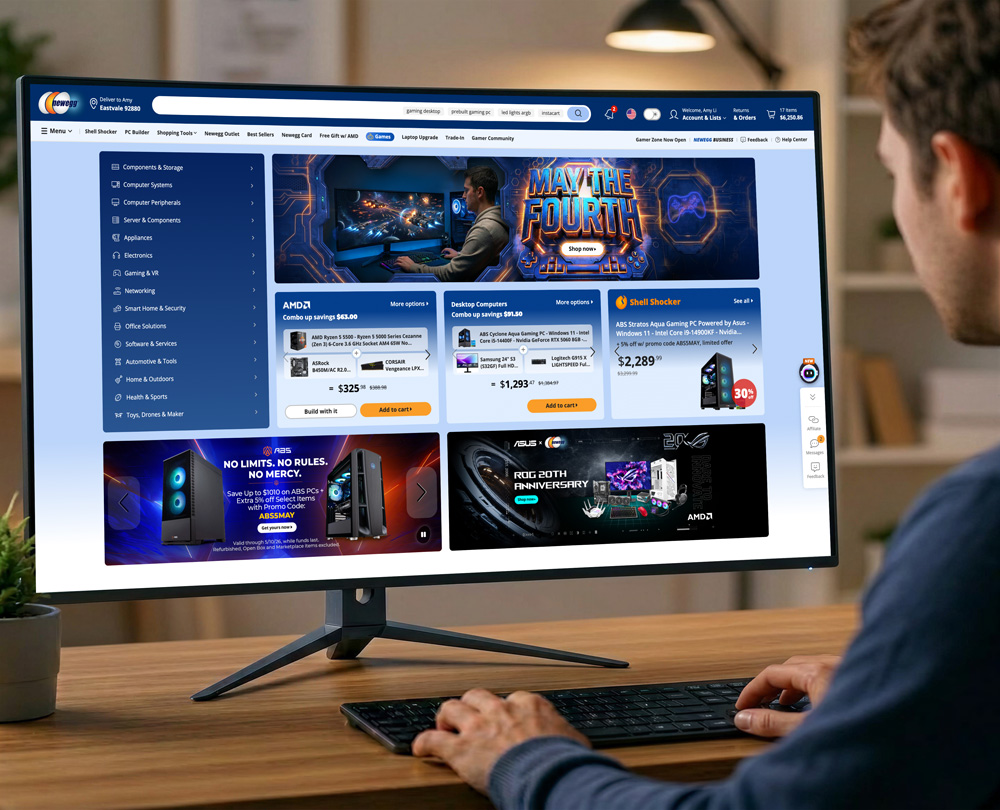
02 A shopping cart with consequences
Today, that proposition includes PC Builder, introduced in June 2020. Choose a component and the tool filters out incompatible choices as the build develops. You can change parts, adjust the cost and buy the resulting selection. It addresses a problem that an ordinary search box leaves with the shopper: individually sensible purchases can make a nonsensical computer.
“The Newegg PC Builder is a direct connection to our DIY roots”
Anthony Chow · PC Builder launch, June 2020
Newegg also sells complete PCs, including ABS systems, plus laptops, peripherals, storage and electronics. Its advantage is clearest when the shopping list needs explanation. Amazon, Best Buy, B&H and Micro Center give buyers other places to shop; PCPartPicker offers another way to plan and compare. Newegg puts a specialist catalog, build tools and a checkout together. That convenience still needs a competitive final price.
Then check power, cooling and physical fit.
Illustrative planning sequence, not a complete assembly guide.03 A billion dollars is not a margin
There are several businesses behind the checkout. Newegg resells inventory it owns. Third-party merchants pay commissions to sell through its marketplace. Sellers can also pay for advertising and services. Shipped by Newegg stores, picks, packs and ships inventory, including orders from other channels. The machinery built to serve shoppers becomes something merchants can rent.
Those merchants have arithmetic to do. April 2026 seller guidance lists standard category commissions of 8%, 10% or 12%. Eligible new sellers can temporarily qualify for an effective 6% promotional rate. Storage, fulfillment and advertising can add costs. A crowded storefront is useful only if the orders leave enough money behind.
The retailer faces the same test. In 2025, Newegg recorded $1.444 billion in net sales and $168.5 million in gross profit. Selling, general and administrative expenses reached $178 million. The year ended with a $4.9 million net loss, much smaller than 2024’s $43.3 million loss. Sales recovered; annual profitability remained unfinished.
04 The $500 test
Specialist credibility also has an after-sales cost. In February 2022, Gamers Nexus described returning an approximately $500 open-box motherboard without having opened it. Newegg initially rejected the return, citing damage. The channel documented the dispute publicly. A transaction small enough to disappear inside a billion-dollar retailer became a widely watched examination of its procedures.
Newegg apologized and announced changes to open-box returns. The failure was in the return process, where a customer’s account met an inspection decision and stalled. Public documentation forced the company to respond. The episode leaves a useful test for any retailer courting experts: how carefully does it listen when the knowledgeable customer says something went wrong?
05 The next thing to assemble
In 2026, Newegg extended the configuration idea to simulator rigs. Its COMPUTEX demonstrations combined ABS PCs, MSI monitors and equipment from Thermaltake and MOZA. Simulator Builder lets enthusiasts select a complete setup. Conversational shopping, launched in June, takes another approach: describe the goal, then refine parts and budget through discussion.

The overlap between hobby and office was visible early. A 2005 BusinessWeek account observed that the enthusiasts buying gaming components were often also the people supporting computers at work. The same person could want a graphics card on Saturday and storage for a small business on Monday. Serving that person well could bring a retailer into two purchasing conversations, with different budgets and different reasons to buy.
The office customer matters too. Newegg Business offers purchasing controls, quotes and approved payment terms. A 2026 HPE webinar focused on preconfigured servers; a Western Digital collaboration addressed storage. The enthusiast’s concern with choosing compatible equipment has an organizational cousin: buying infrastructure without turning every order into a research project.
Supply can spoil either plan. For the second quarter of 2026, management cited memory and flash shortages and pricing pressure. Net sales fell 8.1% to $320.4 million, although the company reported $2.2 million in net income. Better tools cannot manufacture missing chips or make an overstretched buyer’s budget larger.
06 Copy the useful part
For another business, the transferable idea is to put the difficult decision beside the transaction. Explain the dependencies. Let customers revise a choice before paying for it. Give the return process the same attention as the purchase process.
For shoppers, start with the work or games the machine must handle. Compare the total against a prebuilt PC. Check the seller and return terms, and price a bundle against the parts you actually wanted. Building makes sense when the control is worth the effort. Newegg’s opportunity begins with the customer who enjoys making those decisions.