Consider the postage stamp. It is small, familiar, and rarely the reason anyone goes into business. Yet sending a letter can require a surprisingly elaborate detour: find the right postage, check an address, locate a printer, visit a counter. Stamps.com built its proposition around that detour. Put the transaction on the computer already sitting on the desk. Let the printer finish it.
That sounds like a modest convenience. Repeat it across an office, across branches, across years, and it becomes a software business. The interesting question is how much of the surrounding work a print button can absorb.
- The job: buy postage, print stamps and labels, and manage mail without a counter visit.
- The turn: giving up USPS exclusivity in 2019 opened the door to deeper carrier relationships.
- The test: the subscription must earn its place through useful work and savings.
First, get permission
Jim McDermott, Ari Engelberg, and Jeff Green developed the company while at UCLA Anderson. The business began in 1996; incorporation followed in 1998. That distinction explains why its birthday moves around in company databases. In June 1999 it went public. In August, USPS approved its software-only PC Postage model. Investors bought the promise before customers could fully use the approved service.
The achievement was specific. An ordinary computer, printer, and internet connection could produce valid postage. Postal authorization made a commonplace piece of office equipment useful in a new way. It also established the central constraint: this was software operating inside somebody else’s regulated network.
The early corporate expansion proved harder to sustain. In October 2000, management began restructuring to reduce overhead and excess facilities. During 2001, it sold the iShip subsidiary; another subsidiary, EncrypTix, ceased operating. The first correction concerned the company surrounding the postage service. A workable product did not excuse an overextended organization.
The price of choosing
By 2019, a different constraint mattered. The company had shipping products serving merchants who needed carrier options. On its February earnings call, chief executive Ken McBride said exclusivity with USPS no longer fit that future.
“We will no longer be exclusive to the USPS. And that’s nonnegotiable.”
Ken McBride · February 2019 earnings call
The exclusive revenue-sharing agreement ended. USPS postage remained available; regulatory approval had not vanished. What disappeared was an economic arrangement. A USPS inspector general report confirms that Stamps.com and Endicia stopped receiving incentive fees after December 2018. Customers still needed labels, but somebody had to pay for the software that produced them.
The market reaction was severe: shares fell roughly 58% on February 22. In October, UPS announced integrated discounted shipping for the group’s customer base. Management’s stated reasoning was that changing shipping needs required multiple carriers. Freedom to pursue those relationships came with an immediate financial penalty.
The office is still sending things
Today’s Stamps.com sits between the sender and the delivery network. It sells access and organization: postage calculation, address verification, label creation, tracking, and reporting. USPS, UPS, DHL Express, GlobalPost, and eligible FedEx services give users choices without requiring a separate workflow for every package.
Its appeal extends beyond the online shop. Law firms send documents requiring records. Accountants mail returns and invoices. Organizations with several offices need to know who spent what. For these customers, a letter and its trail of evidence belong to the same administrative job.
United Federal Credit Union makes the distinction concrete. In a Stamps.com customer story, the credit union describes reviewing its 2022 postage costs and finding inconsistent reporting across branches. It began using the service in early 2023. The published case study reports $200,000 in savings over ten months and visibility across 40 branches and a corporate office. Those are customer-reported results, not a promise for the next subscriber. The transferable move comes before the purchase: inspect the spending, find the missing records, and decide what a common process should show. The printer can be the easy part; agreeing on the process takes the work.
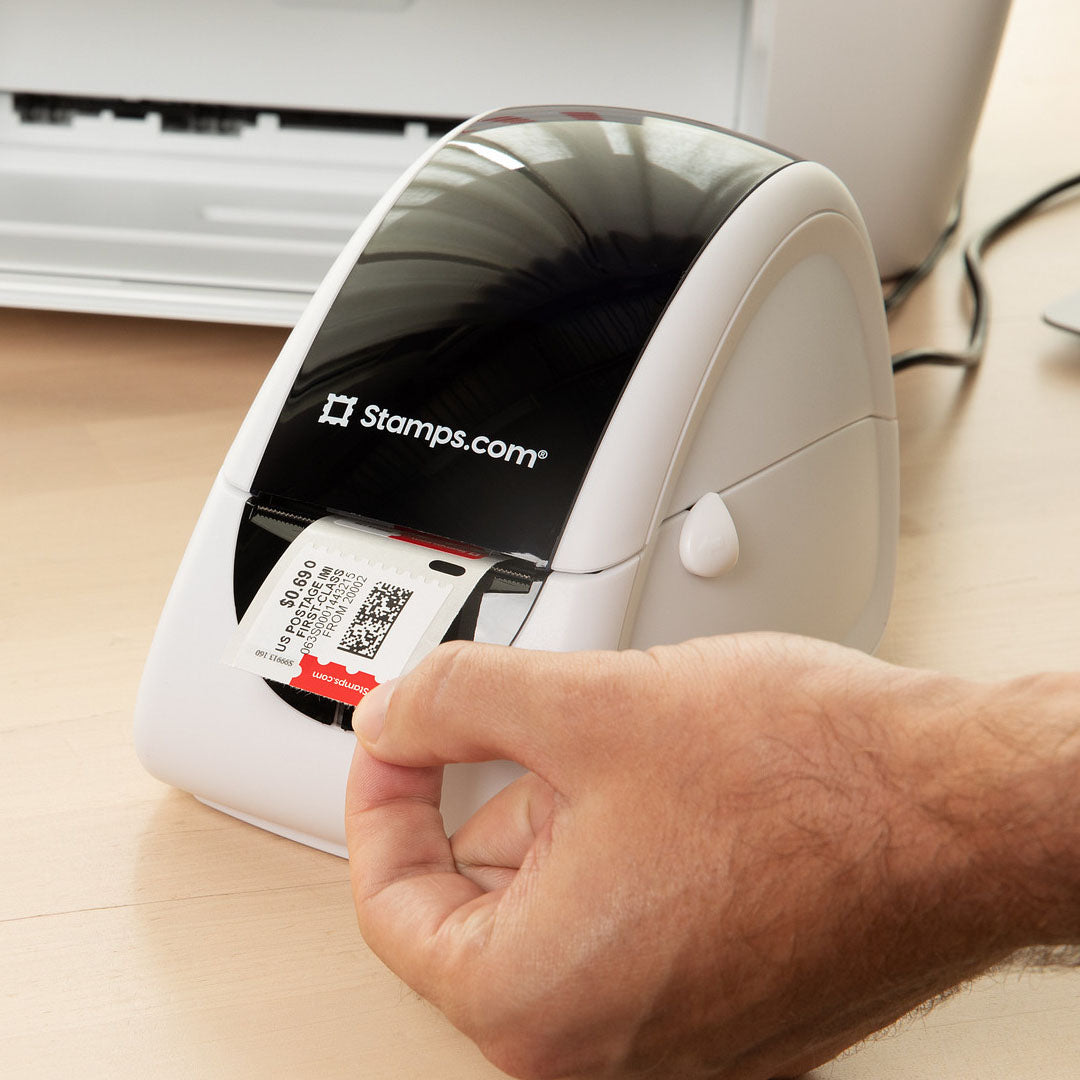
The practical routine is unromantic: enter the recipient, provide accurate package details, choose a service, and print. Stamps.com recommends a sample before the first paid label. That is advice worth copying. Standardize a task only after checking the machinery that repeats it.
Put the subscription on the scale
The advertised October 2026 entry price is $14.99 monthly. Basic includes one user, 25 stamps, and ten shipping labels. Professional is $29.99, with three users, unlimited stamps and labels, batch printing, and support for Certified Mail and Registered Mail. Multi-Location starts at $49.99. Postage is additional.
The fee buys a workflow; discounted postage alone does not make the decision. Pirate Ship, for example, charges no monthly software fee for its USPS and UPS label service. Offices should compare the services they actually use, the records they need, and the time required to produce them.
At $25 per staff hour, saving 72 minutes monthly offsets a $30 subscription. This illustration excludes postage differences, supplies, setup, and optional services.
That calculation becomes less favorable when sending is occasional, existing software already handles the job, or saved minutes cannot be put to useful work. Carrier access needs checking too. The dedicated FedEx documentation excludes scheduled pickups and certain goods. A menu of carriers does not promise identical capabilities.
A bigger network, the same little errand
Thoma Bravo completed a roughly $6.6 billion acquisition of the consolidated company in October 2021. That December, the corporation adopted the Auctane name while Stamps.com continued as a brand. In June 2026, Auctane merged with WWEX Group to form ShipStation Global, bringing shipping software and freight services into a wider portfolio.
There are limits to what the software controls. PhotoStamps once put personal photographs on postage; it closed after USPS ended customized postage in 2020. Printing a label also cannot prevent a carrier delay. The useful lesson is to remove the repeatable friction while keeping track of the dependencies. Stamps.com’s enduring proposition still fits on an envelope: do the mailing here, then get back to work.