The computer case is the least glamorous celebrity in a gaming PC. The graphics card gets the benchmarks. The processor gets the tribal arguments. The case gets kicked under the desk, asked to swallow a nest of cables and blamed when everything sounds like a desk fan in July. Fractal Design saw a more interesting job for it: become part of the room.
That sounds obvious now, in a market crowded with timber accents and tasteful mesh. It was not obvious when founder Hannes Wallin started selling the Fractal idea around Europe. Premium gaming hardware was often designed for a caricature - forever teenage, visually loud, seemingly delighted by every available LED. Wallin's observation was blunt: gamers had grown up, while the products built for them had not.
The company that grew from that mismatch now designs PC cases, fans, liquid coolers, power supplies, chairs, headsets and accessories from Gothenburg, with offices in the United States, China and Taiwan. It outsources manufacturing, owns its product designs and tooling, and moves the finished objects through distributors, retailers and system integrators. More than 90 percent of sales happen online. More than 9 million Fractal products have found their way into over 50 markets.
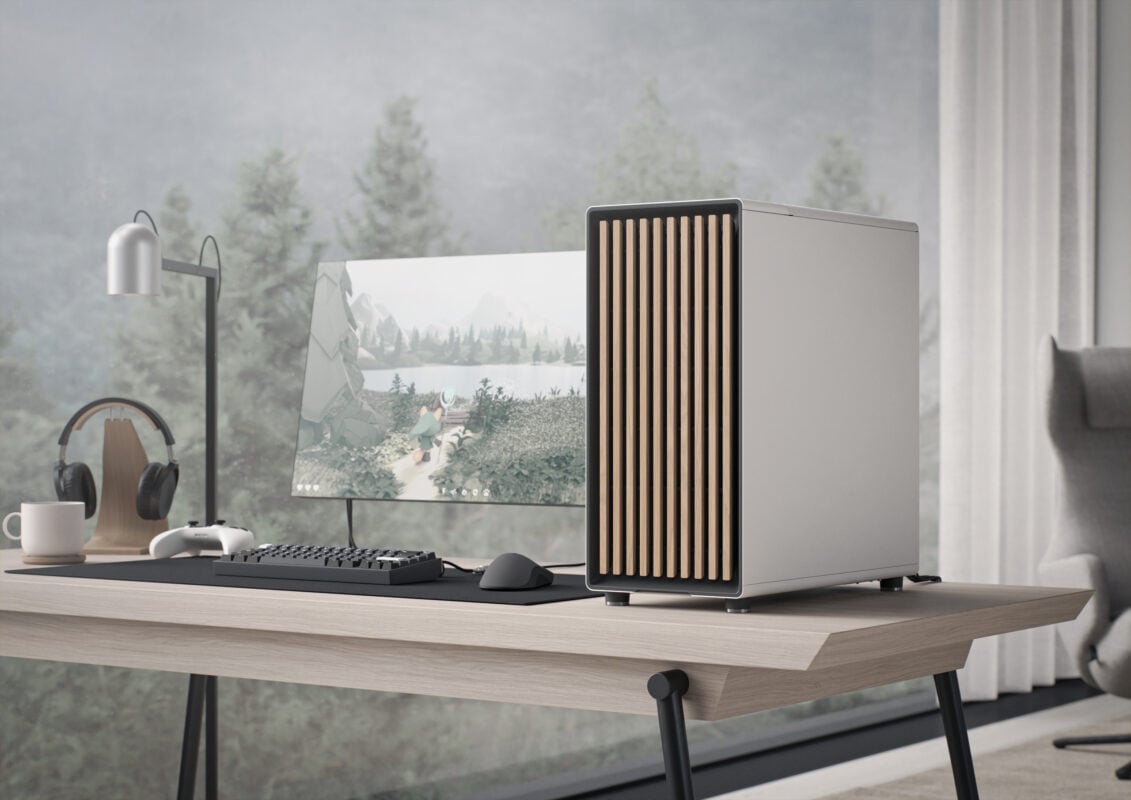
A PC case for people who own lamps
Fractal's first useful move was subtraction. The early Define line favored straight faces, sound damping, modular interiors and a logo small enough to miss. Meshify later opened up the airflow without abandoning the restraint. Then North made the thesis impossible to ignore: real oak or walnut slats, a fabric-like pull tab, fine mesh, and brass or steel details. It looked less like a prop from a spaceship and more like the cabinet the spaceship manuals might be stored in.
The problem it solves is partly thermal and partly social. A builder needs room for a modern GPU, radiators, drives and sensible cable routing. The same person may also need the machine to coexist with a partner, a living room or a carefully chosen desk. Fractal does not sell invisibility. It sells permission to leave the PC where people can see it.
“Everybody kept talking about gamers,” Wallin said, while many of those gamers had already grown up.
The customer is not only a gamer. It is the design-aware DIY builder, creator or professional who enjoys choosing components and dislikes visual clutter. Fractal's rivals include Corsair, NZXT, Lian Li, Cooler Master, be quiet!, Phanteks and Thermaltake. Many make excellent boxes. Fractal's distinction is consistency: the vents, tabs, finishes and proportions keep repeating the same promise - performance can have indoor manners.
Design in Sweden, tooling in hand, boxes everywhere
What exactly did Fractal do? First, it tested an aesthetic position before it had a prototype. The company says the original idea was sold one order at a time around Europe; plenty of prospects declined, but enough agreed to justify moving from sketches into production. That is a wonderfully practical validation loop for a hardware founder: sell the point of view before paying to stamp metal.
Then it built an asset-light operating model around that point of view. Product development, engineering, testing and brand ownership stay with Fractal. Manufacturing goes to established partners in China, while Fractal retains the tooling. Regional distributors and retailers provide reach; Amazon, Newegg, Best Buy and JD.com provide digital shelves; iBUYPOWER puts Fractal cases in pre-built machines for customers who never intend to hold a screwdriver.
The Fractal flywheel / four repeatable moves
The cost depends on which part of the idea a buyer wants. The 2026 North Momentum Edition launched at $179 in the United States and the XL at $209, according to launch coverage. Scape, Fractal's first headset, carries a $200 MSRP. These are not bargain-bin products. The price pays for materials, fit, engineering and a coherent object, though it does not abolish tradeoffs. Scape has no active noise cancellation, and its browser configurator has favored Chromium-based desktop browsers.
For the company, the public-market price is unusually clear. Fractal listed on Nasdaq First North Premier in February 2021 at SEK 41 per share, implying a market capitalization of about SEK 1.194 billion; the offering totaled SEK 550 million. This was not a venture-funded blitz. The company describes a history of organic, profitable growth, with the IPO arriving after the brand and distribution system were already established.
03 / The bruiseThe coolant reacted. The company got specific.
Hardware eventually produces a lesson that cannot be fixed with copywriting. In 2022, Fractal disclosed that some Lumen all-in-one liquid coolers could suffer rising CPU temperatures. Its investigation identified solder used in the aluminum radiator, plus impurities introduced during manufacturing, as ingredients in a reaction with the cooling fluid. Sediment could build up, obstruct flow and degrade performance.
Fractal stopped selling affected units, told customers how to identify the issue and offered replacement products. That was the first material product failure in the modern story worth studying because the response was concrete. It named the affected component, described the mechanism and gave owners an action. The copyable behavior is not “be transparent,” a phrase polished smooth by corporate use. It is: publish enough technical detail that a customer can recognize the failure in their own machine.

What changed their mind?
At the beginning, rejection was part of the filter. The company did not need everyone to believe in a restrained case; it needed enough buyers to prove a neglected segment existed. Later, external criticism became a different kind of signal. Reviewers praised North's looks and airflow but repeatedly flagged noise. Fractal's 2026 North Momentum Edition kept the recognizable structure and swapped in three Momentum fans with liquid-crystal-polymer blades and fluid dynamic bearings. The bigger XL also gained room for rear-connector motherboards and wider cable space.
That is a sensible product correction because it does not confuse a complaint with a request to erase the product. The wood stayed. The silhouette stayed. The acoustic hardware changed. Fractal effectively treated “beautiful but louder than expected” as an engineering brief.
04 / The expansionFrom the box to everything around it
Cases still dominate the business, but the ambition is now the whole gaming station. Refine, launched in 2024, borrows more from ergonomic office chairs than racing seats. Scape, released globally in June 2025, combines a cloth-covered silhouette with a magnet-assisted inductive charging stand, Bluetooth 5.3, low-latency 24-bit/96 kHz wireless audio and a detachable microphone. Its EQ and ambient lighting live in Adjust Pro, a registration-free browser tool, instead of a permanent desktop utility.

This extension works because the company is not really organized around cases. It is organized around a customer with a consistent irritation: capable gaming gear often announces itself too aggressively. A chair, headset, power supply or fan can all answer that. The risk is execution. Case expertise does not automatically produce leading microphone processing, chair durability or software support. At $200, Scape reviewers have reasonably asked why active noise cancellation is absent and whether browser dependence will age well.
The market supplies the other risk. Fractal posted its highest-ever sales in 2025, up 16 percent in Swedish kronor and nearly 25 percent organically in dollars. Then Q1 2026 sales dropped 39 percent year over year. Management blamed a global shortage of memory components, which made complete PC upgrades less attractive. Fractal can design the case of the future; it still needs customers to find RAM for the machine inside it.
05 / The stealCopy the observation, not the oak slats
The most portable lesson is to look for a customer whose identity has moved faster than the category built around them. Fractal found adults with gaming tastes and furniture tastes, then stopped treating those preferences as a contradiction. A founder can copy the sequence: identify the embarrassment, pre-sell the point of view, make one highly visible object prove it, and expand only where the same customer tension remains.
The neglected preference is real, visible and shared by buyers with enough spending power to support better materials and careful design.
The styling masks weak performance, the premium outruns utility, distribution cannot carry bulky inventory, or an adjacent category demands expertise the brand has not built.
It also will not work when taste is merely decoration. Adding walnut to a bad thermal design creates a warmer-looking bad thermal design. Fractal's strongest products make the aesthetic choice and the engineering choice cooperate: North's open slats feed mesh ventilation; Meshify's face is both graphic and porous; Scape's dock is display stand and charger. The object earns its place in the room twice.
Fractal's bet was never that gamers dislike spectacle. Plenty adore it, and the company now sells RGB products too. The sharper bet was that the market contained more than one version of a gamer. That is why the strategy survived competitors adding wood, why it can travel into chairs and audio, and why the next few years matter. Fractal has already made the PC case grow up. Now it has to prove the rest of the desk wants the same life.