The first SteelSeries product was not a headset with spatial audio, a keyboard with magnetic switches or a mouse drilled into honeycomb. It was a sheet of glass. In Copenhagen in 2001, Counter-Strike player Jacob Wolff-Petersen was annoyed by the dust that gathered under the ball in his mouse and ruined its tracking. He made a hard, anti-dust surface called the Icemat. The problem was small enough to sound silly and sharp enough to start a company.
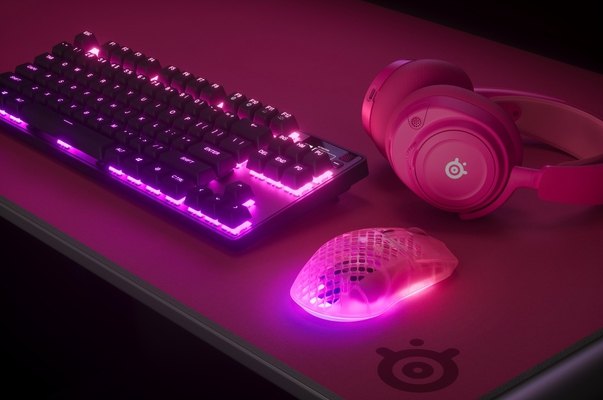
That origin explains SteelSeries better than its orange logo does. The company makes performance-minded gaming gear - headsets and earbuds, mice, keyboards, mousepads and controller accessories - plus the free GG software platform that configures devices, routes audio, records clips and stores game profiles. Its customers range from a teenager buying a first $35 Rival mouse to professional teams whose equipment is tested in public, under lights, with prize money on the screen.
The company now sits inside Danish audio group GN Store Nord, which completed an all-cash acquisition in January 2022 at an enterprise value of DKK 8.0 billion, about $1.2 billion at the time. Yet the more transferable story predates the deal. SteelSeries discovered that a niche can become large if the user is demanding, the feedback is measurable and the company resists wandering away from the job it earned permission to do.
The first failure had a headphone jack
Success gave the young company an obvious temptation: gamers liked its mousepad, so perhaps gamers would buy anything it stamped with Icemat. The result was the Icemat Audio MP3 player. Wolff-Petersen later called it a “very bad idea.” No public postmortem gives a development bill or unit-loss figure, so the honest cost remains undisclosed. The strategic cost is easier to see. It spent attention on a crowded category where the company had no distinctive performance claim.
Publisher-branded hardware became another awkward phase. Licensed products created retail complexity and aged with somebody else's release calendar. The company pulled back from that approach. What changed its mind was not a slide about total addressable market. It was the realization that “gaming” is not a magic adjective. A product needed to help someone play better, train longer or improve the live experience. A generic music player could not clear that bar.
“To stay the course is just as difficult as to branch out.”Jacob Wolff-Petersen, founder
That rule also explains why SteelSeries did not race into chairs, cases and every other object near a gaming desk. It expanded, but along a connected path: from surfaces to mice, keyboards and audio; from PC to console and mobile; from hardware settings to a software layer. Focus did not mean one product forever. It meant each new product had to strengthen the same promise.
Pros were the laboratory, not the wallpaper
SteelSeries entered esports before esports became a tidy sponsorship category. Wolff-Petersen sought feedback from professional players because, in the early days, few other customers could explain the difference between a product that looked fast and one that felt dependable after hours of competition. The company sponsored teams, but the useful exchange ran in both directions. Players participated in concepts, testing and validation. Former pros joined the company.
This is the distinction between community marketing and community infrastructure. A logo on a jersey can buy attention. A demanding user who can identify a tracking error, a fat-fingered key or bad audio separation can change a specification. SteelSeries has worked with organizations including T1, Evil Geniuses, Alliance and Nongshim RedForce. Its extended relationship with T1 is valuable not merely because T1 wins, but because high-level players turn product flaws into immediate, legible complaints.
The repeatable engine
How a pro complaint becomes a second purchase
The approach works because gaming performance offers unusually fast feedback. Mouse latency can be measured. Switch actuation can be adjusted. A headset can separate footsteps from chat. A pad can trade speed for control. The current QcK line even sorts surfaces into Speed, Balance and Control, turning a rectangle of cloth into a preference system.
The box is the sale. Software is the memory.
SteelSeries is still fundamentally a hardware business. It designs products, uses an asset-light manufacturing model and sells through retailers, distributors and its own ecommerce operation. Limited editions with partners such as Blizzard and Activision create collectible bursts. KontrolFreek, acquired in 2020, adds controller thumbsticks and grips. A-Volute, also acquired in 2020, brought the Nahimic audio-software business.
GG makes those boxes behave like a system. Engine controls devices, lighting and macros. Sonar routes and tunes game, chat and microphone audio. Moments records clips. QuickSet applies configurations, and aim-training tools give players another reason to open the software. On console and mobile, the Arctis app now offers more than 200 game-specific audio presets. A buyer can switch a sound profile without becoming an amateur acoustic engineer.
A hardware business gets scale
2025 is SteelSeries product revenue reported by GN
The software is free, which can look strange if one expects every app to become a subscription. Here it has a different job. It reduces setup friction, differentiates similar-looking hardware and makes another SteelSeries device easier to add later. The mouse remembers the settings; the headset shares the control panel; the keyboard joins the lighting scheme. The relationship survives the unboxing.
A crowded shelf and a useful moat
SteelSeries lives in a hard neighborhood. Logitech G has enormous distribution and engineering depth. Razer owns a loud lifestyle identity. Corsair can fill nearly every square inch of a PC setup. HyperX, Turtle Beach, ASUS ROG and Wooting all create pressure in audio, keyboards or enthusiast performance. SteelSeries cannot claim a category to itself.
Its differentiation is cumulative: Scandinavian restraint in industrial design, early esports credibility, a broad but coherent product family and software that connects the parts. GN bought that bundle because it complemented GN's audio science, connectivity expertise and global distribution. The deal price was DKK 8.0 billion in cash, financed with existing cash, a bond and bridge financing. At announcement, SteelSeries had about 350 employees, 80 of them software engineers, and 2020 pro forma revenue of DKK 2.175 billion.
The ownership has not removed market gravity. In 2025, weak consumer sentiment and tariffs pressed the gaming-equipment market. SteelSeries product revenue was DKK 2.683 billion, down organically by 2 percent, although GN said it gained market share. By Q2 2026, the picture had improved: gaming revenue reached DKK 613 million, organic growth was 5 percent and the divisional profit margin rose to 15.0 percent. GN credited headset share gains led by the Nova Pro Omni. The useful signal is not uninterrupted growth. It is a focused business finding momentum while the broader consumer mood remains soft.
Steal this operating system
Five moves worth copying
- Start with an irritation a user can describe in one breath.
- Recruit users whose standards are harsher than the mass market's.
- Turn their feedback into measurable product choices, not testimonials.
- Borrow distribution early, as Icemat did with Microsoft.
- Use software to connect purchases instead of forcing a subscription onto them.
When the playbook breaks
A founder can copy the method without copying gaming. The essential ingredients are a large-enough niche, observable performance and a community willing to articulate trade-offs. Cycling equipment, music tools, creator hardware and specialist work software can share those conditions. The early audience must also be credible to later buyers. Professional players supplied aspiration as well as data.
It travels when...
Performance is measurable, expert users feel pain early, product iterations are affordable, and retail or platform partners can widen distribution.
It fails when...
Influencers are decorative, experts have needs unlike everyone else, feedback cannot be converted into a specification, or the niche has no path to scale.
Focus has its own failure mode, too. It can harden into nostalgia. SteelSeries avoided that by defining the core around better play, not around the PC mousepad that started everything. Console controllers, mobile apps, wireless earbuds and audio software still fit if they solve a live gaming problem. The boundary moves with players, while the test stays fixed.
That is the playful little lesson inside the billion-dollar outcome. SteelSeries did not become valuable because glass was the future of mousepads. It became valuable because one founder noticed a speck of dust, listened to people who cared far too much about it, and eventually learned that the best adjacent market is sometimes the one you decline.
Keep playing
Explore the product lineup, software, company updates and demonstrations directly from SteelSeries.