Max Filin has an awkward object to explain. It looks familiar enough to invite an immediate conclusion: a cube, divided into smaller cubes, ready to be twisted. Then the screens light up. A character can travel across its surface, and a turn of the hand rearranges the world beneath it. The explanation becomes considerably easier once the listener starts playing.
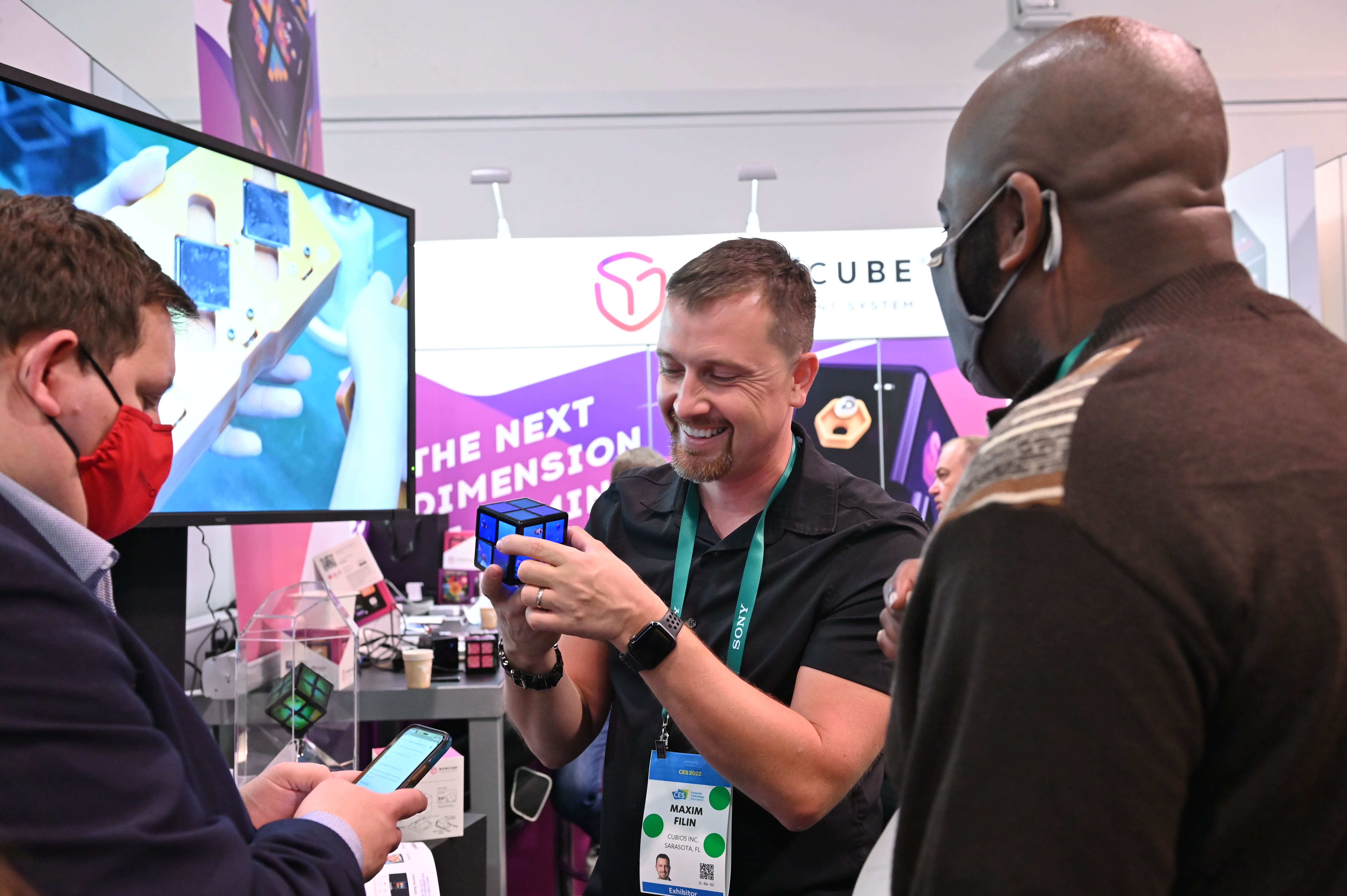
In December 2019, Filin put a WOWCube prototype into a journalist’s hands. Children at a nearby table soon joined the testing. Eight-year-old Indy Valles supplied a description that would have pleased a marketing department: video Lego. The encounter captures the peculiar work Filin had taken on. He could discuss processors, distribution and manufacturing. A child could describe the experience in two words.
Filin is the CEO and co-founder of Cubios, the company behind WOWCube. The original idea belonged to Savva Osipov and his father, Ilya. Filin joined as CEO in 2019, bringing years of experience with consumer electronics to the task of making their invention commercially viable. His part of the story begins where an intriguing prototype starts asking expensive questions.
Before the cube, a warehouse of experience
His education was in Moscow, at the National University of Science and Technology MISIS, where he studied from 1998 to 2004. His career then ran through product management and distribution. He worked at Merlion, spent a period at Koodoo Technologies, and returned to Merlion as a product team lead. By the time he moved to the United States, he had accumulated nearly fifteen years at Merlion across his periods there.
The catalogue of products he had worked with reads like a tour of the electronics aisle: smartphones, tablets, notebooks, navigation devices, digital projectors, music players and in-car electronics. These were physical goods that needed to be developed, manufactured and distributed. He also described himself as a co-owner of a research and development design house and a factory. The cube brought this background into a particularly compact problem.
There is a useful distinction here between inventing a device and preparing it for strangers. A prototype can be handled carefully by someone who knows its weaknesses. A consumer product has to meet the person who has discarded the instructions. Filin’s earlier work placed him close to that second encounter, where the clever idea must survive production, shipping and ordinary use.
Twenty releases between two photographs
The Osipovs’ idea dates to 2016. An early prototype followed in 2017, built with an Arduino and a 3D printer. Before Filin joined, the project had already acquired its public name. At Maker Faire in Santa Clara in 2018, children’s reactions helped inspire the change from CubiOs to WOWCube. Ilya considered COOLCube too; the available domain helped settle the matter. Even an invention needs an address.
Filin later posted a comparison of the first working prototype and a version prepared for mass production. Between those two pictures, he said, were more than twenty separate releases. Each release involved ten to fifteen prototype variants, with weeks or sometimes months of production and extensive testing and simulation. A before-and-after photograph had concealed a very crowded middle.
That is a revealing detail to choose to share. The finished object offers a neat silhouette. Filin wanted people to see the revisions behind it. A cube gives its designers few places to hide: its surfaces must display games, its parts must turn, and the electronics must keep working while their neighbours change position. Every improvement has to fit into the object people already expect to hold.
Eight computers learning to agree
WOWCube combines eight autonomous computing modules and twenty-four screens. Their independence is central to its construction. Turning the cube changes which modules sit beside one another; the system has to preserve a coherent game while that arrangement changes. For Filin, explaining the device means making this moving relationship understandable without turning a demonstration into an electrical engineering examination.
In a 2021 interview with Greg Burke, he demonstrated games and the widgets that could display useful information. The cube could carry entertainment and small utilities on the same surfaces. Its interface also gave familiar games a different physical grammar. In Cut the Rope, twisting cuts a digital rope while tilting controls the candy. A movement of the object becomes an action inside the game.
Filin has also been unusually direct about the cost of the undertaking. In a public post, he listed the screens, processors, speakers, operating system, app store and development tools involved. The point was practical: the price has to support the whole system being built. His sales argument carried a bill of materials inside it, which is one way to make a product pitch less mysterious.
The demonstration is part of the job
After CES in January 2020, Filin described five days of meetings, press appearances, speeches and demonstrations. WOWCube had received the People’s Choice Award at Last Gadget Standing. His account thanked the team and catalogued the activity with the relief of someone who had finally reached the end of a trade show. The cube may fit in a hand; introducing it required considerably more floor space.
In 2021, TIME included WOWCube among its best inventions of the year. Recognition gave Filin another way into a conversation, though the object still benefited from being passed across a table. An award can explain why someone should pay attention. A quarter turn can explain what they are paying attention to. The distinction matters for a device whose central feature is physical movement.
The appearances continued. At New York Toy Fair in 2023, Cubios shared a booth with Metal Time Workshop, pairing the cube with mechanical models and accessories. By 2025, Filin was demonstrating Rubik’s WOWCube with Napoleon Smith in a Techstination interview. The Rubik’s branding followed a 2024 agreement with Spin Master. His unusual device now carried a name that visitors already knew how to pronounce.
The next game comes from someone else
Filin’s ambitions have consistently extended beyond selling the hardware. In a 2022 post, he reported forty-two games and applications, with four independent studios or teams developing more. The number was a snapshot of the catalogue at that moment. The more consequential detail was the invitation: outside developers could use the company’s software tools and emulator to make something of their own.
He offered a smaller example in another post. A student named Anna had used the SDK to create Magic Cube, inspired by the film Interstate 60 and the Magic 8 Ball. Her project reached the store. For a platform trying to attract creators, a published student game makes the invitation tangible. Someone beyond the core team has tried the tools, finished a project and put it in front of players.
The developer kit supports macOS and Windows and lets people work without owning the physical device. It uses the Pawn language and Visual Studio Code. That arrangement reduces an obvious obstacle: a curious programmer can begin before buying a cube. The emulator becomes a place to discover whether a game idea makes sense when the playing surface can be rearranged by hand.
The company’s grant programme takes the invitation further. It advertises funding of up to $100,000, hardware and launch support, while allowing creators to retain their intellectual property. Selection favours ideas that use twisting, tilting, shaking and play across multiple sides. The request is specific. A new machine needs games that give people a reason to reach for that machine.
A working day that keeps changing time zones
Filin once described the rhythm of leading the business with the phrase, “The sun never sets for Cubios, Inc.” His team spanned locations from Florida and California to Asia and Europe. He described starting at six in the morning with messages already waiting, then moving through the American working day toward conversations with Asia again. The cube’s geography was much larger than its dimensions.
Asked which business superpower he would choose, he answered, “Better memory!” It is an appealingly modest wish from someone coordinating so many moving parts. His comments about management were similarly concrete: acknowledge contributions and help people understand where their individual work appears in the finished product. The advice suits a machine assembled from parts that only make sense together.
“Better memory!”Max Filin, on his ideal business superpower
Leaving room for another pair of hands
By early 2026, Filin was again speaking publicly about the platform’s growing developer base. In March, the company announced that its GDC game-ideas contest had selected ten winners, doubling the five originally planned. A contest is an invitation with a deadline. In this case it also provided a way to ask people beyond Cubios what they would do with a screen that turns.
July brought three community-made releases: Planaton, a solar-system explorer by LoRoGaSt; Slime Fight by Ishka Gaming; and ZenSpectrum by Aidan Lane. They offered different reasons to pick up the same object: explore planets, guide an expanding slime, or move colour across its screens. The catalogue was beginning to demonstrate how widely the underlying interaction could be interpreted.
That is where Filin’s story opens outward. He arrived with experience in getting electronics into the world. The cube required him to help create a place where other people could build things too. The original question came from a father and son. Years of revisions made it a manufactured object. Its continuing life now depends partly on what happens when another person picks it up and wonders what a twist could do.