In late 2016 a 12-year-old named Savva Osipov handed his father a complaint disguised as an idea. Screens were boring, he said, because they were flat. What if a Rubik's Cube had screens on every side, so a game character could run around a corner from one face to the next? His father, Ilya Osipov, was an inventor with roughly 30 patents to his name. He did not say that's nice. He 3D-printed a prototype.
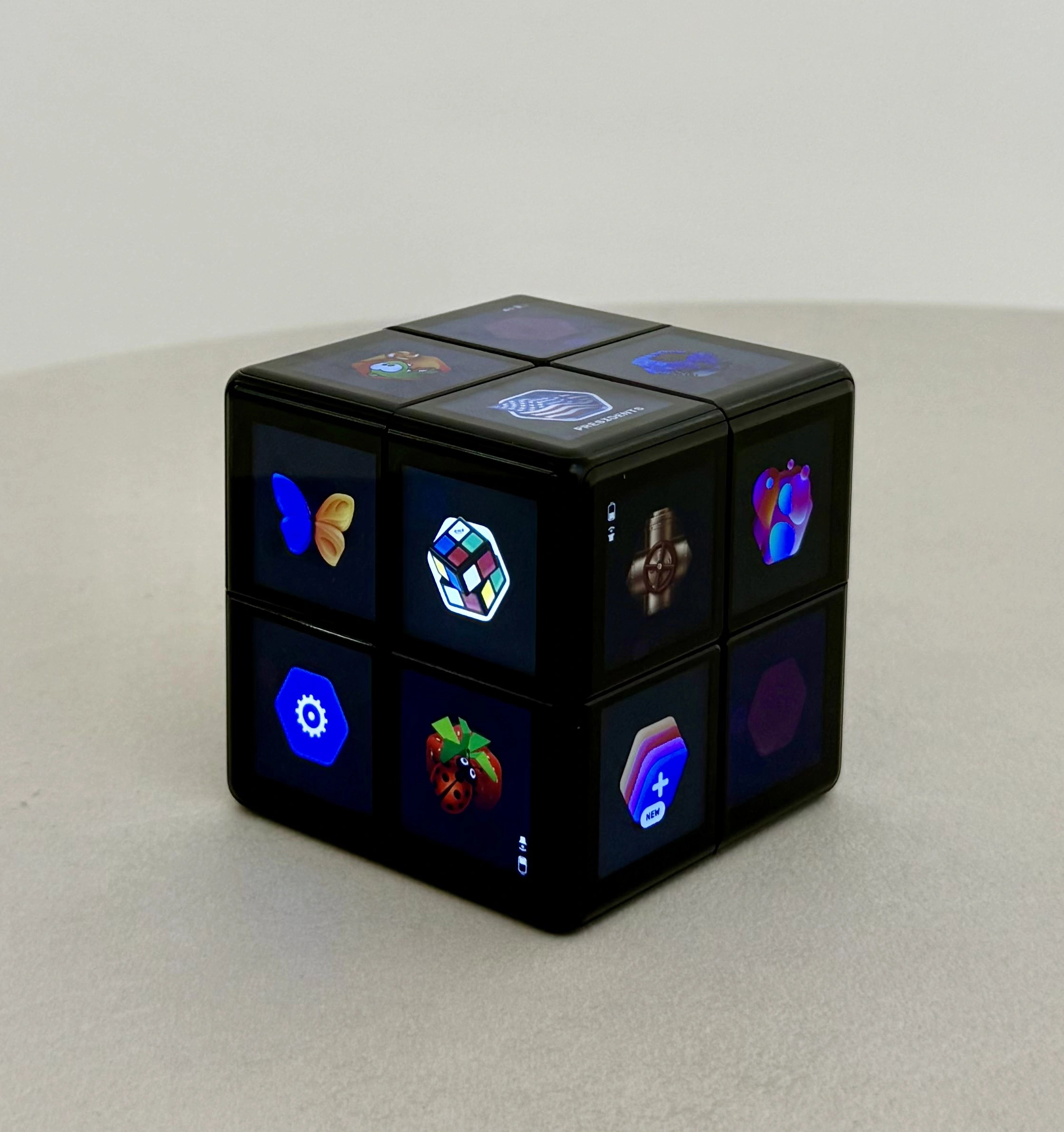
That prototype became Cubios, Inc. - registered on April 11, 2017 - and the prototype's grandchild is now the WOWCube, a handheld gaming console shaped like a 2x2 Rubik's Cube and wrapped in 24 tiny screens. You do not press buttons on it. You twist a side, tilt it, or shake it. Nine years after a kid got annoyed at flat screens, the device sits in the collection of the Strong National Museum of Play and on Time's list of 100 Best Inventions.
A console you shuffle, not press
The mechanics are the whole pitch. The WOWCube is built from eight connected modules, each carrying three screens and its own processor - so the thing in your hand is effectively eight tiny computers agreeing on one continuous game field. Twist the top layer and the play area rotates with it. Tilt the cube and a ball rolls. Shake it and the board resets. The controls are the object.
That is a genuinely different idea from every handheld that came before it, which mostly reproduced a flat screen and added buttons. Cubios built a custom operating system, CubiOS, to run across the modules, and a companion app - WOWCube Connect - to load content, run leaderboards and track how you play.
Who actually buys a screen-covered cube
The buyer is not one person. It is a gadget enthusiast who wants the thing nobody else on the train has; a parent shopping the intersection of screen time and STEM; a puzzle fan; and a small but real developer crowd building for it. Cubios leans into that mix with STEM.org authentication and an edutainment framing, then hedges it with licensed nostalgia - a tilt-controlled Pac-Man, Space Invaders from Taito, and Cut the Rope from ZeptoLab.

The problem it is really solving
Strip away the hardware and Cubios is attacking a distribution problem it created for itself: how do you sell a weird object that only makes sense once someone holds it? A spec sheet cannot explain the moment a character runs around a corner. So the company built two answers. The first is WOWStudio, a no-code tool that lets people assemble cube apps and games from images, panoramas and puzzle templates without writing a line of code. The second is an SDK and DevKit for developers who want to go deeper. Make the object programmable, and the catalog grows without Cubios funding every title.
The second answer arrived in 2024, and it is the more important one. Cubios partnered with Spin Master, the toy giant that owns the Rubik's brand, to release the consumer device as the Rubik's WOWCube. The technology stayed the same. What changed was the logo, and the logo is the point: a no-name cube in a toy aisle is a hard sell, while a Rubik's cube that lights up sells itself off the shelf edge.
The price tightrope
Here is the tension reviewers keep circling. The Rubik's WOWCube opened pre-orders at $299, with reporting pointing to $399 and eventually $499 as the numbers settle. That is PlayStation-and-Xbox money for a device with a fraction of their libraries. Cubios is not pretending otherwise; it is betting that a category of one does not compete on library size. You do not cross-shop a cube against a PS5. You cross-shop it against every other object that costs the same and does something you have never seen.
How it got here
The path was slow on purpose. Cubios iterated through Arduino and STM32 prototypes, upgraded screens generation by generation, and refused to ship the version that early observers kept calling good enough. The awards trail - a World Technology Award in 2018, People's Choice at Last Gadget Standing in 2020, a Silver Edison Award the same year, a CES Innovation honoree nod, a German Innovation Award, and the Time listing - gave a tiny startup outsized credibility while it kept refining the object.
- 2016A kid's what-ifSavva Osipov, 12, suggests a Rubik's cube with screens on every side. First patent follows in months.
- 2017Cubios is foundedRegistered April 11; early prototypes 3D-printed with hardware engineer Semyon Orlov.
- 2018It gets its nameA Maker Faire crowd's "wow" names the device; wins Editor's Choice.
- 2019A CEO and a co-signMax Filin joins as CEO; Steve Wozniak endorses it; $1.4M seed closes.
- 2021Series A and a Time nod$4.5M Series A at a ~$25M valuation; lands on Time's 100 Best Inventions.
- 2024Rubik's signs onSpin Master partnership creates the consumer Rubik's WOWCube.
- 2026CES and a museumShown at CES 2026; added to the Strong National Museum of Play.
The money and the team
Cubios never had console-scale capital. A $1.4M seed in 2019 was followed by a $4.5M Series A in 2021 - led by Aleksandr Agapitov with Dobro Capital, Starta, Invest Fest and Quonota - plus a small StartEngine public raise and later venture money, adding up to a lean total in the single-digit millions. The team runs around 33 people, family-founded and inventor-led, with a US base in Sarasota, Florida and roots in Eastern Europe. Max Filin, who joined as CEO in 2019, brought the consumer-electronics discipline; Ilya Osipov stayed on as president and CTO, still the patents engine.

The expertise underneath
It would be easy to file the WOWCube under novelty and move on. The engineering says otherwise. Getting eight independent modules to render one seamless image while the cube is being physically rearranged is a hard synchronization problem, and it sits on top of motion sensing precise enough to tell a deliberate twist from an accidental bump. Ilya Osipov's background - a 1996 Eastern European programming win as a student, around 30 patents, and prior companies spanning a peer-to-peer language-learning service and an anti-spam mobile app - shows up in how the product is built: patents first, then hardware, then a platform layer that other people can build on.
That platform instinct is the tell. A lot of gadget startups ship one clever object and stop. Cubios shipped an object and then spent years on the boring, durable parts - an operating system, a companion app, a no-code studio, an SDK, a developer kit - so the cube could keep getting more useful after it left the box. Hardware companies live and die on what happens after the unboxing, and Cubios clearly knows it.
Where it fits - and where it might not
In market terms, the WOWCube sits closer to Panic's Playdate than to a mainstream console: a deliberately odd, design-led handheld that wins by being unlike anything else rather than by out-speccing rivals. Its edge is that there is no direct substitute - no other company ships a twist-controlled cube of screens. Its risk is the same fact from the other side: a category of one has to create its own demand, one held-in-hand demo at a time, and $299-plus is a lot to ask on faith.
The honest read is that the WOWCube works when the buyer values novelty, tactility and play over library depth, and struggles when a shopper reduces it to dollars-per-game. Cubios' answer to that is not to argue the spreadsheet. It is to get the cube into your hands, let you twist a side, and watch the character run around the corner.