The visitor arrived with a handshake and a prediction. Bob Cole’s stereo shop would be out of business in three months. The visitor, a competing retailer, intended to help that prediction along. Cole later remembered that the fellow’s car was worth more than everything inside his store. There are gentler ways to welcome someone to the neighborhood.
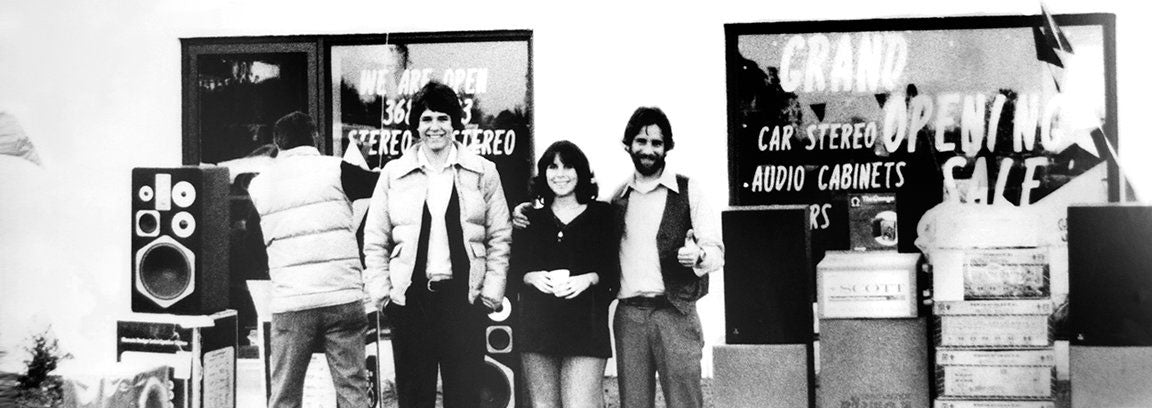
This was Montgomeryville, Pennsylvania, in 1979. Cole had opened World Wide Stereo in a 1,500-square-foot space with homemade displays. The electrical arrangement, by his own account, involved a cord connected to a roadside power pole. Four devices could run at once. For a business built around persuading people to plug things in, that was an awkward opening position.
The shop survived. Cole retired in 2024, when Gramophone’s Andrew Davis and Edward Gordon assumed oversight of the business. Between those two moments sits a career spent making complicated equipment feel approachable, and making customers comfortable enough to return. The interesting question is how someone with so little room for error managed to keep finding room to change.
A spool of thread, some copper wire
Cole’s interest in electronics began with a crystal radio assembled using a sewing-thread spool and copper wire. Music was already in the family: his mother loved the blues, and his godmother taught music. The homemade receiver brought the two interests together. A piece of wire could become something you listened to.
There was a school math-club visit to Bell Labs, too. Cole met the inventors of the transistor. Long before he had to choose stock for a showroom, he had been introduced to the idea that small technical objects could produce large changes in ordinary life.
Born in Long Branch, New Jersey, on November 12, 1948, he acquired a practical education alongside his formal one. As a teenager he cleaned houses, worked in a hardware store and at McDonald’s, and took on union construction work. Carpentry, masonry and ironwork were among the jobs. He also exercised horses at Monmouth Park. A future in stereo retail was hardly the inevitable destination of that collection.
Those jobs gave him useful experience for a founder who would build his own store. The displays in Montgomeryville were something he could make himself. Available skills had to cover for unavailable cash. Cole’s opening resources amounted to $2,000 and $16,000 in bank loans. A polished showroom would have to wait.
The schoolteacher’s contribution
Before opening his independent shop, Cole worked for a stereo franchise, helping struggling stores. Then that business failed. He retained the World Wide Stereo name for his own venture. It was an ambitious name for a small Pennsylvania shop, especially one whose electrical capacity required such careful rationing.
Karen, whom he married in 1978, was an art teacher. Her income provided support while the shop found its footing. Years later, Cole would warn new founders against withdrawing money from a business before it had a firm foundation. In his case, the advice came with an acknowledgment of who had helped make waiting possible.
Ron Rumer joined in the first year and became a familiar part of the enterprise. The shop was known for years as Bob & Ron’s World Wide Stereo. The names offered customers an introduction before they reached the door. There were actual people behind the promise, and those people would still have to answer when something went wrong.
The invasion Cole didn’t order
One early lesson in growth arrived in the form of a frightening purchase. In the early 1980s, a representative bought $16,000 of Atari’s Space Invaders games. Cole thought it would be a disaster. The stock sold out over the first weekend. Pac-Man and other titles followed.
Then a customer’s game broke. Atari authorized the business as a service center, giving the shop another reason for people to visit. Cole later credited that development with helping establish its reputation. A sale had led to a repair, and a repair had opened another line of business.
Custom installation began with an equally modest departure from the expected: a pair of car speakers installed around a customer’s hot-tub area. The job crossed a product category without much ceremony. Someone wanted music in a particular place; the shop worked out how to get it there.
The Atari order and the hot-tub speakers reveal something about the way Cole’s business grew. Neither resembles a tidy expansion plan prepared years in advance. Each began with a specific opportunity or request. Selling equipment put the company close enough to customers to discover other work they wanted done.
A shop with a sense of humor
Cole could be playful about a business that required considerable technical knowledge. The early advertising grew from classified listings into comic radio spots. He remembered buying a limited schedule and placing the ads at the same drive-time slot repeatedly. The budget was small; familiarity had to do some of the work.
That humor suited the atmosphere he wanted inside. In 2005, he described the company as the “Cheers” of audio-video retailing. The reference was to a place where people knew one another and felt able to settle in. It is an unusually domestic aspiration for a shop full of equipment.
A welcoming room also makes commercial sense when the merchandise needs explanation. Someone buying a stereo may know exactly what they want to hear without knowing which amplifier will help them hear it. The person doing the demonstrating has to bridge that gap without turning the conversation into an examination.
Cole’s own writing addressed music fans, dashboard drummers, film buffs, gamers and people shopping for gifts. Expertise was welcome, but it was hardly an admission requirement. His taste for jokes gave the technically curious newcomer a way into the conversation. Nobody had to arrive speaking fluent loudspeaker.
“Do well by doing good.”
Bob Cole’s business maxim
He traced that maxim to a schoolroom exchange over the difference between doing “good” and doing “well.” His reply joined the two. The grown-up version became a rule for treating customers and employees. There is a certain satisfaction in building a business around an answer that once got you into trouble at school.
Letting other people turn the knobs
Cole’s story also contains a change in his own job. Early on, he built, bought and sold. As the company expanded, that habit of personal involvement needed limits. By 2021, he described giving five managers considerable freedom to run daily operations. He was particularly proud that the president, chief merchant and marketing director were women.
The shift matters because the skills that open a small shop can become a constraint on a larger one. If every decision still needs the founder, the business has acquired a queue. Cole spoke openly about having micromanaged. Allowing capable colleagues to make decisions gave them room to develop and gave the organization room to function.
His view of other retailers was less solitary than that first competitor’s visit might suggest. In a buying-group discussion, Cole described the value of dealers sharing education and experience. Rivals could still benefit from helping their wider channel succeed. Years of competition had left him with an appreciation for company.
The showroom gets a much longer reach
In 2008, his daughter Emily joined the family business and launched its online store. The challenge was recognizable: carry the showroom’s helpful, friendly character into a transaction conducted at a distance. A website could take the order; the company still needed to earn the customer’s confidence.
E-commerce became a substantial part of the operation alongside retail and installation. Cole’s small shop had developed several ways to reach people, each with different demands. Someone browsing online could not simply be handed the experience of sitting between two speakers in Montgomeryville. The presentation and support had to travel with the product.
Industry recognition followed. Cole entered the Consumer Technology Hall of Fame in 2018 and credited his team during his acceptance speech. CE Pro included him in its 2021 Masters class. The recognition attached to his name, but the company he described increasingly depended on people whose judgment he had learned to trust.
Forty-six trips, then a handover
In January 2024, Cole reported attending his 46th CES. He wrote about transparent displays and the prominence of artificial intelligence, while wondering whether this might be his final visit. The youthful builder of a crystal radio was still paying attention to what the next device might do.
That May, the Gramophone partnership announcement described his retirement and the transfer of oversight to Davis and Gordon. The companies would retain separate identities, with leadership and staff staying in place. After decades of change, the handover was designed to preserve the relationships that customers and suppliers already knew.
Asked earlier what he wanted his legacy to be, Cole had settled on honesty. He wanted people to believe he meant the philosophy he repeated. The answer was personal, and it fit a career conducted largely through conversations: with customers, colleagues, manufacturers, and the occasional competitor bearing an unwelcome forecast.
The three-month prediction makes a good opening anecdote because the ending is so measurable. Cole kept going for roughly 45 years before retiring. Yet the more revealing detail may be the handshake. His working life would depend on persuading people to trust the person standing in front of them. He had plenty of time to make a better impression.
Keep listening
Conversations, recollections, and the next chapter.
Follow the company