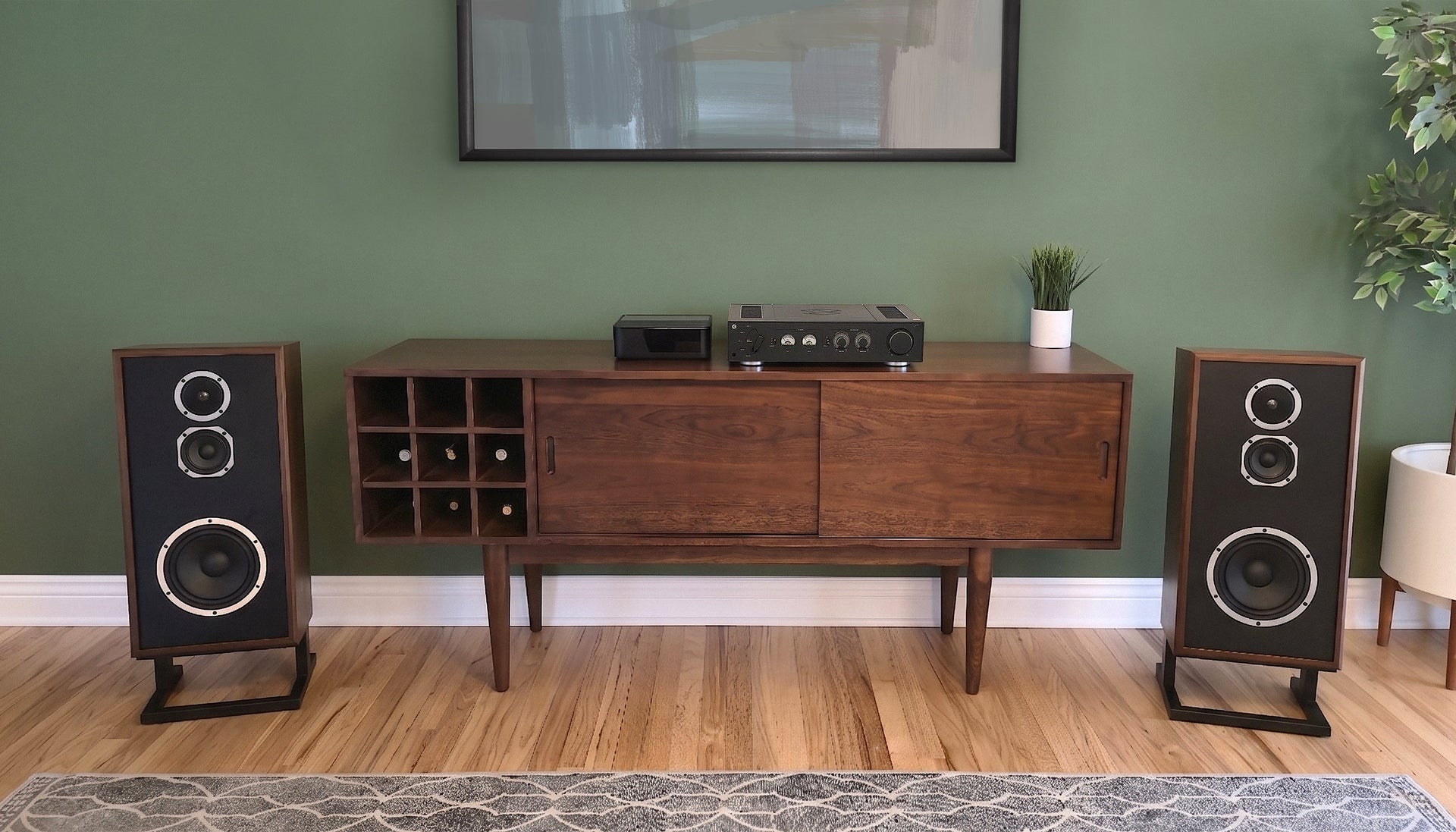
The most revealing thing about KLH Audio's newest speaker is its depth: 8.25 inches. The Model Four is wide, low and handsome in the way a walnut credenza is handsome, but that shallow measurement gives away the actual pitch. This is a serious passive loudspeaker built to sit a few inches from a wall, not a precious object that orders the sofa out of its way. In an industry that loves dedicated listening rooms, KLH is designing for the room with a plant, a dog, three chargers and nowhere sensible to put a ported tower.
That sounds like an ordinary product decision until you notice the company is using a loudspeaker architecture associated with 1954 to make it. Acoustic suspension puts a compliant woofer in a sealed cabinet. The trapped air works as a spring, controlling the cone and allowing measured bass from a smaller box. It can give up efficiency compared with some ported designs, but it also avoids a rear port's uneasy conversation with the wall. Old physics, newly convenient.
KLH has built a whole revival around that sentence. The current Model Collection runs from the compact Model Three at $799 each to the Model Seven, a 13-inch-woofer flagship listed at $4,999 a pair. Between them sit the familiar Model Five at $1,499 each and the Model Four, announced at $999.99 each. They share a visual language - broad faces, real-wood veneers, fabric grilles and angled steel risers - without pretending the drivers, crossovers or manufacturing methods are still from the Johnson administration.
01 / What the company actually does
It sells furniture that happens to move air
KLH makes passive loudspeakers for two-channel music and home listening. Passive matters. There is no battery, voice assistant or magical setup animation. The customer supplies an amplifier or receiver, speaker cable and a little patience. In return, KLH offers the sort of object that can remain in a room for a decade. Most current Model Collection speakers carry a 10-year warranty, which is a useful counterpoint to consumer electronics designed around the lifespan of an app.
The buyer is not only the spec-sheet audiophile. It is also the vinyl listener building a first serious system, the design-conscious homeowner who refuses a pair of black monoliths, and the home-theater customer who wants speakers to look like furniture. KLH's finishes and grille options do commercial work here. English Walnut, West African Mahogany, Black Ash, White Oak and Nordic Noir allow audio hardware to join the room instead of occupying it under protest.
The business is a familiar hardware braid: direct ecommerce, specialty dealers and international distribution. The website handles education, accessories and immediate checkout. Dealers let a pair of speakers do the one thing no landing page can - be heard. In Canada, Erikson Consumer became the exclusive distributor in 2025. The 2025 Victrola acquisition added a larger commercial machine across retail, marketing and ecommerce, while KLH remained aimed at the premium listener rather than being folded into a turntable logo exercise.
02 / The comeback
A famous name spends decades becoming obscure
KLH began in Cambridge, Massachusetts, in 1957. Its initials belonged to Henry Kloss, Malcolm S. Low and Josef Anton Hofmann. The company became a roll call of audio firsts: the Model Eight high-selectivity table radio, the Model Nine full-range electrostatic loudspeaker, the portable Model Eleven record player and the Model Forty tape recorder with Dolby noise reduction. At its early peak, KLH employed more than 500 people and shipped more than 30,000 speakers a year across six continents.
Then came the part most heritage-brand biographies blur into a tasteful sepia gradient. Singer bought KLH in 1964. Kloss eventually left. Ownership changed again, the original engineering group dispersed, and the name lost the coherent association it once had with product invention. The first thing that failed was not acoustic suspension. It was continuity. A badge can survive corporate transactions more easily than the reason anyone cared about the badge.
Former Klipsch and VOXX executive David P. Kelley bought KLH in 2017 and moved its headquarters to Indiana. His decision was less “bring everything back” than “pick a spine.” KLH launched a broad contemporary range, then reintroduced the Model Five in 2021. The new Five looked enough like the 1968 speaker to trigger recognition, while replacing period components with modern pulp-paper drivers, an aluminum-dome tweeter, a designed crossover, reinforced MDF and an adjustable acoustic-balance switch.
What changed the bet was evidence that buyers wanted the combination, not merely the name. Reviews praised the Five's balance of vintage scale and modern control. The Model Three followed in 2022, compressing the idea for smaller rooms. Victrola acquired KLH in April 2025 for an undisclosed amount. A new owner did not have to invent the adjacency: Victrola sells the machine that reads the record; KLH sells the boxes that make it audible. In 2026, shared chief commercial officer Heather Squire took responsibility across sales, marketing, ecommerce, retail and direct-to-consumer channels for both brands.
03 / Where the product bends
The first failure was a very pretty grille
No revival story should be allowed to float above the carpet. During a Stereophile review of the Model Three, a deep bass note produced an alarming flutter. The reviewer swapped channels, worried about loose screws and wondered whether a woofer was defective. The culprit was simpler: the magnetic fabric grille rattled under that specific bass load. Removing it made the noise disappear.
It is a small, useful embarrassment. KLH sells the union of sound and domestic beauty, which means neither half is decorative. If the handsome grille interferes with bass-heavy music, physics wins and the grille comes off. The same review found the speaker's bass strong and controlled after that correction, but the episode establishes the conditions. Deep low-frequency material, level, room behavior and accessories can expose a weakness that a normal showroom track does not.
There are broader limits. These speakers will not work for someone who wants a one-box wireless system, moves every six months, refuses an amplifier or expects a compact speaker to reproduce cinema-level sub-bass without compromise. Acoustic suspension is not a universal upgrade. It often asks more of the amplifier, and room acoustics still matter. Even KLH's three-position balance control - a gentle attenuation above roughly 400Hz on the Three and Five - is a correction tool, not a force field.
04 / The part worth stealing
Use the archive as a parts bin, not a shrine
The Model Four is the cleanest view of KLH's method. It takes the 8-inch woofer introduced in the Model Three; borrows the midrange driver, tweeter and crossover architecture of the Model Five; and uses the wide, shallow proportions explored by the Model Seven. The result targets a missing job: three-way, full-range sound in a living room where depth is scarce. This is not invention from zero. It is disciplined recombination.
8-inch woofer
3-way architecture
shallow stance
A company with history can copy the logic in five moves. First, identify the old idea the brand has the right to own. Second, translate it into a present-tense pain; KLH turned a sealed cabinet into easier placement. Third, build a ladder around rooms and budgets instead of producing disconnected commemorative objects. Fourth, reuse components and visual cues so each new product strengthens the family. Fifth, sell through channels suited to the proof. A speaker should be auditioned, so dealers remain part of the product even when Shopify handles the transaction.
The competitive set makes this discipline necessary. Wharfedale Linton, JBL Classic, Klipsch Heritage, Mission 770 and MoFi SourcePoint all play somewhere near the intersection of visible cabinetry, recognizable lineage and modern engineering. KEF and Monitor Audio offer different visual and technical answers. Wireless speakers and soundbars win on convenience. Restored vintage KLH pairs win on literal provenance. KLH cannot own “retro.” It can own a consistent connection between an old acoustic principle and contemporary rooms.
That is where KLH fits in the market: above mass-market boxes, below the most esoteric high-end systems, and to the furniture side of laboratory minimalism. Its expertise is not merely voicing drivers. It is packaging passive hi-fi so that a non-obsessive buyer can understand why the cabinet is wide, why the stand tilts and why the speaker can live near a wall. The company calls the audience music and movie lovers. The better word might be residents - people whose listening room is also simply their room.
KLH's acquisition price and current revenue are not public, so there is no tidy financial victory lap. That is healthy for the story. What remains is observable: a small revived brand built a legible collection, earned another owner, expanded distribution and launched a new model for a sharply defined use case. The company made its past useful without demanding that buyers live in it. In heritage hardware, that is enough of a plot.