The advertisement was paid for with a mouse mat. Years before Fractal Design reached the stock market, Hannes Wallin ran GTEK, a Swedish business selling the sort of computer equipment that enthusiasts could discuss for an entire evening. GTEK became an early advertiser on SweClockers. The payment, he later recalled, was something to put underneath a mouse.
It is a pleasingly modest object to find near the beginning of a hardware entrepreneur's story. A mouse mat has no processor, requires no firmware and rarely receives a keynote. Yet it belongs to the same world as the company Wallin would build: people who care very much about the things surrounding their computers.
Wallin founded Fractal in 2007. Its opportunity lay in an everyday question: why should a powerful computer have to look so busy? His answer grew into a business selling cases, cooling and power supplies internationally. Eventually, he would apply a related question to his own position. How much of the founder's original job should the founder keep?
A quieter sort of ambition
Before making products under his own brand, Wallin worked in distribution. GTEK dealt in cooling equipment, cases and hardware for people who modified their machines. That placed him close to a useful intersection: what manufacturers offered, what shops stocked and what enthusiasts actually wanted to buy.
By 2008, Captech had bought GTEK. The retail shop would disappear while the distribution operation continued within the larger company. Wallin explained the arrangement in practical terms: customers would benefit from the resources and logistics of a bigger distributor. The transaction also belongs to the period when Fractal was becoming his central business.
The new brand entered a crowded market. There were already plenty of businesses capable of making a metal box for a motherboard. Wallin's opening was a particular combination of appearance, usefulness and price. He wanted something simple enough to sit comfortably in a room, without making the owner surrender the features that had justified assembling a computer in the first place.
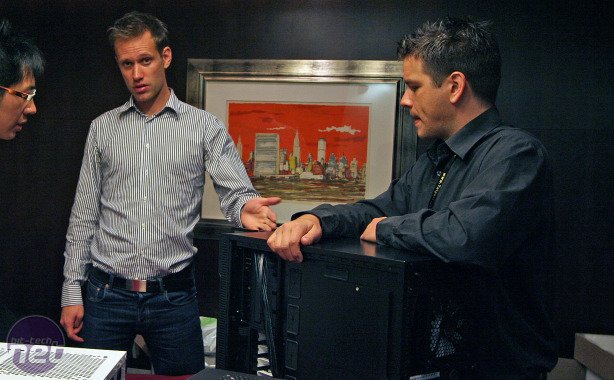
In 2010, Wallin and colleague Tommy Leeman described customers who wanted a clean, quiet case but had been buying soundproofing separately and doing the work themselves. A finished product could save them that trouble. The same restrained exterior also worked for office and CAD users. A computer case could accommodate serious hardware without arriving dressed for a nightclub.
The Define R2 made that argument tangible in 2009. Its priorities included storage, a considered internal layout and a comparatively restrained exterior. In the team's early explanation, the balance between two optical-drive bays and eight hard-drive bays reflected how people were using computers. Taste came with a parts list.
“What if you made a case that was built on design and function, rather than flair and fanfare?”
Hannes Wallin
The snow on the boat window
Wallin's account of Fractal's name begins some distance from a computer shop. He was out in a boat catching lobster during the period when the company was being discussed. It was cold. On the window, he noticed the geometric beauty of snow crystals.
He described being struck by the arrangement of their lines and surfaces: natural forms that were individual yet possessed a clear order. The crystals helped inspire the company's name and original snowflake logo. A boat window is an unusual place to conduct a branding workshop. It does have the advantage of discouraging PowerPoint.
The story also makes sense of his interest in objects beyond PCs. During a visit to Japan in 2014, Wallin talked about his admiration for craftsmanship: repeating a task, improving it and continuing until the result was right. He saw an affinity between that approach and Fractal's own ambitions.
For him, minimalism involved asking what a user needed and which elements could be removed. The work was in deciding. A plain front panel still had to coexist with ventilation, access and maintenance. Each omission left the remaining decisions more exposed.
What does the
user need?
What can we
leave out?
How will it
work every day?
An idea bank with a long memory
Wallin described ideas arriving through conversations, natural scenery and even looking at audio equipment. He and the development team kept an “idea bank” containing pictures, photographs and web articles. Something filed away today might become useful in a product a year later.
There is a different tempo here from the familiar tale of a single flash of inspiration. An idea could sit beside other ideas until a practical reason to use it appeared. The bank gave an observation somewhere to wait. It also made that observation available to colleagues, rather than leaving it inside the founder's head.
By his 2014 account, developing a product could take nine months to two years. The Define R5 had taken two years. That is a substantial amount of attention to spend on an object whose exterior was supposed to look uncomplicated.
The results were often small conveniences. The R5's front door could be mounted to open from either side. Cable straps helped manage wiring behind the motherboard. The bottom filter could be pulled out towards the front, making cleaning possible without moving the case. These are features whose value becomes particularly clear once a desk, a wall and several cables have complicated the owner's afternoon.
Wallin also pointed to the quick-release side panel and a tidy appearance when the top ventilation covers were fitted. This was the detail beneath the aesthetic: giving someone access when needed, then allowing the machinery to settle back into the room.
From a case to a listed company
Litorina invested in Fractal in 2016. Its plan included new product categories, refined sales and marketing, and expansion into additional geographies. Those ambitions required more than a convincing case design. A company serving customers across borders also needed distribution, service and an organization capable of repeating its work.
On 11 February 2021, Fractal began trading on Nasdaq First North Premier Growth Market. The offering price was SEK 41 per share, corresponding to a market capitalization of approximately SEK 1.194 billion. The offering consisted of existing shares sold by shareholders, principally Litorina.
- 2007Fractal begins
- 2009Define R2 arrives
- 2021Public trading begins
- 2024Founder becomes chair
Wallin's statement at the listing set out a fairly concrete programme: develop products, serve customers, enter additional categories and expand geographically. The language of a public offering can become airborne rather quickly. These were tasks that would eventually have to land on somebody's desk.
Product development kept moving. Later in 2021, Fractal introduced Torrent, a case built around cooling performance. Its recognition included a Gamers Nexus award, and Wallin publicly credited the team. A brand associated with quiet, restrained boxes was also making room for users whose first concern was airflow.
The distinction matters to his story. A recognizable design philosophy had to accommodate different practical requirements. The founder's original taste could provide direction, while engineers and customers supplied reasons to develop it. Otherwise, a successful first answer might become a rule that prevented the next useful question.
Leaving the CEO's chair, keeping a seat
In December 2023, Wallin announced that he would step down as chief executive. Jonas Holst, Fractal's head of global sales, would take over on 1 January 2024. Wallin was proposed as board chair and became chairman during 2024.
He explained publicly that the decision was his own. The next stage of growth brought different challenges, and he believed another person could lead that phase better. He wanted to concentrate on longer-term strategy alongside the CEO and management team.
“As such, I'm leaving but not leaving.”
Hannes Wallin, announcing the transition in 2023
The wording has the neat awkwardness of a founder trying to describe a change that outsiders might mistake for a farewell. He was giving up the executive role while remaining involved in the company's future. Ownership continued too: Wallin participated when Litorina sold its remaining holding in December 2023.
The roles are distinct in everyday practice. A chief executive runs the business; a board sets direction, oversees management and appoints the CEO. For someone who began close to products and customers, moving between those responsibilities changes how influence is exercised. The founder can still care about the details without being the person responsible for every decision.
By September 2026, Wallin remained chairman. Fractal had expanded its ambitions around the gaming setup, including furniture alongside cases and cooling. The question of what belongs around a computer had become larger than the box beneath the desk.
Still close enough to hear
There is an ordinary enthusiast beneath the boardroom biography. In 2021, Wallin named Age of Empires II: Definitive Edition among the games he played and said he read hardware news and forums daily. The person selling equipment was still spending time among the people using it.
That proximity runs through the story: distribution before manufacturing, customer comments before specifications, pictures saved before products existed. His early development process began by understanding the market's needs, then moved through ideas, drawings, prototypes and testing. The plain appearance at the end concealed a sequence of conversations.
The mouse mat makes a useful bookend. It belonged to a small circle of enthusiasts trading attention, equipment and opinions. Fractal grew far beyond that scale. Wallin's continuing task as chair is to help guide a company with a much wider audience. The useful question remains close to the original one: what would make somebody's experience at the computer a little better?