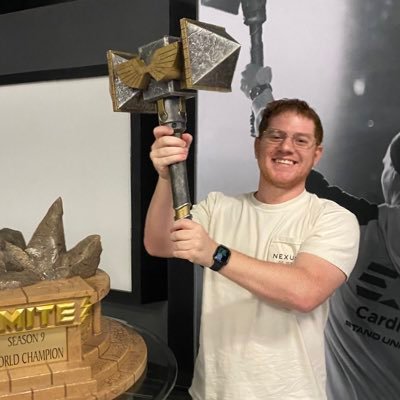
The Man Wiring Gaming's Creator Economy Wants Creators on the Payroll
Justin Sacks runs a company built on a simple observation: the people who convince you to download a game rarely get paid when you do. As co-founder and CEO of Nexus, the Austin-based platform behind creator programs for live service titles, he spends his days closing that gap. When a player types a creator's code into an in-game store and buys something, that creator earns a share. Multiply that across thousands of creators and dozens of games, and you get the business Sacks has spent the last several years building.
Nexus describes itself, in Sacks's own shorthand, as "a creator program in a box." The pitch is deliberately unglamorous. Live service games - the always-online, constantly-updated titles that dominate modern gaming - live and die by discovery and retention. Content creators drive both. But wiring up a program that finds the right creators, tracks who actually drove a sale, and pays them fairly is a genuine engineering and operations problem. Publishers used to solve it with full internal teams over months. Nexus turns it into something a studio can switch on.
"Content creators are the driving force for discovery and retention for games, but it's incredibly challenging for game publishers to identify attribution or work with creators at scale."
That word - attribution - sits at the center of everything Sacks talks about. For years, gaming's marketing spend flowed toward influencer campaigns that were hard to measure. A creator posts a video, downloads tick up, and nobody can prove the link. Sacks frames creator programs as the opposite of that guesswork. They are performance-driven by design: a creator's code follows the player into the game, and the resulting purchase is trackable. The creator, the publisher, and the player all sit inside a loop where incentives point the same direction.
From competitive player to the business side
Sacks did not arrive at this from a spreadsheet. By his own account he has spent roughly 15 years in gaming, moving through the industry's layers - competitive gamer first, then content creator, then business development for a global gaming media company, Curse, Inc. That progression matters to how he talks about the work. He has been the person making content and the person cutting the deals, which is why he tends to describe creators less as a marketing channel and more as the culture itself.
"Gaming influencers are pop culture; they are the celebrities of today."
Before Nexus, Sacks founded Chrono.gg, a daily game deals site that built a following among PC players hunting for discounts. Chrono was a discovery play - a way to help people find games worth buying. But Sacks watched the mechanics of discovery move out from under the storefront model. People were no longer finding games through deal sites or ad units. They were finding them through the creators they already followed. Nexus, co-founded in 2020, was the answer to where the audience had actually gone.
A thesis about the future of work
Ask Sacks where this is heading and the answers get large. He has said, more than once, that "the most common occupation in the future will be creators," and paired it with a line he seems fond of: "Yesterday's astronauts are tomorrow's YouTubers." The point underneath the sound bite is serious. If a meaningful share of people will earn a living making content, then the tooling that pays them - fairly, at scale, with clean measurement - is infrastructure, not a novelty. Sacks is building for the version of the world where that has already happened.
How a Support-a-Creator program works
Why he thinks this becomes standard
Sacks is candid that creator programs are still an edge today, not a default. That, to him, is exactly the opportunity. He argues the window is closing: what looks like a competitive advantage now will soon be a baseline expectation, the way a game today is expected to have a Discord or a battle pass. Studios that build the muscle early, in his telling, compound the benefit; those that wait end up bolting it on under pressure.
"Creator programs are competitive advantages today, in just a few years they'll be expected table stakes."
He also watches where the money is physically moving. Sacks has pointed to a strong pull toward direct-to-consumer sales, especially in mobile, where publishers increasingly route players to their own web storefronts rather than surrendering a platform cut. Creator codes are a natural fit for that shift: a creator becomes the reason a player leaves the app store and checks out on the web, and the attribution holds all the way through. It is the same alignment idea, applied to a new sales surface.
The Nexus flywheel
Games, books, food, and work
For all the talk of infrastructure and table stakes, Sacks keeps a narrow definition of his own life. "My life is only four things," he has said. "Games, books, food, and work." It is a founder's answer, delivered without apology, and it fits the arc: someone who started inside games as a player and never really left, just kept climbing until he was building the layer everyone else stands on. He points to studios he admires - Supercell among them - as pioneers who got the craft of games right, and positions Nexus as the piece that lets that craft reach the creators who carry it to players.
"It's about connecting with players in the ways they want to be engaged with."
The recent proof points are getting bigger. In late 2025 Nexus launched a creator program for Sonic Rumble alongside SEGA and Rovio, a blue-chip pairing that signals the model has moved past scrappy indie titles into franchise territory. Earlier programs for games like Bloons TD and Town of Salem showed the mechanics worked; the SEGA partnership suggests the majors are paying attention. For a company that started as a deals site and evolved into a creator platform, it is a long way from where Sacks began - and, if his read on the future holds, still early.
What comes next depends on whether his central bet lands: that creators are not a marketing tactic but the future shape of work, and that games are simply where it is happening first. Sacks has organized his company, and by his own description most of his waking hours, around the assumption that they are. The rest of the industry is starting to build as if he might be right.
Yesterday's astronauts are tomorrow's YouTubers.
The most common occupation in the future will be creators.
We're a creator program in a box.
My life is only four things! Games, books, food, and work.