In August 2018, an investor finished leaving Medpace. August Troendle stayed. Cinven had backed the Cincinnati company, helped expand its staff and international operations, and taken it to the stock market. Now the private equity firm was selling its remaining shares. For Cinven, this was an exit. For the founder, it was another date in the life of a business he had started in July 1992.
There is something pleasantly awkward about fitting Troendle into the usual entrepreneurial plot. The business gets bigger. New owners arrive. The company goes public. Yet the central character continues to occupy the same two positions: chief executive and chairman. Thirty-four years after founding Medpace, he still holds both jobs. The business card has had considerably less excitement than the business.
His career is an unusually long experiment in organizational continuity. Its recurring questions concern who does the work, how people learn to do it, and whether a growing company can preserve the habits that made customers hire it in the first place. These questions rarely make a glamorous entrance. They do, however, have a habit of returning every Monday morning.
An education on both sides of the desk
Troendle earned his MD at the University of Maryland School of Medicine and an MBA at Boston University. His early employment put him inside two different kinds of institution. From 1986 to 1987 he worked at the US Food and Drug Administration. From 1987 to 1992 he worked in management at Sandoz, the company now associated with Novartis.
The sequence matters. Government and industry have different responsibilities, different reporting lines, and different ways of judging whether work is ready to move forward. Troendle had worked within both before becoming a founder. That background gave his next move a practical context: he was starting an organization in a field whose institutional demands he had already encountered.
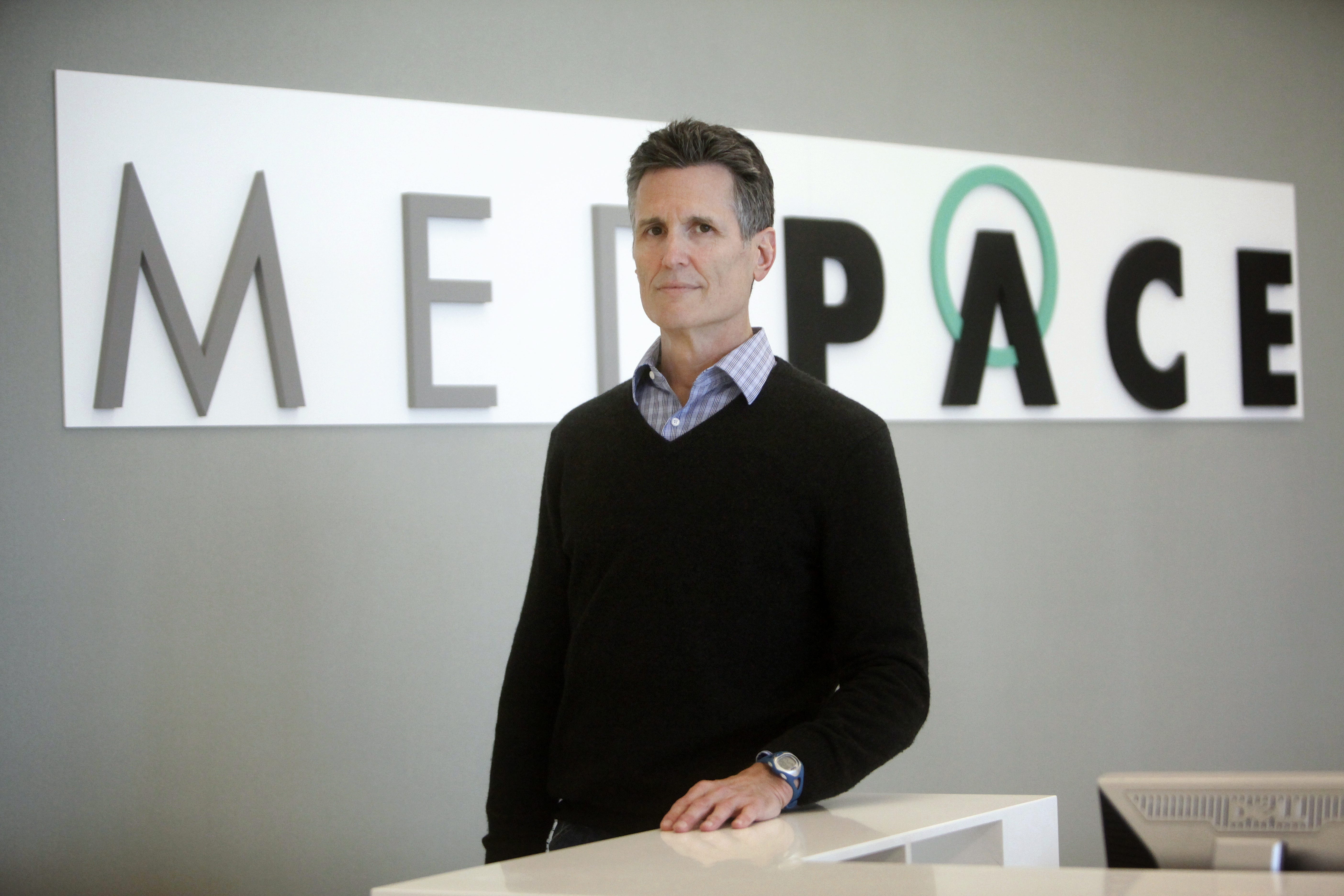
In July 1992 he founded Medpace in Cincinnati. The city remained its headquarters as the operation expanded abroad. His continuing presence is easy to establish; the private moment in which a person decides to become an entrepreneur is harder to compress into a neat scene. The observable decision was consequential enough. He would spend the next three decades running the organization he had created.
The attraction of keeping the pieces together
Medpace built its identity around a full-service model. Customers could put a coordinated body of work with one organization, supported by shared systems, project management and specialist teams. Smaller and midsized businesses became a particular focus. For an enterprise with limited internal resources, the ability to work with an established operating organization has an obvious practical appeal.
That choice also places a burden on the supplier. A company offering a coordinated service has to make its own departments coordinate. It must train people, maintain common methods and make information travel between functions. The promise on the outside becomes a management problem on the inside. An attractive diagram on a sales presentation does very little of this work by itself.
teams+Shared
systems+Coordinated
management
Troendle’s emphasis on growth from within was already explicit in 2015, when he received an EY Entrepreneur Of The Year award in the Ohio Valley region. “Medpace has enjoyed substantial organic growth,” he said. The phrase sounds modest beside the vocabulary of entrepreneurial reinvention. It describes a demanding preference: increase the capacity of the organization you already have.
An investor presentation the following year described growth since inception as almost exclusively organic and dated the start of its global expansion initiative to 2004. This was a business learning to reproduce its operating methods across borders. The founding idea had to survive more people, more offices and more opportunities for an instruction to acquire a different meaning along the way.
New owners, the same founder
Continuity did not mean keeping outside capital at arm’s length. CCMP became an owner in 2011. In February 2014, Cinven announced an agreement to acquire a majority investment from CCMP for $915 million, plus specified cash inflows. Troendle and the management team would remain significant minority investors. The announcement specifically preserved his place at the head of the company.
Troendle explained the geographic logic at the time. Medpace had been growing in Europe, and Cinven brought a European presence and experience supporting expansion in Asia. Here was a founder willing to change the ownership structure while continuing to lead the operation. Capital and management had different clocks, and the arrangement allowed both clocks to keep running.
The next transition came in August 2016, when Medpace completed its Nasdaq initial public offering at $23 a share. Two years later, Cinven’s final sell-down closed its investment chapter. By its account, Medpace’s workforce had grown from roughly 1,500 people in 2014 to 2,700 in 2018, alongside investment in systems, infrastructure and additional staff.
These were meaningful changes in the surroundings of the founder’s job. Private owners could eventually sell their holdings; public shareholders could arrive and leave daily. The work of running the company continued across those changes. Troendle’s story makes the distinction unusually visible because the person responsible for operations remained in place while the shareholder register changed around him.
Cincinnati becomes part of the operating plan
A company’s ideas eventually occupy actual rooms. In Medpace’s case, they also occupied a substantial piece of Cincinnati’s Madisonville neighborhood. Its headquarters development reused a former NuTone manufacturing site. The location connected a global business to a particular urban landscape, with all the construction, employment and public decisions that such a connection entails.
In December 2022, Medpace announced a $150 million expansion plan expected to add 1,500 jobs. Troendle’s comments concentrated on the people who might fill them. Many new employees, he said, would arrive without prior industry experience. The company would need to provide “training and mentorship and support.” The short list tells you more about the mechanics of expansion than a rendering of an office tower.
The physical setting acquired a more sociable life, too. The Summit Hotel opened in 2018; Element Eatery followed in 2022. Both are separate from Medpace and managed through Troendle’s AJT Management. By 2024 the wider Madison Square development included places to eat, gather and spend time beyond the working day. A headquarters address had become somewhere people could also choose dinner.
That distinction matters when considering Troendle’s connection to Cincinnati. His business presence extends beyond a corporate title, into property and hospitality. The uses share a location, but they are separate enterprises. Together, they make his investment in the city tangible: offices for work, rooms for visitors and tables for people who have no intention of discussing a quarterly forecast.
“Training and mentorship and support.”
August Troendle, on hiring people new to the industry, December 2022
The founder has colleagues
A long tenure can make a company’s history look like a solo act. Medpace’s leadership history gives a fuller picture. Susan Burwig joined in August 1993, little more than a year after the founding, and became executive vice president of operations. Jesse Geiger became president in August 2021, when Troendle’s own period as president ended.
That handoff deserves attention precisely because it did not involve the founder disappearing. Troendle remained CEO and chairman while another executive took the presidency. The organization could change its division of responsibility within a continuing leadership structure. Thirty years of company history contain many such decisions that are less photogenic than a listing ceremony and more useful to the next working day.
In 2022, Troendle and Burwig attended the opening of an additional floor at Medpace’s Warsaw office during the company’s thirtieth anniversary celebrations. The occasion ended with food, drinks and colleagues socializing. It is a small, concrete scene in a corporate history that otherwise tends to be measured in investment amounts. A growing international office still needed people to turn up in person.
What the quarter can tell you
By the second quarter of 2026, the scale of the business was visible in a different unit: $707.3 million of quarterly revenue, an increase of 17.2 percent from the corresponding period a year earlier. The reported number measures activity over three months. It also represents an organization built over a much longer stretch of time.
On the accompanying call, Troendle described demand, cancellations and staffing. His account of the workforce was specific: employee growth was predominantly in the United States, with additional growth in Asia Pacific, including India. Turnover had remained low by the company’s historical standards. These were observations about the capacity available to meet work, rather than a new founding manifesto.
His earlier comments about customers being acquired were equally direct. In April 2026, he described the loss of future business that can follow when a customer joins a larger company. “It’s a loss for us,” he said. A customer’s successful exit can therefore create a supplier’s commercial headache. Entrepreneurship is generous enough to provide several interpretations of the same celebration.
Troendle’s continued role puts him in charge of managing those changes as well as describing them. The company cannot freeze its customers in place or arrange for demand to arrive at convenient intervals. Keeping an organization together still means adjusting it to circumstances that its founder does not control.
Another date on the calendar
Medpace has scheduled its third-quarter 2026 results for October 21, with a conference call the following morning. As of October 20, those are forthcoming events. The next entry in the story will include another set of figures and another round of questions about the organization’s direction.
The striking feature of Troendle’s career is how much change has fitted inside a continuous commitment. He has worked with different owners, led a public listing, expanded internationally and kept a substantial business anchored in Cincinnati. The original company has become a much larger employer without requiring its founder to become a historical footnote.
There is an ordinary pleasure in that ending, provisional as it is. After the transactions, the ceremonies and the anniversary photographs, there remains an organization full of people whose work must fit together. Troendle is still responsible for helping it do so. For a founder who started in 1992, staying has turned out to be a considerable amount of work.
Follow the story
- Medpace · Company website
- August J. Troendle · Official biography
- EY Entrepreneur Of The Year · Watch the 2015 video
- Cinven · The 2014 investment
- Cinven · The 2018 exit
- Madison Square · The Cincinnati development
- Medpace · Warsaw anniversary celebration
- Medpace · Q2 2026 results
- Medpace · Next results announcement