A television is easy to sell in a photograph. It is considerably harder to carry upstairs, mount level, connect to five boxes and explain to a family whose streaming password has vanished. Best Buy has spent six decades learning that the distance between a product and a working product is where a specialist retailer can still earn its keep. Its shelves hold familiar goods - laptops, phones, refrigerators, game consoles - but the useful thing it sells is reduced uncertainty.
That distinction explains why the blue storefront remains standing after ecommerce stripped mystery and margin from electronics. A shopper can research a processor at midnight, compare prices in seconds and order from almost anywhere. Best Buy does not pretend otherwise. Roughly 34 percent of its fiscal 2025 domestic revenue was already online. Instead, the company connects digital shopping to more than 1,000 North American stores, trained associates, local pickup, delivery crews and Geek Squad technicians. The store has become less a warehouse with fluorescent lights and more a physical endpoint for the internet.
The tornado in the origin story
Best Buy began in St. Paul in 1966 as Sound of Music, an audio shop founded by Richard Schulze with a business partner. The delightful turn arrived in 1981, when a tornado tore through a Roseville store. The company moved damaged and excess inventory into a parking-lot sale, advertised bargains with unusual urgency and found shoppers waiting. What began as salvage became a lesson: broad selection, visible prices and a no-frills atmosphere could move more merchandise than the commissioned stereo salon.
Sound of Music became Best Buy in 1983. The warehouse-style, non-commissioned format and yellow tag followed later in the decade. This was not merely cosmetic. Removing the negotiation changed the emotional contract. Shoppers could roam, compare and choose without wondering whether a salesperson’s enthusiasm tracked the size of a commission. By 2000 the company had opened BestBuy.com; in 2002 it joined forces with Geek Squad. Those moves placed self-service and expert service side by side, a pairing that still defines the business.
The moat is the awkward hour after checkout.When the screen is too heavy, the router blinks red, or the old machine needs somewhere responsible to go.
One store, six jobs
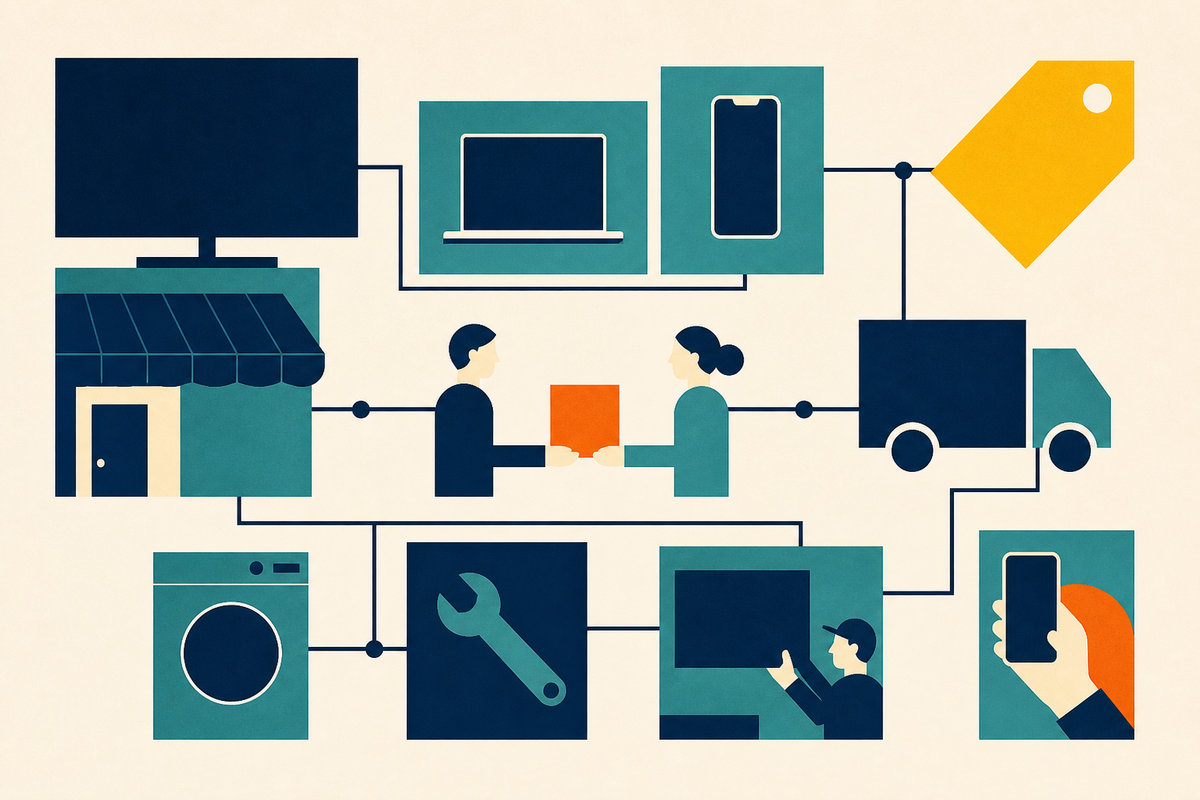
Consider what happens inside a modern Best Buy box. It is a showroom for products that benefit from touch: an OLED screen beside another screen, a mechanical keyboard under actual fingers, a refrigerator door opened before it occupies a kitchen. It is also a same-day pickup point, a returns desk, a repair intake counter, a source of advice and a local node in a national fulfillment system. New shop-in-shops, such as Meta Lab spaces introduced in more than 50 stores in 2026, turn unfamiliar devices like AI glasses and VR headsets into things a customer can try before believing.
That bundle is the company’s answer to generalists. Amazon offers extraordinary breadth and shipping; Walmart and Target combine electronics with routine errands; Apple controls a polished universe of its own products; Home Depot and Lowe’s have deep relationships around appliances and the home. Best Buy’s place between them is narrower but coherent: a multi-brand technology specialist that can advise without manufacturing most of what it recommends, then deliver, install, protect and repair the purchase.
Its customers are as varied as the objects that require a charging cable: families replacing an appliance, students buying a first laptop, gamers tuning a setup, people fitting a home theater, and enthusiasts who enjoy the spec sheet. Best Buy Business extends the system to schools, small firms and enterprises with procurement, deployment, support and device retirement. The common problem is not access to hardware. It is choosing compatible hardware and keeping it useful through a messy life.
A lifecycle disguised as a checkout
Geek Squad is the clearest expression of that idea. Agents troubleshoot computers remotely, install televisions and smart-home equipment, repair phones and appliances, recover data and help tame home Wi-Fi. Protection plans and My Best Buy Total can make support recurring rather than episodic. Plus and Total members began earning rewards on eligible purchases in June 2026, a notable return to the ordinary retail pleasure of points. The memberships are designed to pull the customer back while product protection and support stretch the relationship beyond the transaction.
Trade-in and recycling close the loop. A working device may return as gift-card value, move through a secondary market or supply parts for refurbishment. A dead one can enter the recycling stream in store, by mail or through haul-away. Best Buy says it has collected more than 2 billion pounds of electronics and appliances since launching its recycling initiative in 2009. The program solves a mundane but real problem: a drawer of obsolete phones is easy to accumulate and strangely difficult to empty responsibly.
The shelf becomes a platform
The newer Best Buy is not satisfied with product margin and service fees. Marketplace, launched in August 2025 on technology from Mirakl, more than doubled the online assortment. Hundreds of brands and third-party sellers added accessories, furniture, kitchenware, musical instruments, seasonal decor and even movies, which had previously left the shelves. The logic is sensible: a shopper buying a television might also need the stand beneath it, seating opposite it and an air fryer for game day.
Marketplace gives Best Buy breadth without requiring it to own every unit of inventory. It also introduces the familiar marketplace hazard: if abundance makes the catalog feel indiscriminate, Best Buy risks weakening the curation that helps distinguish it. The company’s stores provide one unusual bridge. Marketplace purchases can be returned locally, and an associate can help a customer build an online basket even when the item is not on the floor. The physical network absorbs some of the friction that third-party ecommerce usually exports to the buyer.
Best Buy Ads is the second platform bet. Brands pay to reach people who are actively shopping for technology across the retailer’s digital properties and, increasingly, its stores. At a 2025 showcase, the company said it could connect 93 percent of transactional revenue to a customer ID. That makes closed-loop measurement - whether an ad contributed to a sale - the pitch. A bank of televisions is simultaneously inventory, demonstration space and media surface. The retailer’s in-house studio adds creative production to the package.
The people problem
The model depends on expertise being available at the exact moment a shopper wants it. That is both Best Buy’s advantage and its operating burden. Advice requires training; delivery and repair require scheduling; a store network creates rent and labor costs whether the latest device cycle is exciting or sleepy. Consumer electronics also has brutal rhythms. A pandemic can pull demand forward, a housing slowdown can cool appliance sales, and a thin year of product innovation can persuade people that last year’s television is perfectly fine.
Best Buy’s public culture language emphasizes learning from change, humility, integrity and the power of its people. That can sound like a plaque in a break room until one sees where the strategy places the employee. The associate is meant to translate specifications into a decision, the technician to make the promise real, and the creative team to turn an unfamiliar device into a reason to care. In fiscal 2025, the Best Buy Foundation also reached more than 86,000 young people through technology programming, including Teen Tech Centers. Expertise is both commercial product and community theme.
A handoff at sixty
Best Buy enters its seventh decade with a leadership change scheduled. Corie Barry is due to step down at the end of October 2026, and Jason Bonfig will become the company’s sixth chief executive on November 1. Bonfig is an internal operator who joined as an inventory analyst in 1999 and most recently oversaw merchandising, ecommerce, marketing, supply chain, Canada and Best Buy Ads. He also led the creation of the U.S. marketplace. The resume points to the assignment: make the pieces reinforce one another.
The company does not need to become a technology manufacturer or a boundless everything store. Its more interesting opportunity is to make the physical network compound: a demonstration should lead cleanly to a purchase; a purchase to membership or installation; a repair to trust; a trade-in to the next device; a customer relationship to measurable advertising value. Each loop makes the familiar blue box do another job.
That is why the humble moment after the sale matters. Technology promises a better evening, a faster workday, a safer home or a healthier routine, then arrives as cardboard, cables and instructions. Best Buy’s business is to occupy that gap without making the customer feel foolish for needing help. The gadget will eventually become a commodity. Confidence remains harder to ship.