Fred Chang’s customers wanted to take the computer apart before they had even bought it. At ABS Computers, the business he had founded to sell complete systems, requests kept arriving for individual components. A buyer wanted a particular piece, rather than the whole machine. For a company organised around assembling PCs, this was an awkward sort of compliment. Customers liked the ingredients. They proposed to do the cooking.
Chang helped turn that demand into Newegg, which opened in January 2001. The timing gave the venture a certain cheek. Internet commerce had recently acquired an expensive reputation for promises it could not keep. Here came another online store, with an egg in its name, offering computer enthusiasts the means to make their own machines. Its proposition was unusually concrete: choose the components, place the order, build the PC.
The customers asked for the pieces
Chang came to the business from Taiwan and earned a bachelor’s degree in applied mathematics at Chinese Culture University. Before Newegg, there was ABS Computer Technologies, founded in 1990. That earlier company served the sort of customer for whom a computer’s specifications were an absorbing subject. Gamers and demanding users bought systems built to order. The details mattered because the customers understood them.
The requests for separate parts exposed a gap between what ABS was equipped to sell and what some of its buyers wanted. A complete machine bundled together decisions those customers preferred to make individually. Selling components would let them exercise that preference. It also required a business designed to handle a different kind of order.
Chang’s early collaborators included Howard Tong and Ken Lam. Contemporary accounts identify Tong as an engineer and Lam as a programmer. Tong became a prominent public voice for the company, explaining the audience and the commercial logic behind it. Chang supplied the founding impetus while the enterprise took shape around an existing community of people who knew what they wanted to build.
It is a pleasing origin for a retailer. The customer’s troublesome request became the point of the shop. A person who wanted only a motherboard could be served on those terms, without first being persuaded to purchase the rest of a computer.
A shopping cart with a workshop attached
Building a PC involves buying objects that must work together. A promising specification is useful; the wrong connector is a small tragedy with a return label attached. For such shoppers, information has immediate practical value. The store must help them judge the item as well as acquire it.
Newegg developed a shopping experience with detailed descriptions, photographs and customer commentary. By 2017, its offering included more than three million customer reviews, tutorials and high-resolution product galleries. These features made room for the questions that accompany a technical purchase. They also gave the experienced buyer something more useful than a salesman’s assurance that everything was excellent.
There is a social quality to this sort of retail. Someone else has already fitted the part, wrestled with the instructions or discovered a peculiarity. Their account can help the next person decide. A store that brings those experiences close to the product gives its customers a reason to read carefully before reaching for the card.
“We’re not the cheapest price, but we’re competitive.”
Howard Tong, Newegg vice president, 2006
That distinction suited an audience with particular requirements. Price mattered alongside selection and service. A component that meets the build’s needs is worth identifying properly. The retailer’s task was to make that selection manageable, then make the transaction dependable. The customer would handle the screwdriver.
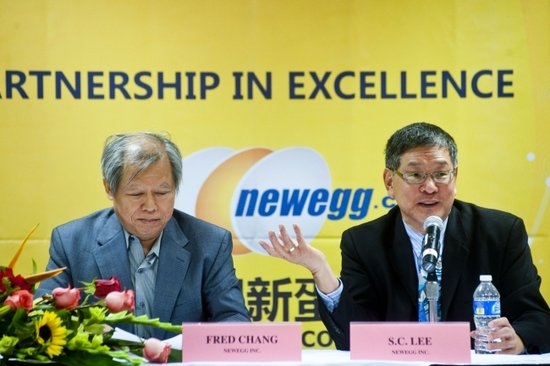
The website needed shelves
A website can take an order very elegantly and still disappoint the person who placed it. Newegg’s early operation paid attention to the part of the experience that began after checkout. It owned inventory and fulfilled shipments directly, giving it control over goods that other online retailers might have relied on distributors to supply.
In 2005, its warehouse network included facilities in California, New Jersey and Tennessee. Photography studios in the warehouses helped produce detailed product images. The arrangement joined two apparently different jobs: showing a buyer what was available, and keeping the physical item ready to send. Both jobs served the same purchase.
Owning stock meant committing money and space before the next order arrived. It also made availability a question the retailer could answer with goods on its own shelves. A promise on a screen acquired a material foundation. For someone awaiting the last component of a build, that foundation was rather more interesting than the screen.
By 2007, the company was also using an inventory system that stopped orders when an item ran out. It resisted advertisements that would clutter the shopping experience. These were operational choices with consequences for the customer’s time and attention. A store can make money in several ways; it still has to decide what it wants a visit to feel like.
A billion dollars, in components
The scale soon made the specialist audience difficult to dismiss. Newegg recorded $980 million in sales in 2004. Revenue reached about $1.3 billion in 2005. The buyers looking for their own particular combination of parts added up to a considerable business.
The later figures continued the ascent. Company materials put revenue at approximately $1.9 billion in 2007, $2.1 billion in 2008 and $2.3 billion in 2009. Each figure belongs to its year. Together, they show how quickly this store for technically interested customers grew beyond the dimensions the word “niche” might suggest.
Hardware enthusiasts also brought another useful connection. Some were the people who looked after computers at work. Their familiarity with buying parts for a home machine could carry into purchases for smaller businesses. A customer’s hobby and professional responsibility occasionally shared a shopping list.
The company expanded into other electronics, but its origins remained legible in the way it served the buyer. Choosing a processor or a hard drive requires a different conversation from choosing a decorative object. Chang’s business had grown by taking that conversation seriously. The specificity was part of the attraction.
There is a useful distinction between a broad market and an indifferent audience. Newegg’s early customers had strong preferences. Their purchases required decisions, and their satisfaction depended on more than getting any available machine onto a desk. Serving that audience meant accepting its interest in detail. A retailer could grow with those customers by helping them make the next choice, whether it was a modest upgrade or the components for another complete build. The commercial opportunity lay in the sequence of purchases as much as the first order. A computer assembled from parts could bring its owner back for more parts.
The founder who kept coming back
Chang’s public profile remained comparatively quiet. Contemporary coverage repeatedly described a founder who avoided interviews. The company’s egg puns were considerably more talkative. For readers accustomed to entrepreneurs who narrate every stage of their ascent, his career offers a change of pace: the decisions and the job titles carry much of the story.
Those titles also require dates. His documented terms as Newegg Inc.’s chief executive ran from October 2005 to August 2008, January 2013 to January 2015, and October 2019 to March 2020. The repeated returns resist the neat founder biography in which an executive either stays forever or leaves for good.
2005-2008October to August
2013-2015January to January
2019-2020October to March
He also served on the subsidiary’s board, departed in 2018 and returned in September 2019. Board membership and day-to-day executive management are different responsibilities. In Chang’s case, distinguishing them makes the continuity easier to understand. The founder could remain connected to the company while another person occupied the CEO’s chair.
Newegg’s public-company chapter arrived in May 2021 through its combination with Lianluo Smart Limited. The renamed Newegg Commerce began trading under NEGG on May 20. It was a corporate transaction with several moving pieces, arriving two decades after the store’s founding. The familiar name on the shopping site now also belonged on a stock-market screen.
Twenty-five years after the first order
In 2026, Newegg marked its twenty-fifth anniversary with a campaign celebrating builders, gamers and technology enthusiasts. The choice of audience brought the story back to its beginning. After all the changes in products and corporate structure, the customer assembling a computer still had a place in the company’s account of itself.
Chang remains a director of Newegg Commerce. The company also records him as chairman of Taiwan Commate Computer since July 2003 and chairman and CEO of Nurodata since October 2024. His present working life therefore extends beyond the retailer with which his name is most closely associated.
His ownership remains part of the picture too. An October 16, 2026 disclosure reported beneficial ownership of 4,145,400 Newegg shares, or 19.8%, including exercisable options. It also recorded sales by Tekhill, one of the entities through which he holds shares. These are dated ownership figures, separate from the history of his executive appointments.
The lasting appeal of the origin story is its modest unit of observation. Customers asked for components. Chang and his colleagues built a business that could supply them. A buyer could select a case, a board and the other pieces, then make something personal from standard parts. There is room for considerable ambition in that exchange. Sometimes it arrives in several boxes, with the assembly left to you.