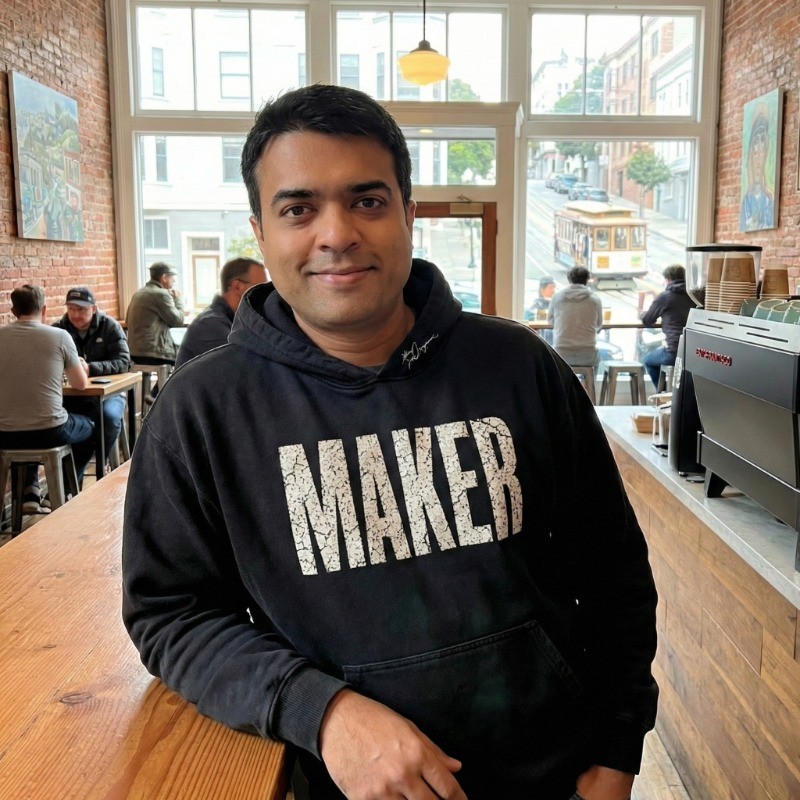
Bhanu Sharma once wrote a small instruction for an occupation that produces very large amounts of advice: “Fall in love with a problem.” It appeared in December 2013, in a short piece called Make what matters. There was no market diagram, no ceremonial mountain to climb. Just the suggestion that making something becomes harder when you have no affection for the thing you are trying to fix. For a founder whose company is called Maker, it was a fairly intimate business plan.
By then, Sharma had already worked on web conferencing, collaboration software and mobile products. He had co-founded Wanadu, held product roles at Macromedia and Adobe, directed product management at Skyfire and served as vice president of Frontier Products at Sony Mobile. He had spent years around the machinery that lets people communicate and work together. Maker brought his attention to another familiar frustration: having something to say online and needing a small procession of specialists before you could say it.
His career makes an interesting case for staying with a problem while the tools change. The meeting moves into a browser. The design becomes a website. The website acquires an AI agent. In each case, somebody still has to decide what would actually help the person sitting at the other end of the screen.
A commerce degree, then a life in products
Sharma studied commerce at Panjab University in Chandigarh. His education also includes design-thinking study at Stanford in 2011. That combination suits the work that followed: understanding a business, then asking how an ordinary person is expected to use its software. A balance sheet can explain why a product ought to exist. It is less helpful when the customer cannot find the button.
In 1998, he worked in information systems and marketing at AIESEC India. In 2000, he co-founded Wanadu and became its vice president of products. The company worked on web conferencing and online learning, before joining a video meeting became quite so ordinary a calendar indignity.
A contemporary 2002 announcement placed Sharma at Wanadu discussing Macromedia Flash Communication Server MX. His interest was practical: using the reach of Flash Player to deliver business communications with greater convenience and lower cost. The software vocabulary has aged. The wish to make an existing technology easier for customers to use has aged rather well.
Wanadu was acquired by Latitude Communications, which was subsequently acquired by Cisco. Sharma went on to work on web conferencing at Latitude and on Breeze Meeting at Macromedia, later known as Adobe Acrobat Connect. These were products concerned with an unglamorous, consequential question: how do people share an experience when they are sitting in different places?
Co-founder
Product management
Frontier Products
Founder & CEO
His subsequent roles included entrepreneur in residence at Adobe and director of product management at Skyfire from 2007 to 2008. He advised Socialcast and mentored companies through 500 Startups. By the time he started Maker, he had worked inside established software businesses and alongside younger ones. He had seen product work from several seats at the table, including the seat occupied by the person expected to make everybody else's plans fit together.
The inventor behind the job titles
There is a more technical record beneath that succession of roles. Sharma and Sanjay Chouksey are named as inventors on an Adobe patent for real-time communication using inter-process communications, granted in April 2011. It concerns enabling communication from an application through a separate communication process. The title lacks the charms of a consumer slogan. Its subject is the kind of connection a user should ideally never have to think about.
Another patent, granted in November 2016 and originally assigned to Sony entities, names Sharma as its inventor. It describes video conferencing using a wireless peripheral device. The underlying proposition is easy enough to understand: a video conversation need not be limited to the camera physically built into the device in your hand.
These records establish specific inventions rather than a vague aura of technical expertise. They also make his later work on websites less of a detour. Applications, cameras and online stores are different objects, but making separate systems cooperate is a recurring piece of the work. A user tends to notice the boundary precisely when it gets in the way.
“Don’t make to make.”
Bhanu Sharma, 2013
The website you already have
Maker's proposition starts with a concession to reality: businesses already have websites. Those sites contain product catalogs, established branding, customer journeys and a considerable amount of previous expenditure. Beginning again is an expensive way to change a page. Sharma's company has built around adding experiences to that existing foundation.
Its tools bring together visual editing, design import, publishing, analytics, testing and, now, AI-assisted creation. The ambition is to shorten the journey between a marketing or design idea and the working page a customer can actually visit. A lovely mockup has many virtues, but accepting an order is rarely one of them.
The longevity of the customer work is revealing. Maker describes Speedway Motors as a customer of more than eight years, with over 600 enhanced product detail pages. The relationship has expanded into calculators, configurators, campaign pages and personalization. In that account, a live connection to the catalog keeps product information synchronized while teams build new experiences around it.
Enhanced product detail pages at Speedway Motors, in Maker's published customer account. A measure of deployed work, rather than a promise about everyone's results.
Beach Lunch Lounge offers a different example. Maker's account describes a redesign covering navigation, the homepage, collections, landing pages and product pages. The work combined the platform with its Humans&Agents services team. With assets in hand, delivery took less than a week. The distinction matters: people handled the strategy, judgment and rollout alongside the software. Automation still required someone to know what a finished shop should feel like.
These examples do not turn every website project into a predictable timetable. They show the range of work Sharma has chosen to pursue. A product page might need richer content; a car enthusiast might need a calculator; a fashion label might need a clearer way into its collections. The useful unit of progress is the experience that gets published.
A thank-you with no launch announcement attached
One of the more telling details in Sharma's public history appears in a quiet acknowledgment from Anandini, a nonprofit organization in India. It calls him a friend of the organization and thanks him, alongside Ashim Aggarwal, for helping bring its website into existence. It also thanks him for hosting the site and giving patient tutorials over video conferencing.
There is something pleasingly complete about that small episode. A person who worked on conferencing software used video conferencing to teach people how to run their website. The product history acquired a very practical application. The audience needed help, and he supplied time as well as technology.
A similar theme appears in customer reflections years later. Nicobar co-founder Raul Rai describes a relationship involving training, attention to the brand and assistance beyond the sale of a tool. Marketing director Jasman Mann has likewise praised the team's responsiveness. These are customers' judgments, but they point to a quality that feature lists do a poor job of measuring: whether the people behind the software remain interested after it has been bought.
A book for the children, a motorcycle for the road
Sharma's making also extends beyond websites. He has described creating Empire & Freedom, an illustrated account of Indian history under British rule, for his children, using AI tools. He later revisited the book, directing another round of illustration, checking and production. His account places him in the editor's chair: deciding what to keep, what to correct and what to try again.
The project gives a domestic scale to his professional interests. A founder selling tools for creation also wants to make something his own children can read. The technology supplies more ways to attempt it. The reason to attempt it comes from somewhere considerably closer to home.
Rai supplies another detail: Sharma received a secondhand Royal Enfield as a graduation gift and has continued riding, including with his son in Portugal. It is an unusually concrete footnote to a software career. The motorcycles have engines, weight and weather to contend with. They also offer the appealing prospect of a journey whose progress is visible without opening an analytics dashboard.
The problem is still worth the trouble
Maker now describes itself as an agentic website platform. The terminology has changed considerably since Sharma's early conferencing work. The intended destination remains recognizable: help people put an idea to work without making them negotiate every technical boundary themselves.
His public remarks also leave room for restraint. He argues that simple edits can be quicker to make directly than to describe to AI. That is a useful position for somebody building AI software to hold. A button does not acquire dignity because a language model has been summoned to resize it.
The recurring choice in Sharma's work is where to spend human attention. Software can carry more of the production; people still choose the problem, the audience and the standard of the result. His career includes acquisitions, patents and executive titles. The more memorable details are smaller: a tutorial, a children's book, a customer relationship that lasts. They give his 2013 instruction some texture. Loving a problem apparently involves answering quite a few questions after the first version ships.
Follow the work
Maker · LinkedIn · X · Writing on Medium · Career profile
Make what matters · Speedway Motors · Beach Lunch Lounge · Chandi.AI