Andrew Busey once went looking for work with the sort of search engine available in Champaign-Urbana in the early 1990s: a telephone book. He had studied computer science and electrical engineering at Duke, decided the harder edges of electrical engineering were not for him, and imagined a job that barely had a settled name. He wanted to figure out what should be made. Microsoft called such people program managers. He applied to work on TCP/IP and did not get the job.
So he called local software companies. One was Spyglass, a small Illinois company considering the commercial rights to a university project called Mosaic. Busey had phoned to pitch his own multiplayer-game idea. Spyglass did not invest, but it did need somebody for the browser. He said yes, partly because the web seemed interesting and partly because rent maintains a refreshingly strict editorial policy.
That accidental entrance became the cleanest preview of his career. Busey repeatedly arrives near a new technical capability, notices the awkward gap between invention and use, and builds somewhere inside it. The settings change. The product instinct does not.
A browser, a phone call and a choice
At Spyglass, Busey worked as product manager on a commercial version of Mosaic. He attended early Internet Engineering Task Force meetings and helped begin conversations that led to Microsoft licensing Spyglass technology for Internet Explorer. One evening he answered an office phone call from Rob Glaser, who wanted source code for work that became RealAudio. In those days, the future often rang a landline and asked whether anyone responsible was still at a desk.
Netscape recruited him. He could have gone west and joined early. He had visited Silicon Valley once, disliked it, and passed. When Spyglass moved toward Chicago, he moved to Austin at the end of 1994. The choice looks contrarian now because Austin later became an obvious technology city. At the time it was simply where he preferred to live.
Austin gave him room to build. He assembled early internet installation disks for service providers, licensing both a browser and the TCP/IP software that Windows users once needed to get online. While looking at the bundle, he noticed the obvious omission: chat. He wrote a business plan, found financing and started iChat. A 1996 account described its first backing as a $50,000 check passed across a kitchen table.
The useful nuisance
“Annoying questions” is Busey's own description, affectionate and accurate. A beginner can ask why a system works badly because the beginner has not absorbed all the explanations for leaving it alone. The skill lies in continuing past the first answer. Busey says he keeps asking until he gets what he needs to understand.
The method powered a run through several versions of online life. He co-founded Pluck, which put community features on large publishing sites. He founded Challenge Games, maker of asynchronous social games, and sold it to Zynga in 2010. He ran Zynga's Austin operation, led the game studio Team Chaos, worked at Austin Ventures and became a partner at Chaotic Moon. Later, Conversable applied software to commerce conducted through messaging. LivePerson acquired it in 2018.
These businesses belong to different market categories, yet their product questions rhyme. How does a browser become usable? What happens when a website can host a conversation? How can a game continue when its players are not online together? How should a company speak with customers inside a messaging channel? Each question concerns the layer between technical possibility and routine human behavior.
The peanut-butter-cup theory
By the time Busey helped start Colossal Biosciences in 2021, the new domain was computational biology. His metaphor for crossing disciplines is cheerfully domestic: software is the chocolate or the peanut butter, and he looks for the other ingredient that makes the combination novel. It is a better image than a Venn diagram because it acknowledges that the mixture should be useful enough to want.
He did not approach genomics by claiming instant fluency. He found a University of Texas professor who had co-authored a genomics textbook and hired her to teach him. He spent much of 2021 interviewing people with deep training in molecular biology and related fields. The conversations revealed fragmented data practices and cumbersome computational workflows. To a software product person, the missing layer was hard to unsee.
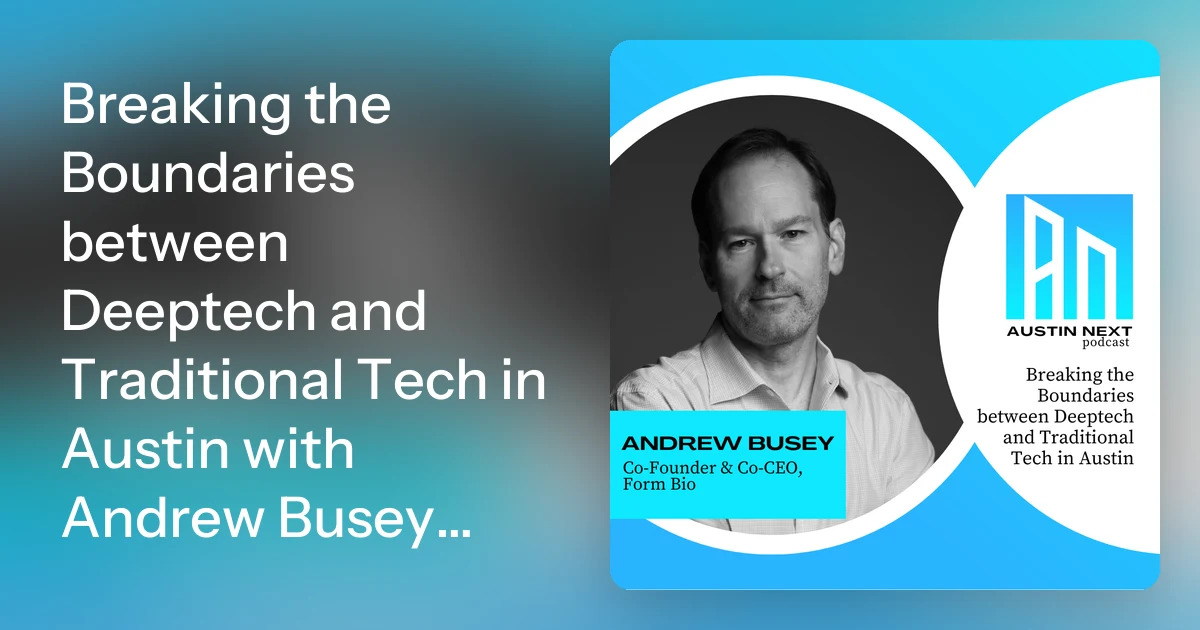
Form Bio grew from that observation and became Colossal's first spinout in 2022. It offered software and AI tools for managing and analyzing complex biological data. The origin also gave the young platform something platform companies frequently lack: a demanding first user. Colossal could test the system against real work rather than admire its architecture from a safe distance.
Platforms must earn the noun
Busey's rule for platform companies is bracingly practical. Find one or two valuable use cases as early as possible so somebody will buy the platform. A platform can otherwise become an expensive abstraction, broad enough to describe every future and sharp enough to solve none of the present.
That idea travels well beyond scientific software. It suggests a sequence for founders tempted by infrastructure: solve a specific problem, watch which elements recur, and let those repetitions define the common layer. Generality should be the residue of useful work. It should not be the opening boast.
Form Bio also offers a case study in letting leadership change as the company changes. In August 2025, Michelle Chen became president and CEO, succeeding Busey and fellow co-founder Kent Wakeford in their operating posts. Busey publicly welcomed her and said he would remain involved as executive chairman. His continuing role at Colossal is co-founder and chief product officer, a title unusually well matched to the through-line of his career.
The worlds beside the work
Busey's interest in constructed systems began before Mosaic. He developed Multi-User Dungeons, the text-based online worlds that preceded modern massively multiplayer games. He moved to Illinois for a woman he met through one of them, a personal choice with a remarkable technological side effect. In 1994 he published Secrets of the MUD Wizards, an early book on building those worlds.
Two decades later he published Accidental Gods, a science-fiction novel about researchers who simulate a universe in which life emerges. The premise sits neatly beside his stated interest in the philosophy of AI and artificial sentience. Product work asks what a system should do. Fiction gets to ask what the system means, especially after it behaves in ways its makers did not schedule.
This parallel matters because Busey's career could otherwise look like serial opportunism: browser, chat, community, games, commerce, AI, biology. The books reveal a steadier fascination with worlds, rules and the people inside them. A MUD is a social system rendered in text. A platform is a set of permissions and constraints. A simulated universe is the platform thought experiment taken to its impolite conclusion.
Curiosity as an operating system
Busey resists the polished claim that he deliberately predicted each technological turn. His account is more modest. Timing was interesting. Curiosity pulled him toward new systems. He learned by finding experts and asking until the shape of the problem appeared. There is ambition in that method, but very little mysticism.
The career lesson is unusually stealable. Expertise is essential, yet a founder crossing into a technical field need not counterfeit it. Hire the person who knows. Learn enough to ask a better second question. Bring a real capability from the previous field. Then locate the seam where the two disciplines fail to connect.
There is also a useful refusal hiding in the story. Busey declined the expected geography of his industry. He did not require Silicon Valley to certify the work, nor did he wait for Austin to become fashionable before choosing it. Place became a constraint he could design around. The result was a career tied to one city but rarely to one category, with investing and mentorship at Capital Factory extending that local commitment beyond his own companies.
Busey's three decades in Austin amount to a long argument for the seam. Mosaic needed a product layer. The young web needed conversation. Social networks needed play. Messaging needed commercial tools. Computational biology needed software built around its data and workflows. In each case, the missing thing was less glamorous than the new frontier and more useful than another speech about it.
The phone book is gone. The annoying question remains.