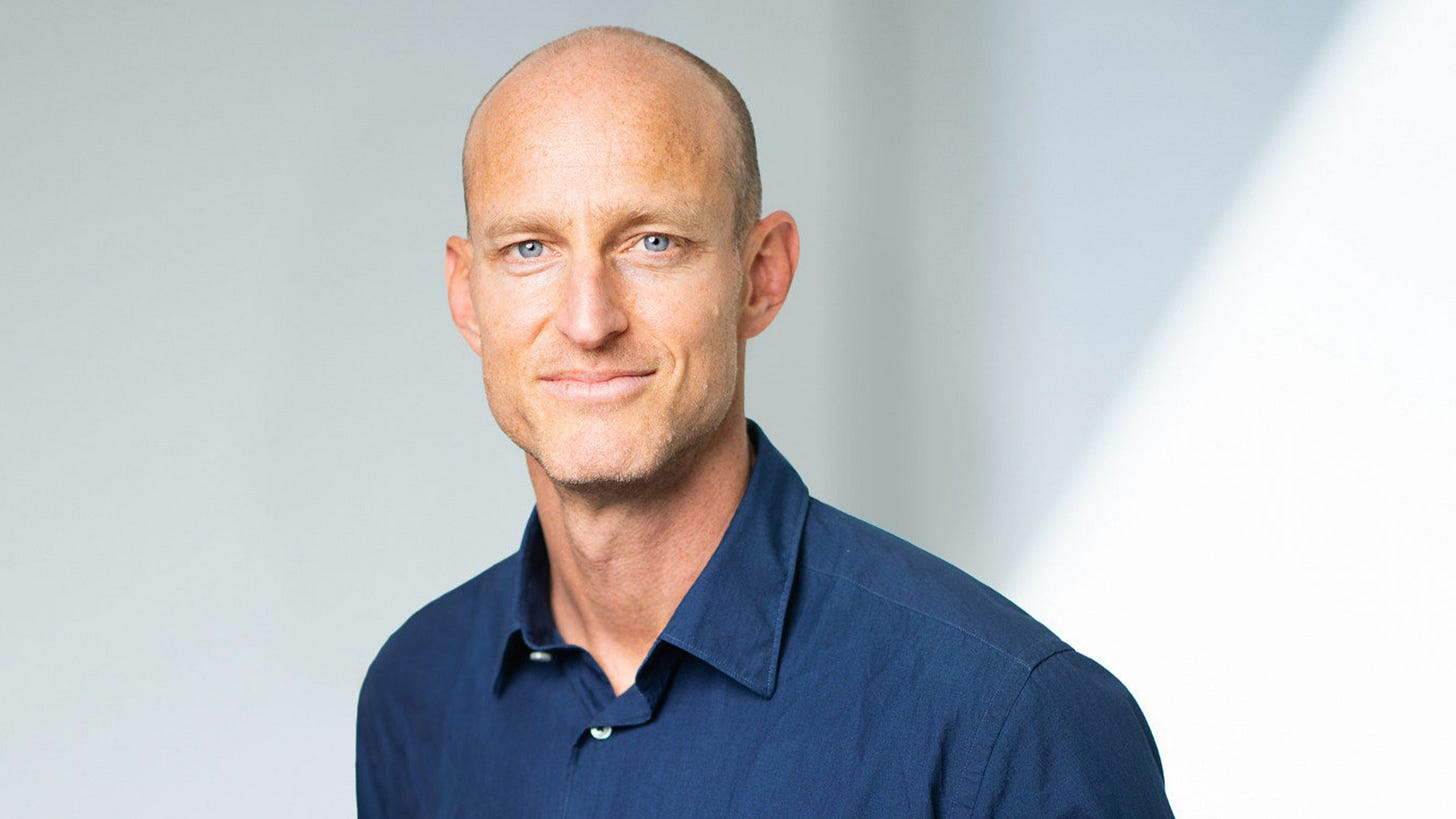
In sixth grade, Eric Green wrote a school project on the causes of schizophrenia. His father was an oncologist. His mother taught school for forty years. The combination - science as urgent moral project, education as daily practice - apparently lodged somewhere permanent. Decades later, he runs a company where the first requirement for joining, for any employee or investor, is to have personally met someone living with ALS.
That requirement is not a culture slide. It is an operational policy. Green believes the urgency of the work needs to be metabolized, not just understood. At Trace Neuroscience, the South San Francisco biotech he launched with $101 million in November 2024, urgency is the one thing that cannot be outsourced to a spreadsheet.
Green did not arrive at ALS via a straight line. He came through cardiology, which itself came through chemistry, which came through a Harvard undergraduate lab where he first learned that curiosity-driven science and real-world impact are not in tension. Greg Verdine, the organic chemist who ran the lab where Green worked as a college student, modeled the idea that following novel biology was its own kind of practicality. Green absorbed it and never let go.
At Stanford, where he pursued a joint M.D. and Ph.D. in Chemical and Systems Biology, Green found a second gear: entrepreneurship. While still in training, he and his college roommate built iLab Solutions - scheduling software for research core facilities, the kind of behind-the-scenes infrastructure that makes academic science run without constant friction. Agilent eventually acquired it. Respira Design, his next venture, won the Stanford $50K Entrepreneurship Challenge and aimed to get asthma devices to patients in the developing world.
Fellowship at Brigham and Women's Hospital followed - cardiology, board certification, and a faculty appointment at Harvard Medical School. But the version of cardiology that interested Green was the version that intersected with genetics. In 2013, Charles Homcy, a cardiologist-turned-Third Rock Ventures partner who became a key mentor, brought him into the venture studio. The instruction Homcy gave - root drug discovery in human genetics - shaped everything that followed.
At MyoKardia, Green led the translational research group working on mavacamten, a small-molecule therapy for hypertrophic cardiomyopathy. The drug was built from genetic insight: specific mutations in sarcomere motor proteins caused the disease, and the therapy targeted the mechanism directly. When Bristol Myers Squibb acquired MyoKardia in 2020 for $13 billion, it was one of the largest pharmaceutical deals of its era. Mavacamten later received FDA approval. The genetics-first playbook had worked.
Maze Therapeutics, which Green co-founded in 2017, was an attempt to generalize that playbook. The company built a platform for translating population-scale genomic data - from biobanks like the UK Biobank - into drug candidates across rare diseases. As Chief Scientific Officer, Green oversaw programs in Pompe disease and APOL1-mediated kidney disease. He also began working with Aaron Gitler, a Stanford professor whose lab was deep in ALS genetics.
The science that would eventually become Trace came together in a pattern that Green describes as almost structurally impossible. Four scientists at different institutions - Gitler at Stanford, Pietro Fratta at University College London and the Francis Crick Institute, Michael Ward at the National Institutes of Health, and the team at Maze - independently arrived at the same molecular insight: TDP-43, a protein that malfunctions in ALS, causes abnormal splicing of UNC13A messenger RNA, which in turn depletes UNC13A protein, which is essential for neurons to communicate with muscle cells.
Four groups. Same discovery. That kind of scientific convergence does not happen often, and when it does, it tends to mean something. Green understood immediately that this was not a platform play. It was a single, precisely defined therapeutic target with multiple independent lines of genetic validation - exactly the conditions under which an antisense oligonucleotide could work.
Trace Neuroscience was formally founded with those four co-founders. The company's lead ASO is designed to intercept the UNC13A splicing error - the aberrant version of the RNA produced when TDP-43 fails - and restore production of the intact protein. The plan is not to start with healthy volunteers. Trace intends to go directly into ALS patients at doses the team believes will be effective, a decision that reflects both the severity of the disease and the specificity of the genetic mechanism.
Third Rock Ventures led the Series A, which also drew Atlas Venture, GV, and RA Capital Management. Green's track record with the studio - MyoKardia, Maze, now Trace - made the third bet a relatively natural one. In November 2024, the company launched publicly, and by 2025, Fierce Biotech had named it one of its Fierce 15 companies to watch.
Green describes his broader philosophy as an "abiding faith" that pursuing novel biology in service of patient needs builds real businesses. The career bears that out - not in a linear way, but in the way that someone who takes curiosity seriously accumulates credibility. He started a scheduling software company as a medical student. He won an entrepreneurship challenge with a breathing device. He helped develop a billion-dollar heart drug. And now he is betting on a protein most people have never heard of to change the trajectory of a disease that has resisted every previous attempt to slow it.
The clinical trials are targeted for early 2026. The genetic rationale is solid. The team is assembled. The question - as always in biotech, as always in ALS - is whether the science translates. Green says he is an irrational optimist. What the record shows is a founder who has been right often enough that calling him irrational seems hasty.