She spent four years as an emergency medic and noticed that half her calls were psychiatric. Then she built a company around the brain.
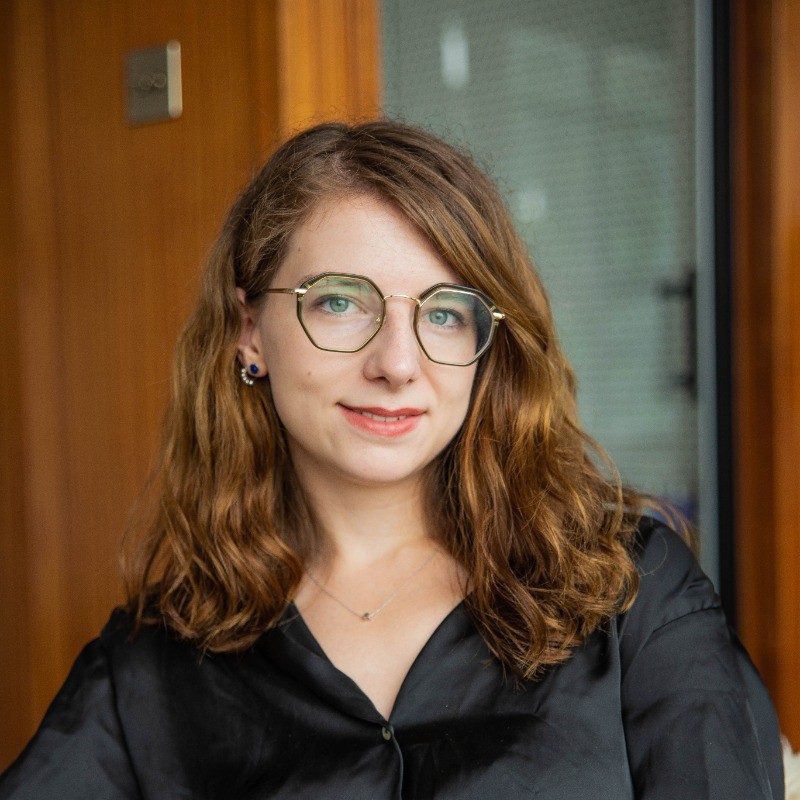
Emilė Radytė, photographed for the NHS Innovation Accelerator. The glasses are doing a lot of work; so is the woman behind them.
Emilė Radytė runs Samphire Neuroscience, a London neurotech company with a contrarian premise: that some of the symptoms long filed under "hormones" are really questions of brain circuitry - and that you can reach those circuits without a single drug.
Samphire's device, Nettle, is worn on the head. It uses non-invasive transcranial direct current stimulation - a gentle, well-studied electrical technique - to target the neurological drivers behind menstrual pain and mood symptoms, including PMS, PMDD, PME and endometriosis. No painkillers. No hormones. No implant. The pitch is almost suspiciously simple, which is exactly why the science underneath it has to be airtight.
That insistence on evidence is the through-line of her career. Radytė is not a wellness founder who discovered neuroscience as a marketing layer. She is a neuroscientist who discovered, repeatedly, that the people most in need of good science were the ones the data kept skipping. Women's brains were historically under-researched precisely because menstrual cycles introduced variability - the very thing that made the data interesting got it thrown out as noise.
So she built a company to study the noise. In 2024 that work landed her on the Forbes 30 Under 30 Healthcare list, and Nettle was named Medical Innovation of the Year at Medica, one of the world's largest medical trade fairs. For a device that looks like a quiet piece of industrial design, that is loud company.
Two clues from her twenties explain everything that came after.
The first clue: the back of an ambulance. As a Harvard undergraduate, Radytė worked four years as an emergency medic and eventually led the university's emergency medical service - 90 medics under her watch. Out on calls, she kept running into the same wall. More than half the emergencies she answered were psychiatric, and yet almost nothing in her training had prepared anyone to actually help in that moment. "There are so few things you can do at that response level to improve the person's mental state," she has said. The gap was not a footnote. It became a target.
The second clue: she refused to treat the brain as if it floated free of everything around it. She was the first Harvard student to graduate with a joint degree in neuroscience and social anthropology, and she did it summa cum laude. The combination sounds academic until you hear her reasoning: "There's no way of understanding pure science without understanding where it's situated in our society." Working on Housing First approaches to homelessness in France only sharpened the point - mental health, she came to believe, lives in both the neurons and the circumstances.
Then, during the COVID-19 lockdown, she went home to Lithuania and did the thing restless people with a mission do: she built something. With Dr. Laura Stankeviciute she co-founded the Integrative Neuroscience Association, which grew into the country's largest neuroscience community - more than 400 practitioners - and launched Lithuania's first memory cafe for Alzheimer's patients, on the simple, evidence-backed idea that socialising improves dementia outcomes.
From there came Oxford, where she earned a master's and PhD straddling psychiatry and engineering, specialising in the non-invasive brain stimulation that would become Samphire's core. By the time she founded the company, she had assembled an unusual toolkit: a clinician's eye for who gets left behind, an anthropologist's suspicion of tidy explanations, and an engineer's appetite for a device that actually ships.
"I've met hundreds, maybe at this stage thousands, of women who truly cannot function for a week or two of their cycle. Realising how much they just feel unseen in society has been heartbreaking."- Emilė Radytė, on what keeps her building
Studies neuroscience and anthropology; works four years as an emergency medic and leads Harvard's 90-medic emergency service.
Co-founds the Integrative Neuroscience Association in Lithuania - 400+ practitioners and the country's first Alzheimer's memory cafe.
Begins MSc/PhD work bridging psychiatry and engineering, specialising in non-invasive brain stimulation. Co-founds Samphire Neuroscience in London.
Named to Forbes 30 Under 30 (Healthcare). Nettle wins Medical Innovation of the Year at Medica.
Samphire raises a new round to bring brain-first menstrual care to more people, and Radytė keeps making the case on stages from London Tech Week to Slush.
Listen to your gut. I have always made the right decision when I listened to my gut.
How many men walk with implants in their bodies? Very few. How many women have an IUD or an implant? A ton.
Build evidence early and don't underestimate the value of scientific depth.
#WomenInTech is not only about representation but about correcting blind spots in innovation, especially in women's health.
Make brain-first, drug-free neurotechnology an ordinary thing women reach for at home.
- the bet behind Samphire Neuroscience