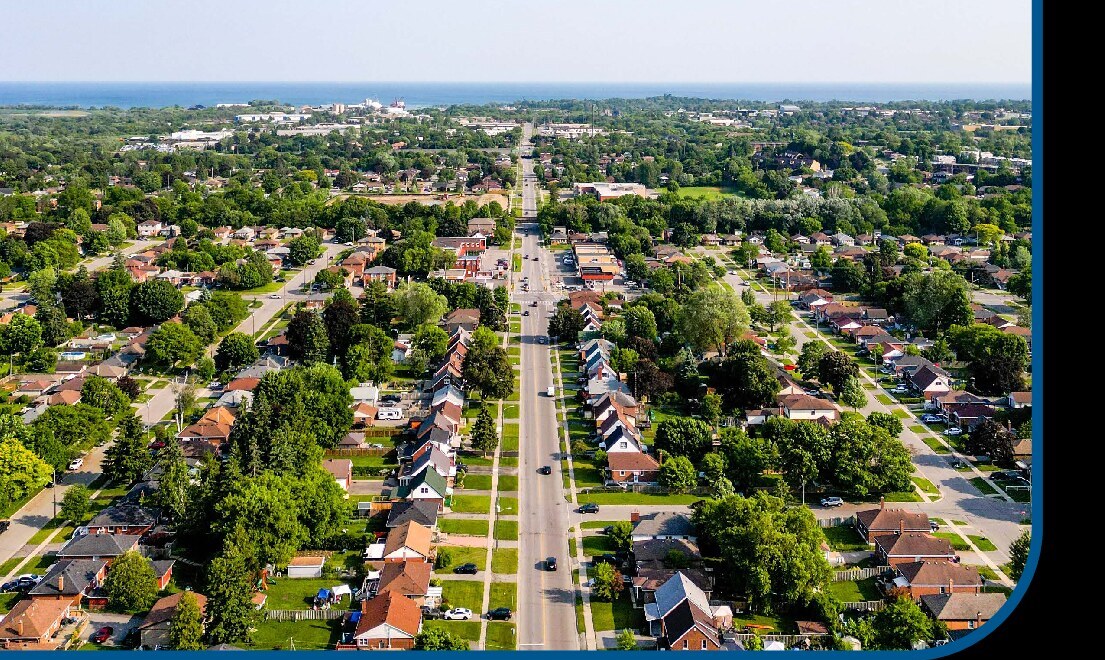
There is no tasteful way to photograph a regional government. Its best work is buried, chlorinated, dispatched, scheduled or arriving with its lights on. Durham Region, east of Toronto, is responsible for the services people notice most when they stop working: drinking water, sewers, buses, paramedics, public health, waste, housing, police, major roads and emergency management. The legal name is The Regional Municipality of Durham. The more useful description is a shared operating system for eight communities that do not otherwise share a personality.
Ajax is compact and urban. Brock is rural. Oshawa has an industrial spine. Pickering faces Toronto. Clarington hosts one of the country’s defining energy clusters. Scugog and Uxbridge bring farms, lakes and long distances into the service equation. Whitby houses the regional headquarters. Durham’s job is to make this uneven map function as one place when scale helps and eight places when proximity matters.
The company with compulsory customers
The prompt calls Durham a company, so keep the category - but do not mistake the economics. This is an upper-tier municipal government created by Ontario law in 1974, not a venture-backed business. It has no founders in the startup sense, no funding rounds and no valuation. Its users are residents, businesses, visitors, developers and community institutions. They cannot churn to a competing water network after a bad quarter.
That changes the definition of product-market fit. A regional service must be available to the whole jurisdiction, legible to people with different abilities and incomes, and durable beyond an election. Property taxes pay for police, transit, roads, waste, social programs, health, paramedics and other shared services. Water and sewer systems use consumption-based rates. Transit fares cover about one-third of daily operating costs; subsidy makes up the public-service gap. The business model is pooled risk plus shared infrastructure.
Regional layer
- Water and sewer
- Transit and regional roads
- Police and paramedics
- Public health and housing
- Waste and growth planning
Local layer
- Fire protection
- Parks and recreation
- Libraries
- Local streets
- By-law enforcement
The alternative is not another brand. It is a different allocation of responsibility: local governments doing more themselves, provincial agencies taking over a function, or private contractors delivering a piece. Durham’s advantage is purchasing power, specialist expertise and systems that cross municipal borders. Its recurring risk is the same one every platform business knows: a shared layer can become an extra layer.
“Calling 311 means you don’t need to know which department or division provides the service.”Durham Region’s explanation of the product
What they actually built
The cleverest Durham product may be a three-digit number. Dial 311 inside the region and a customer-service representative can work from a shared knowledge base. The myDurham 311 portal adds a 24-hour route to submit and track requests for waste, water, sewer and traffic. That sounds basic until you count the departments and local boundaries a resident previously had to decode. The feature is not the form. The feature is making the organization chart somebody else’s problem.
Behind that front door sits a surprisingly broad catalogue. Durham Region Transit offers fixed-route and On Demand trips. Public works treats and distributes drinking water, manages sewers, runs regional roads and handles waste across six of the eight municipalities. The health and social portfolio reaches from restaurant inspections and vaccines to Ontario Works, child care, community housing and four long-term-care homes. Growth planners model the next subdivisions while economic-development teams pitch the region to employers.
Digital access has become connective tissue rather than a department. MyDurhamWater replaced an older billing application whose technology could no longer support a much larger customer base. Durham OneNet has brought high-speed connections to more than 2,000 rural residents. Your Durham lets people comment on projects. Open data lets outsiders reuse regional information. None is a standalone transformation. Together they reduce the distance between a household and the institution serving it.
What failed first: the handoff
Durham’s documented weak point was not a cinematic collapse. It was the ordinary accumulation of legacy paths. The old water-billing system hit technology limits. A person with a service question needed to identify the right division and phone number. Waste information lived in a specialist channel. At regional scale, these are not small irritations. They manufacture repeat calls, staff transfers, blind spots and residents who feel bounced between institutions.
So the organization changed the interface before pretending it could simplify the work itself. The waste call centre moved into myDurham 311 in December 2022. The portal turned requests into trackable objects. A new water account system made bills, meter readings, payment options and secure messages available online. The launch did not include every familiar feature - equal billing was unavailable at first - which is the sober reality of replacing a legacy system while keeping a utility running.
What changed the strategic mind was also concrete: participation. For the 2025-2035 plan, the Region ran 24 pop-up events, delivered 13 presentations, distributed 700 flyers and 1,000 posters, and used its online engagement platform. Council approved a ten-year plan organized around connected communities, climate action, health and care, resilient economies and stronger relationships. The point was not that everybody agreed. It was that a service organization asked users where friction lived before setting the roadmap.
Durham’s 2026 regional property-tax increase was 4.8 percent - about $14 a month for the average homeowner. Roughly $10 went to police services and $4 to the rest of the regional portfolio. The chart is a ratio, not a budget total.
Program costs make the trade-offs sharper. Durham committed $8 million in July 2026 to help produce 106 affordable rental homes: $750,000 for 10 units in a converted Sunderland retirement home and $7.25 million for 96 affordable units inside a larger Oshawa tower. Durham Greener Homes received a $3.4 million federal-backed investment through the Federation of Canadian Municipalities. Its companion building-benchmarking program began with an estimated 2023 regional cost of $150,000. Public value still has a price tag; good administration makes the tag readable.
The climate plan enters the house
Durham markets itself as the Clean Energy Capital of Canada, a claim anchored by the Pickering and Darlington nuclear stations, engineering talent and construction of a small modular reactor at Darlington. The more transferable climate product is smaller. Durham Greener Homes gives households an energy coach, assessments, guidance through incentives and low-interest financing for measures such as insulation, air sealing and heat pumps. In 2026 it added free weather-ready assessments for heat, cold, floods and windstorms.
This is service design applied to decarbonization. Homeowners do not fail to retrofit only because they lack conviction. They face contractor selection, audit rules, rebate paperwork, financing and uncertainty about which upgrade comes first. The Region and Windfall Ecology Centre bundle that confusing journey into a coached sequence. Durham Greener Buildings uses a related move for larger properties: measure energy and water performance, disclose it, compare it, then reward improvement.
The reusable insight is not “build a portal.” It is “hide institutional complexity without hiding accountability.”
The operating playbook to steal
Five moves that travel
- Give users one front door, even when specialists own the work behind it.
- Pool the expensive layer - infrastructure, expertise, procurement and data - across neighbouring markets.
- Keep local delivery local when proximity genuinely improves it.
- Turn vague priorities into visible prices, dates and public indicators.
- Add a human guide where forms, incentives and vendors create decision paralysis.
Durham’s culture statement is less interesting than the mechanisms beneath it. The formal values are accountable, caring, collaborative, inclusive and innovative. The mechanisms are shared case handling, a public dashboard, municipal partnerships, university projects through CityStudio Durham, broadband construction, accessibility work and service experiments that can be measured. In 2025 the Intelligent Community Forum named Durham its Intelligent Community of the Year. Awards are weak evidence by themselves. The portfolio that earned the award is the useful part.
The approach will not work everywhere. Regional pooling needs shared travel patterns, infrastructure that naturally crosses borders, enough population to support specialist teams and political trust among local governments. A 311 layer fails if departments do not accept ownership, update the knowledge base or close requests. Consultation fails if feedback is not connected to a decision, budget and named delivery plan. A retrofit concierge fails where financing is unaffordable or qualified contractors are scarce.
When not to copy Durham
Do not add a regional platform when the service is hyper-local, the participating governments cannot share standards, or the new layer merely forwards requests without authority to resolve them. Coordination is valuable only when it removes more friction than it creates.
A government that behaves like infrastructure
Durham began in 1974 with roughly 247,000 people. Today it serves more than 780,000 residents and 28,000 businesses, and growth keeps pressing on pipes, roads, housing and response times. Its mission now promises equitable, sustainable and integrated services that improve people’s lives. The interesting word is integrated. Nobody experiences a region in departments. A late bus affects a shift. A housing problem becomes a health problem. A flooded basement becomes a climate, sewer, insurance and customer-service problem in one wet afternoon.
The best version of Durham Region is therefore not a clever municipality with many digital tools. It is an institution that notices the connections residents already live with and organizes around them. Scale the treatment plant. Share the fibre. Route the bus across the border. Keep the park local. Put one number on the fridge. Then publish enough of the cost and performance that the people paying can argue with something more useful than a slogan.