Learning to drive is built from official moments: the first class, the first turn onto a public road, the test, the licence. Marketing happens in the spaces between them. It reaches the teenager wondering what G1 means, the parent comparing schools, the student replaying a mistake after a lesson, and the graduate looking for proof that a course may help with insurance. Ursula Romeo’s career has been an education in those in-between moments.
Romeo is the Chief Marketing Officer of Young Drivers of Canada, the Vaughan-based organization that has taught Canadians since 1970. The company says it operates in more than 140 service areas and has graduated more than 1.3 million students. Those are institutional numbers. The people behind them usually arrive one household at a time, with a mix of anticipation, cost questions, scheduling puzzles, and nerves about the road.
The interesting part of Romeo’s route to the executive office is how little of it began with cars. Her public career record starts in hospitality. In 2006, while studying commerce at Ryerson University, she worked at the Crowne Plaza Toronto Airport as a front desk agent. A front desk teaches an unglamorous truth about service: the customer experiences the organization at the handoff. A booking can be correct and a room can be ready, but the interaction still has to make the next step clear.
Thirteen years inside the phone
After earning her Bachelor of Commerce in 2009, Romeo moved into mobile marketing. From 2010 until 2023, her work at Zipstripe covered SMS marketing, social media, account management, and both business-to-business and consumer campaigns. Her LinkedIn profile also points to Zipgive, a mobile fundraising service. In posts from that period, she shared text-to-donate campaigns supporting the Ottawa Senators Foundation and Food Banks BC.
That detail captures what mobile marketing looked like before every company wanted an app with an artificial-intelligence feature. The phone was already personal, immediate, and action-oriented. A short message needed to earn attention, state a useful next move, and reduce the distance between interest and response. In fundraising, the response could be a small donation completed by text. The campaign worked only if the instruction was simple enough to survive the moment.
By the time Romeo joined Young Drivers in 2023, the phone had become more than a delivery mechanism. It was where a learner searched, watched, booked, practiced, and expected feedback. Her move therefore reads less like a change of subject than a change of scale. The mobile behavior remained. The consequence of getting the message right became larger.
A national brand, two people in every decision
Driver education has an unusual customer structure. The learner uses the service, but a parent or family member may research it, pay for it, supervise practice, and worry about the outcome. The student wants independence. The parent wants evidence of care. One audience is thinking about mobility; the other may be thinking about risk. A single landing page has to make room for both without turning either into a stereotype.
Young Drivers adds another layer. Its brand is national, while the lesson is local. A student encounters the organization through a specific instructor, a particular car, and the roads around home. The marketing promise travels across Canada; the proof happens at an intersection nearby. Romeo’s operating challenge is to keep those scales connected across service-area pages, social feeds, customer support, partnerships, and products.
In November 2024, Romeo appeared as the media contact for a partnership between Young Drivers, Avenue Insurance, and Oracle RMS. The offer connected completion of an approved Ontario Beginner Driver Education course with a route to potential insurance discounts for qualifying graduates. It was a practical partnership story: training creates a credential; the credential can carry value beyond the road test; marketing explains how a graduate can use it.
The announcement listed Romeo as Communications Manager. Her current professional profiles list her as Chief Marketing Officer. Titles describe the widening circle of responsibility, but the work remains anchored in translation. A regulation-heavy course needs plain language. A national partnership needs local instructions. A safety claim needs context. A brand promise needs a next step.
When the lesson follows the learner home
Young Drivers’ recent product direction makes Romeo’s mobile background newly relevant. In 2025, the organization launched Drivers Coach, an iOS app in Canada and the United States. The app includes AI-generated handbook questions, practice tracking, feedback on in-vehicle sessions, road-test simulations, checklists, and a learning library. Its stated purpose is to give structure to the practice that happens between professional lessons.
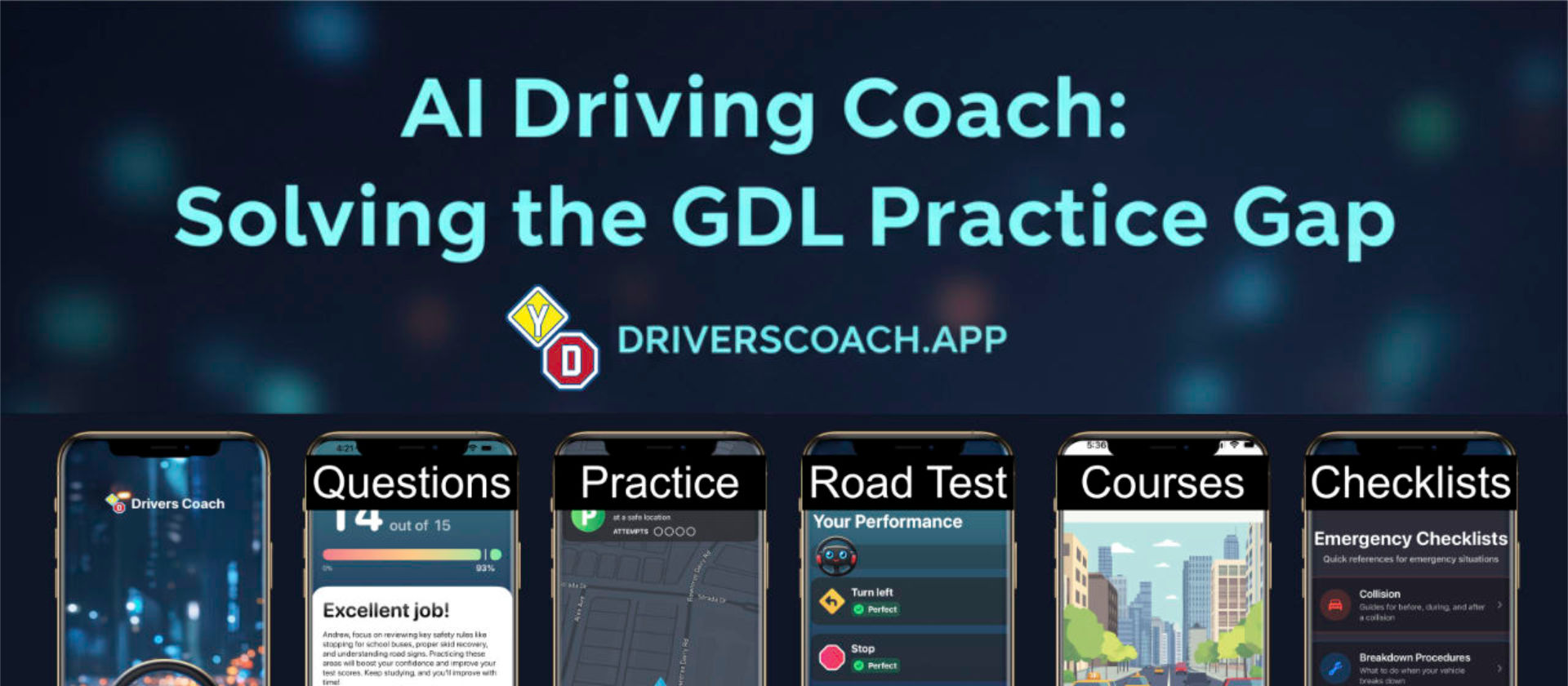
The product does not erase the instructor. It addresses a gap the instructor cannot physically occupy. After a scheduled lesson ends, many learners practice with a parent or another supervising driver. Time accumulates, but the quality of that practice can vary. A digital tool can give the session a plan, preserve a record, and make progress visible before the next lesson begins.
This is also a marketing shift. A driving school once had a clean sequence: attract a customer, enrol the student, deliver lessons. An app makes the relationship more continuous. Content can become a feature. Feedback can become retention. A checklist can be both a teaching device and a reason to return. The distinction between communicating the service and delivering the service starts to narrow.
One learner, four useful moments
The value of a transferable craft
Romeo’s path offers a grounded lesson about executive careers. Industry expertise matters, but so does a craft that travels. Hospitality taught service at the point of contact. Mobile marketing taught concise action and attention. Account management required responsibility after the sale. Driver education gives those skills a category in which trust, timing, and follow-through are unusually visible.
Her public footprint is professional rather than performative. It consists mainly of a LinkedIn profile, company communications, and the corporate channels she helps support. There is no personal manifesto attached to the work. Instead, the record is a sequence of operating roles: front desk, account manager, mobile marketer, communications manager, CMO. Each sits close to the place where an organization meets a person.
That sequence matters because marketing can look abstract from the outside. In this business, it is attached to concrete actions. Find a local centre. Understand graduated licensing. Book a course. Practice between lessons. Retrieve proof of completion. Ask about a partner benefit. The campaign is only as good as the handoff to the next action.
The range of Young Drivers’ programs makes that handoff broader than the company name might imply. Its public materials cover novice instruction, driver improvement, re-testing, fleet programs, and instructor training. The audience can be an individual learner on one page and a business responsible for commercial drivers on the next. Romeo’s earlier mix of B2C and B2B work fits that span. The tone, proof, and buying process change with the audience, while the central subject stays consistent: preparing someone to make better decisions on the road. Marketing has to preserve that idea across very different reasons for arriving.
Young Drivers’ long history supplies recognition. Romeo’s background supplies a feel for how attention behaves now. The combination is most useful when neither side overwhelms the other. History alone can become a plaque on the wall. Technology alone can become a feature in search of a need. A learner needs a coherent path through both.
The moment after the driving lesson is easy to overlook because nothing official happens there. The car may be parked. The instructor has left. The learner is replaying a turn, and a parent is wondering what to practice next. Yet that is where a new habit either gets reinforced or fades. It is also where Romeo’s two professional chapters meet: the personal device and the public responsibility of learning to drive.
A marketing career rarely follows a road as tidy as the customer journey drawn in a presentation. Romeo’s has moved from a hotel desk to text campaigns to the executive team of a national training organization. The consistent work is simpler to name. Make the next move legible. Stay close to the customer’s real context. Remember that service continues after the formal moment ends.