A finance executive can know a company’s numbers and still miss how the company works. Norman Hyde-Whipp’s career is interesting at that junction. A former Siemens colleague, Geoff Newman, remembers a VP of Finance who understood sales and operations and helped guide the team. The useful detail is the combination: financial responsibility alongside an interest in the mechanics of a business. A balance sheet, after all, is a rather compressed account of what people have been doing all day.
Today, Hyde-Whipp is chief executive officer of Barrier Ridge Capital. The businesses around him inhabit a physical world: foundations, fabricated metal, fences, concrete and the expertise needed to get construction projects built. There is little room for a charming abstraction when a component must fit or a crew needs the next part of a job to be ready. That makes his earlier finance work a useful starting point for understanding his current position.
His professional story also has a cast. Operations leaders, procurement specialists, an HR executive and a president under whom he served as CFO appear in his public recommendations. Read together, those relationships suggest a productive way to approach his career: through the work he has shared with other people, and the contributions he has chosen to acknowledge.
The accountant who noticed the machinery
Hyde-Whipp holds CPA and CMA designations and is listed as an active CPA Ontario member. The credentials give his finance background a specific foundation. His education listing also includes a Wharton executive development program associated with L3Harris. These are distinct pieces of a professional record: an accounting qualification, continued executive education and a leadership role.
Newman’s recollection adds something a credential cannot. He describes Hyde-Whipp’s attention to the commercial and operational workings of Siemens, along with mentoring. Another colleague’s public recommendation emphasizes team development and open communication. Those are colleagues’ assessments, rather than a personality verdict. Their value lies in showing how the finance role felt to people working around it.
In industrial work, finance and operations have plenty to discuss. A delivery commitment involves resources. A production decision affects cost. A sales opportunity must eventually become something a customer can use. The interesting question is how an executive handles those connections. Newman’s account places Hyde-Whipp close enough to the work to understand them.
That is a more revealing professional detail than a list of titles alone. It describes a way of participating in a company. The finance executive has a responsibility to the figures; colleagues can also notice whether he understands the activities that produced them.
Twenty-two years, seen through a colleague
One of Hyde-Whipp’s more personal professional observations concerns Anthony Bezina. In a public recommendation, he recalls having worked with Bezina for 22 years. It is a substantial span to compress into a few paragraphs. His account links understanding manufacturing processes with understanding finance, then turns to how Bezina connects with people across an organization.
The recommendation praises customer focus, work ethic and care for employees. It is an endorsement of Bezina, and should be read as such. Yet the qualities Hyde-Whipp selects are also revealing editorial clues. He gives attention to the movement between technical detail, business responsibility and human relationships. The organizational chart provides job descriptions; the recommendation describes how someone travels between them.
His comments about Fazal Khan supply another angle. Hyde-Whipp identifies Trench Canada as a place where they worked together. He remembers procurement problems met with practical solutions, and praises Khan’s knowledge of the business and respect for people. Purchasing can sound like a narrow function until the required material fails to arrive. Then its relationship with everything else becomes wonderfully clear.
These accounts keep the story close to specific work. Operations and procurement appear as sources of judgment, rather than scenery around an executive career. They are also reminders that long professional relationships contain knowledge no announcement can adequately summarize.
What he remembers about the people in charge
Hyde-Whipp has also described working for Murali Krishnan as his CFO for two years. His recommendation emphasizes what he learned, and Krishnan’s ability to understand the business in detail. The statement records an executive relationship from the position of someone reporting to a president, rather than someone presiding over a team.
That distinction matters to the portrait. A CEO’s career includes experiences of being led. Here, Hyde-Whipp publicly acknowledges one of them. He highlights business understanding and responsibility to employees, themes that also appear when he discusses colleagues in other functions.
His recommendation for HR executive Caroline Sothern recalls more than five years of close work. He credits her with handling difficult business topics during a transformation and staying connected to employees. It places human resources inside the work of changing a business. The comment concerns Sothern’s contribution; it does not turn the transformation into a personal achievement for Hyde-Whipp.
Likewise, his recollection of working with Christoph Arnold at Siemens Canada emphasizes leadership and respect. Across these messages, attention falls on people who understand their businesses and take responsibility for colleagues. That recurring emphasis is a reasonable reading of his public writing. It is a useful thread to carry forward into the investment role.
A family business becomes an investment business
Barrier Ridge describes its history as beginning with founders who also operated the business, followed by a second generation that developed the organization. The firm presents professional management and investment as extensions of that experience. Hyde-Whipp leads within that institutional history; the history should not be mistaken for his own family biography.
The distinction helps explain the setting of his job. The firm’s managing directors include Benjamin Powell, Matthew Powell and William Powell Jr. Its leadership team brings together finance, civil construction, real estate and information technology. A CEO works among those responsibilities, with different kinds of expertise required to make the whole organization function.
Barrier Ridge reports 30 operating companies, approximately five portfolio platforms and more than 1,200 team members. Those are firm-reported figures, not a count of personal achievements. They establish the scale of the organization around Hyde-Whipp and give the word “operations” a concrete meaning.
Company-reported figures, checked October 2026. These describe Barrier Ridge’s organization.
Investment, with concrete attached
In May 2025, an announcement about The Powell Group’s strategic investment in Corebuild Construction included Hyde-Whipp’s comments as Barrier Ridge CEO. He welcomed the partnership and described its purpose in terms of the Canadian construction industry. His phrasing reached beyond the transaction itself to a commitment shared by the organizations involved.
“a shared commitment to advancing the construction industry in Canada.”
Norman Hyde-Whipp / Corebuild investment announcement, May 2025
Corebuild’s own announcement described the partnership as supporting operations, innovation and its market presence. A construction investment has a particularly visible destination. Whatever language surrounds the agreement, the eventual work still involves projects, equipment and people. It is an appropriate setting for a leader whose professional relationships include manufacturing, procurement and finance.
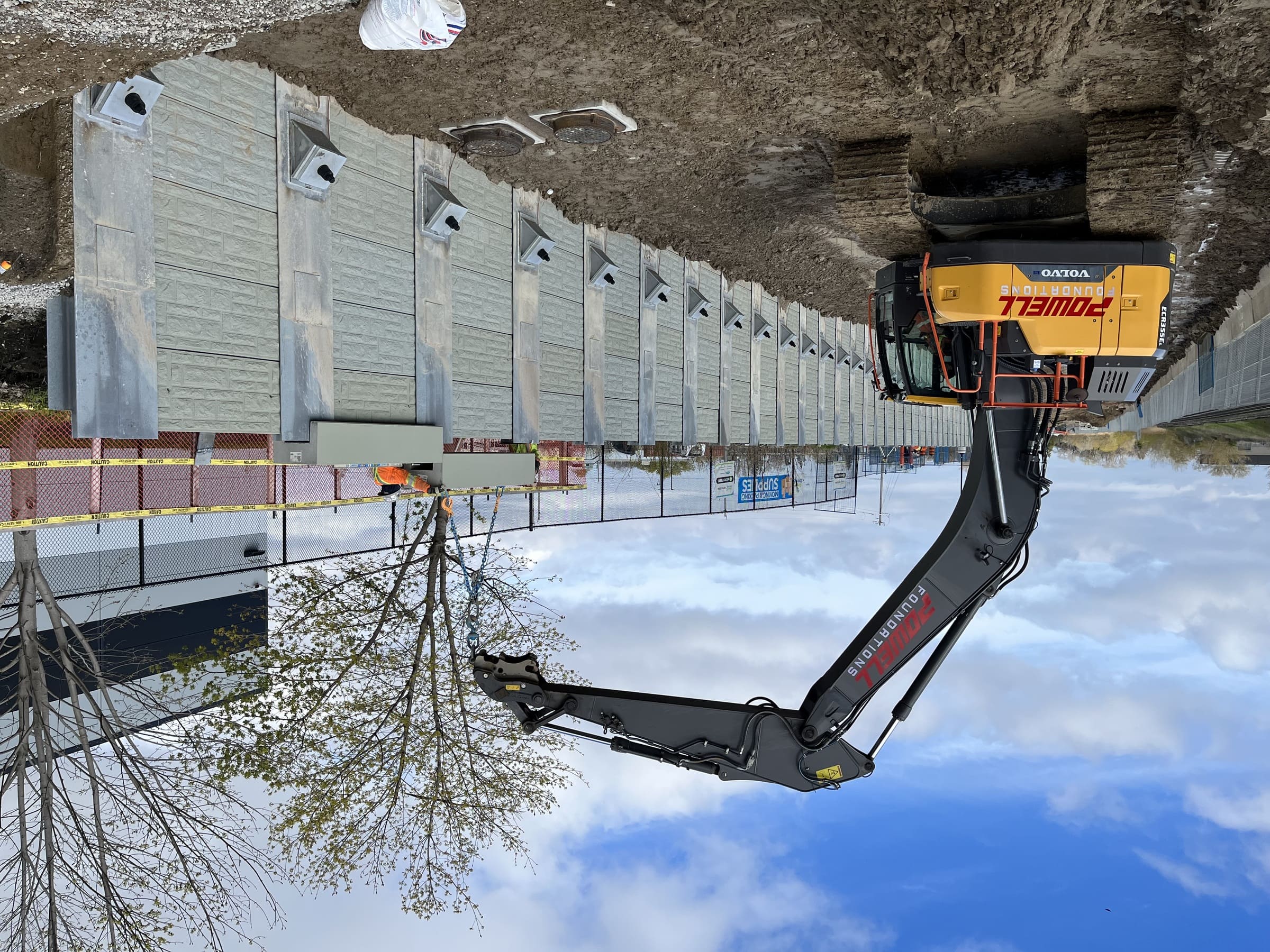
The photograph here makes that physical setting plain. Powell Foundations equipment lifts a panel toward a wall while workers attend to the installation. It is company imagery, rather than a scene from Hyde-Whipp’s day. But it gives the investment discussion an object: the material and coordinated work that sit at the far end of a business plan.
A further 2025 transaction placed Barrier Ridge in Earth Boring’s court-supervised restructuring. In September, the court approved a share subscription agreement involving the firm. The agreement provided for management to hold shares and remain involved in operating the business. Hyde-Whipp was identified as the recipient of notices for the purchaser.
That is a specific example of the organizational detail inside an investment. Ownership and operating responsibility appear together in the proposed arrangement. For this profile, it adds another documented connection between Hyde-Whipp’s executive role and the practical question of who runs a business after a transaction. An agreement has a financial structure; it also assigns responsibilities that people must carry out.
The business behind the barrier
Barrier Ridge’s published sector focus includes precast and noise wall solutions, construction and foundations, perimeter security, metal fabrication and engineering consulting. The categories place its investment interests among businesses that make, install or design essential parts of the built environment. A finished structure can conceal a surprisingly crowded business story.
- 01Precast &
noise walls - 02Construction &
foundations - 03Perimeter
security - 04Metal
fabrication - 05Engineering
consulting
A sector map, not a claim that every business works on the same project.
For the person leading the firm, those businesses supply a practical context for the CEO title. The work requires different forms of knowledge, and Hyde-Whipp’s public career includes relationships with people who hold several of them. His recommendations offer small, specific accounts of that experience.
The resulting portrait has an accounting foundation and an operational vocabulary. It includes a finance colleague who remembers mentoring, an operations relationship measured in decades and public comments about construction investment. The mechanics of growth, in this story, are visible in the people and businesses that must make it happen.
Follow the working relationships
- Barrier Ridge Capital
- Norman Hyde-Whipp on LinkedIn
- CPA Ontario member record
- Corebuild partnership announcement
- Anthony Bezina: professional recommendations
- Fazal Khan: professional recommendations
- Murali Krishnan: professional recommendations
- Caroline Sothern: professional recommendations
- Christoph Arnold: professional recommendations
- Earth Boring transaction record