At a red light, a learner driver can perform perfectly and still be badly prepared. The hands sit at the right place. The mirror check is theatrical. The stop lands neatly behind the line. Then a pickup truck arrives too fast in the rear-view mirror, and the road test's tidy choreography becomes a physics problem. Young Drivers of Canada has spent 56 years selling preparation for that second scene.
The company is Canada's largest driver-training organization by its own count: more than 1.3 million graduates, more than 140 service areas and a brand that predates Ontario's graduated licensing system. Its core customers are new drivers and the parents who finance them, but the catalogue stretches to anxious adults, people returning to driving, court-referred motorists and companies trying to keep fleet vehicles out of body shops.
This is not the cheap lane. Public Ontario comparisons in 2025 put many Young Drivers beginner packages around C$1,700 to C$2,150 before tax, depending on the location and bundle. Basic competitors can appear around C$600 to C$900. The gap is large enough to turn a driving-school decision into a household debate: are you buying a certificate, or are you buying fewer bad seconds over the next 40 years?
A race driver designs the escape route
Heinz Naumann founded Young Drivers in 1970. The philosophy people now associate with the company arrived with Peter Christianson, who joined in 1975 and eventually became president. His résumé included rallying and racing. His motivation was less glamorous.
In testimony to an Ontario legislative committee in 1993, Christianson described a 1946 crash that killed his father. He was three. Just before impact, his father pushed him from the back seat to the floor, in an era before seatbelts. Later, five of Christianson's friends died in road collisions. Racing had taught him car control; bereavement gave the subject its weight.
“It changed the way I looked at driving.”Peter Christianson, before an Ontario legislative committee
That experience changed the question. Instead of asking, “Can the student execute the manoeuvre an examiner expects?” Christianson asked why drivers die and what repeatable action might interrupt the chain. Keep space. Scan beyond the car in front. Notice the shoulder. Preserve an exit. Practise the evasive move before panic makes the choice.
Young Drivers formalized that thinking as the Collisionfree! Approach in 1995. Today the company describes it as four key habits and 20 supporting sub-habits. Its courses can include risk perception, rear-crash avoidance, head-on collision avoidance, gravel-shoulder recovery, threshold or ABS braking, emergency braking and a combined brake-and-avoid technique. These are not exotic racing tricks. They are rehearsals for common ways an ordinary drive goes wrong.
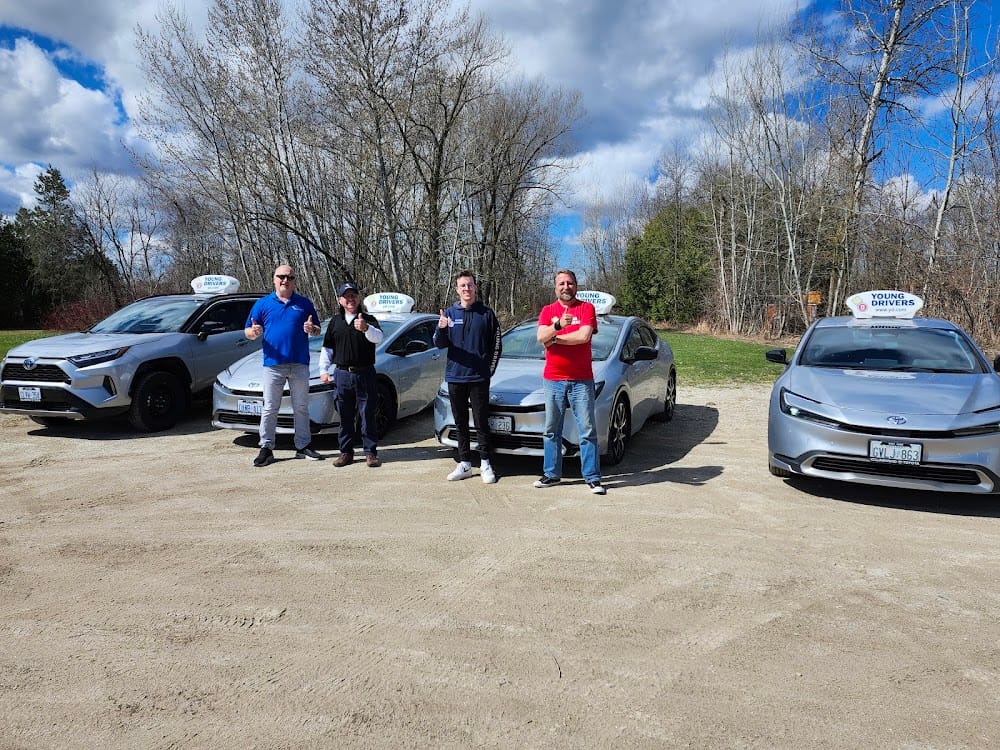
The first failure is teaching the test
The road test is necessary. It is also a narrow sample taken on one route, in one car, on one day. A school that optimizes only for that sample can produce a student who knows the test centre's favourite left turn but has never recovered from two wheels dropping onto gravel. Young Drivers' argument is that compliance is not competence, and competence is not yet judgment.
Its teaching format reflects the distinction. In-car lessons are private - one learner with one provincially approved instructor. Theory may be self-paced online, taught live on Zoom or offered in a classroom, depending on the province and centre. The company says instructors are internally retrained and recertified every year. Cognitive exercises target attention, reaction, visual scanning and decision-making. A parent or supervising adult can use co-driver guidance rather than improvising a lesson from the passenger seat.
How the product moves from rules to reflex
The business model follows the same ladder. Consumer tuition pays for beginner packages, extra in-car sessions, improvement courses and advanced programs. Employers buy fleet modules on distraction, adverse conditions, trailer handling and evasive manoeuvres, hoping to reduce collisions, downtime and insurance costs. Local operations deliver a national curriculum through a mix of company-run and independently operated service areas. The central asset is not the classroom or the Toyota. It is the method, the instructor system and the brand parents remember from their own adolescence.
The premium, made visible
Illustrative public Ontario pricing observed in 2025. Packages, hours, taxes and local availability differ, so this is not a like-for-like quote.
The expensive promise meets operations
Premium pricing sharpens every edge. A family paying twice or three times a low-cost quote expects easier scheduling, a strong instructor and no administrative fog. Public reviews across locations are mixed: many graduates remember unusually attentive teaching; others describe delays, communication trouble or frustration over value. In a distributed service network, the curriculum can be standardized more easily than the Tuesday-afternoon customer experience.
This is the condition under which the model does not work: when the local delivery feels ordinary. Proprietary vocabulary cannot rescue missed appointments. An insurance discount is not guaranteed merely because a student completed a course. A self-reported company survey is useful evidence, but not the same as a controlled, independent safety study. And some learners need straightforward, affordable test preparation more than an expansive safety program. For them, a reputable approved school plus disciplined practice may be the sensible choice.
Young Drivers knows the price objection, and answers with the cost of one collision. Its commercial winter course has been marketed at roughly C$200 against a potential C$20,000 collision-and-insurance bill. For a parent, the arithmetic is emotional rather than actuarial. The company is asking what one avoided mistake is worth. That framing works when the buyer trusts the method and can afford the upfront fee. It fails when safety sounds like a surcharge on anxiety.
The instructor leaves. The product should not.
The more interesting recent move is digital. Young Drivers released YD Drive in 2017 as a learner-test app. In 2025, its research arm launched Drivers Coach for iPhone in Canada and the United States. The new product attacks what the company calls the practice gap: learners receive limited professional instruction, then spend far more time driving with a parent who may be loving, licensed and completely untrained as a teacher.
Drivers Coach tracks practice, offers test-prep questions and uses phone sensors to identify abrupt events such as hard braking or sharp turns. It provides post-drive analysis and optional paid features. The useful idea is not “AI teaches driving.” An app cannot see everything a trained instructor sees, and it does not replace lawful supervision. The useful idea is continuity: the lesson now has a feedback loop after the dual-control car returns to the lot.
That also widens the market. Physical lessons are geographically constrained and labour intensive. Software can travel with the learner, keep the brand present between sessions and eventually reach families outside a Young Drivers service area. The company has also announced Salesforce Agentforce adoption for customer-facing operations and online scheduling for in-vehicle lessons. The 56-year-old school is gradually turning its curriculum into a system that can show up before, during and after the paid hour.
The clever product is not the app that replaces the instructor. It is the app that remembers what the instructor said.
What another company can steal
Young Drivers offers a clean playbook for any expert service competing with cheaper providers. First, stop selling the credential everyone else sells. Name the consequential skill beyond it. Second, turn tacit expertise into a method customers can repeat and discuss. Third, train the trainer, because a premium promise is only as credible as the least consistent delivery. Finally, extend the product into the long intervals when the professional is absent.
The copyable five-part method
- Find the high-stakes problem the standard test does not measure.
- Give your method a memorable name and a finite set of habits.
- Rehearse edge cases before customers meet them alone.
- Certify practitioners repeatedly, not only when they join.
- Build a lightweight feedback product for the gaps between sessions.
There are limits. This playbook needs a problem where better behaviour creates meaningful value, where expertise can be codified without pretending every case is identical, and where customers can recognize improvement. It struggles in price-only markets, in services used once with no practice interval, or when the evidence behind the premium is thin. Most of all, it requires operational discipline. The moment the experience feels like generic instruction wearing proprietary labels, the moat disappears.
Young Drivers remains a driving school, not a safety oracle. Its graduate figures are company-reported. Its newest digital coach still has to prove durable behaviour change. Yet the company has identified the right enemy: not the failed road test, but the unexamined habit. A learner can retry a test. On the road, the pickup truck behind them does not offer that courtesy.