Most fleet software is a very diligent witness. A vehicle brakes hard, a camera records it, a dashboard colors a cell red, and eventually someone in an office asks what happened. GreenRoad built its identity around arriving earlier. A small in-cab signal tells the driver about risky acceleration, braking, cornering or speed while the trip is still happening. The driver adjusts. The software remembers. The manager sees the pattern rather than merely the wreckage.
That distinction sounds modest, almost annoyingly sensible. It has supported a company for more than two decades. Founded in 2004 by Ofer Raz and Hod Fleishman after a reckless driver nearly ran them off the road, GreenRoad now sells its safety system to hundreds of organizations in more than 70 countries. Buses are a visible stronghold, but the customer list also runs through utilities, deliveries, field service, construction, food and beverage, and oil and gas - anywhere a bad maneuver can injure a person, idle a vehicle and set an insurer's calculator humming.
The product is a correction loop
GreenRoad's catalog makes more sense as four moments than four boxes. Drive turns a phone or tablet into a software-only coach, useful for contractors and mixed fleets that cannot wait for an installer. Edge is the dedicated hardware version, with simple green, yellow and red LEDs placed in peripheral vision. Central is the browser-based control room: safety scores, trends, alerts and comparisons across drivers, teams, vehicles and countries. VideoSense Pro brings cameras and driver-monitoring alerts into the same record, adding evidence about distraction, fatigue, seatbelts and smoking.
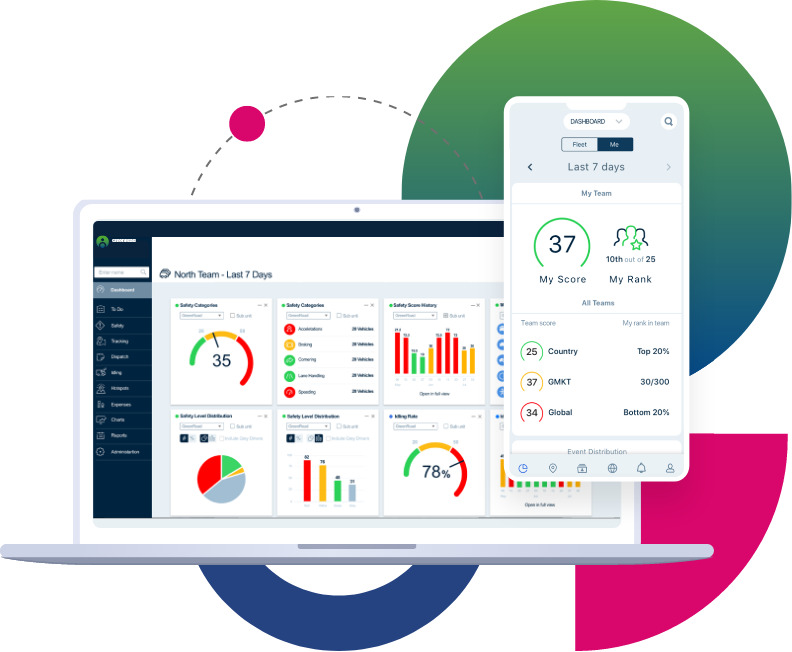
AskMila, the newest layer, lets a manager question that history in ordinary language. Who is improving? Which drivers need attention? What is pushing up energy use? It is a conversational door into GreenRoad's existing safety scores and event data, not a replacement for them. The strategic move is clear: after years of selling reports, GreenRoad wants to sell the answer that points to the next action.
What changed the drivers' minds
The machine is only half the implementation. Compass Travel, an independent bus operator in southeast England, adopted GreenRoad in 2017 after an insurer required telematics. Its premiums had climbed for years. Management initially treated more accidents as an unavoidable tax on bus operations, then concluded that many were preventable. The first thing to fail was not a sensor. It was that fatalistic assumption.
The rollout combined Edge devices and Central with training, monthly scoreboards, bonuses for green scores and a manager who spoke directly with struggling drivers. Red drivers were retrained; amber drivers got a quieter conversation; green drivers got recognition and money. Crucially, drivers could inspect the events behind their score. Accuracy and explainability turned the system from surveillance into what managing director Chris Chatfield called a self-help tool. Compass later reported its accident rate fell about 50% in the first year. In 2021 it negotiated its first year-over-year insurance premium reduction in more than a decade.
“They appreciated that we were giving them a ‘self-help’ tool rather than ‘big brothering’ them.”Chris Chatfield, Compass Travel
This is the part a reader can copy without buying GreenRoad. Put feedback close to the decision. Make the scoring legible. Let the person being measured see the evidence. Pair correction with recognition. Finally, ask whether the schedule, route or target is producing the bad behavior. GreenRoad's own management guidance warns that a risky driver may simply be rushing to meet an unrealistic arrival time. A score without operational curiosity becomes a blame machine.
A £4 million warning before the bridge
The clearest physical expression of GreenRoad's thesis is not a grand AI prediction. It is a beep before a double-decker meets a low bridge. In 2022, Stagecoach completed a £4 million national rollout of low-bridge detection across more than 4,000 buses in Scotland, England and Wales. GreenRoad combined vehicle position, bridge heights and road restrictions to warn drivers approaching a hazard. HERE Technologies and mapping reseller ADCi supplied the map ingredients.
The engineering constraint is more interesting than the press-release number: the warning cannot disappear with cellular service. Relevant map layers and processing can live on the Edge device, allowing the alert to work offline. HERE's frequently refreshed road data matters because a stale restriction can be as useful as a chocolate brake pedal. It also reveals the conditions under which this product cannot work well - poor vehicle-height data, stale maps, ignored alerts or a deployment that assumes technology will replace training.
Stagecoach's publicly stated cost for a national low-bridge safety project covering more than 4,000 double-decker buses. GreenRoad's current platform prices remain private and quote-based.
Nor did rollout make bridge strikes metaphysically impossible. A UK Traffic Commissioner decision records later Stagecoach incidents involving vehicles fitted with GreenRoad. Alerts are an intervention, not a force field. They still meet a human being, a route, a training system and the messy seconds before impact. That is not an argument against the alert; it is the honest boundary around it.
Focused where rivals are broad
GreenRoad sits beside larger fleet platforms such as Samsara, Motive, Geotab, Webfleet, Lytx and Netradyne. Those companies may offer deeper dispatch, maintenance, asset tracking or video-first operations. GreenRoad is narrower. Its center of gravity is the driver-behavior loop: detect, coach, score, review, improve. That focus is useful when safety is the purchasing brief. It is less compelling when the buyer chiefly needs to route jobs, track trailers or run maintenance from one system.
Its customer evidence also shows why the same product can have several buyers inside one fleet. The safety director wants fewer incidents. Finance wants claims and premiums to stop climbing. Operations wants vehicles available, passengers comfortable and routes completed. Sustainability teams care that smoother acceleration and less idling burn less fuel and stretch an electric vehicle's range. Drivers want a system that does not ambush them months later with unexplained accusations. GreenRoad's advantage is making one behavior stream answer all five concerns. Its risk is that a procurement team hears five promises and mistakes the platform for an all-purpose fleet operating system.
| Choice | Best reason to choose it | Tradeoff |
|---|---|---|
| Drive app | Fast software-only coverage for dispersed or contractor drivers | Depends on a compatible, correctly used mobile device |
| Edge hardware | Consistent, low-distraction coaching and offline alert logic | Installation and dedicated hardware add friction |
| VideoSense Pro | Visual context for events and driver-impairment warnings | Higher cost and a more sensitive privacy bargain |
GreenRoad earns money as an enterprise subscription business, generally priced per vehicle and assembled through custom quotes, with hardware, cameras and consulting layered in. There is no reliable public list price today. A government study preserved one 2014 pilot quote at $42 per vehicle per month plus $130 installation, useful as archaeology but useless as a 2026 shopping list. The absence of transparent pricing makes early comparisons harder, especially for small fleets.
The more revealing cost is organizational. Hardware has to be fitted or phones enrolled. Drivers need an explanation before the first score arrives. Managers need thresholds, a fair escalation path and enough time to coach. Unions or worker representatives may need a seat at the table. Someone must check that trips are associated with the right driver, because a beautifully calculated score attached to the wrong person is worse than no score at all. GreenRoad can provide consulting and workflows, but the customer supplies credibility. That is why the strongest case studies read less like software installations and more like small labor-relations projects.
Twenty years of data, three colored lights
The company has raised roughly $98.9 million according to private-market data, including a $26 million growth round in 2015 led by Israel Growth Partners. Its backers have included Benchmark, Amadeus, Generation Investment Management and Virgin Green Fund. That is a substantial sum for a business whose most memorable interface could be explained to a child before the traffic light changes.
It has also survived several generations of fleet fashion: hardwired black boxes, smartphone telematics, cloud dashboards, video and now conversational AI. The architecture changed; the pitch kept returning to behavior. In March 2026, longtime enterprise-software executive Yali Harari moved from chief operating officer to chief executive, with a mandate centered on predictive risk and global growth. The test for the new chapter is whether prediction remains as concrete as the old LED. A warning earns its place when a driver or manager knows what to do next.

The simplicity is deliberate. A driver cannot study a dashboard while driving. A manager cannot personally coach every mile. GreenRoad splits the job: tiny signals for the person in motion, accumulated patterns for the person planning the intervention. Its Fleet Elite program closes the circle with status. The company said 13,414 drivers earned recognition for 2025, nearly a quarter of its global driver base, including 789 people who had sustained the standard for ten years.
The model does not travel automatically. It needs enough driving volume to expose patterns, management willing to act on them, drivers who trust the measurement and incentives that do not encourage gaming. It is also a poor standalone answer when safety problems come primarily from broken vehicles, impossible schedules or bad route design. Software can reveal those conditions. It cannot negotiate a humane timetable by itself.
GreenRoad's useful provocation is that fleet safety should not begin in the claims department. It should begin with a nudge before the corner, a score the driver understands and a manager curious enough to ask why it moved. The company has added cameras, maps and AI around that idea. The humble traffic light is still doing the editorial work.