In July 1916, the Catawba River became an obstacle to the very system it had helped create. Floodwaters made carrying electrical lines across by boat impractical. Duke’s crews found another method: a cannon. They used it to help get lines over the river. Restoring service still took two months. The artifact survives in the company’s archive, a rather persuasive reminder that electricity has always required people willing to solve awkward physical problems.
- Duke sells electricity and gas through regulated utilities.
- Its $103 billion plan buys infrastructure over five years, not instant reliability.
- The next challenge is making large new customers carry their share of construction risk.
The cannon is amusing. The network behind it is the business. Duke’s early hydroelectric system helped run Carolina textile mills; connecting plants and customers made power useful across a region. Today’s debate about data centers has a familiar shape. A promising industry wants electricity. Somebody must build the machinery that makes the promise practical.
A network with a very ordinary job
Duke Energy Corporation supplies a commodity people judge with exceptional impatience. Electricity must arrive when the kettle, factory motor or air conditioner needs it. Its regulated subsidiaries combine generation, transmission and neighborhood delivery; gas utilities supply heating, commercial processes and other uses. Customers buy service within defined territories. Most cannot shop for a different set of local wires.
The footprint stretches through six electric-service states, from the Carolinas and Florida to Indiana, Ohio and Kentucky. Southern Company, Dominion, American Electric Power and NextEra are useful industry comparisons. They generally cannot replace Duke at your address. Duke’s position rests on its installed network, operating expertise and regulatory arrangements. A solar developer sells projects; Duke must keep an entire service system working.
The outage you never have
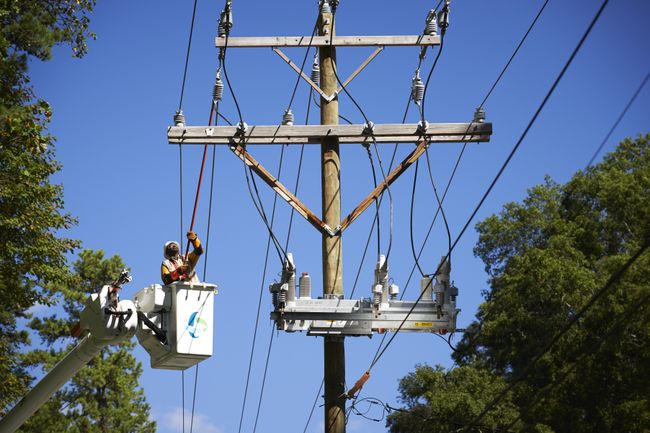
One useful improvement sounds almost suspiciously cheerful: a “self-healing” grid. Sensors and automated switches detect trouble, isolate the affected section and reroute electricity through another available path. A broken branch can become a smaller interruption, leaving fewer people waiting for a truck. The wires have acquired a little discretion.
Duke reports that this technology avoided approximately 2.2 million customer outages in 2025 and saved 5.2 million hours of outage time. These are company estimates of interruptions avoided, not a claim that millions of distinct households received uninterrupted service. The distinction matters. So does the engineering limit: rerouting needs a usable alternative path. Software cannot manufacture spare electricity.
Detect → isolate → reroute
When the backups get cold, too
Christmas Eve 2022 supplied a harder demonstration. During Winter Storm Elliott, plant equipment failed, expected electricity purchases became unavailable and Duke imposed rolling outages in the Carolinas. South Carolina’s regulatory staff counted nearly 95,000 affected customers in that state alone. Average interruptions there lasted just under three hours; some exceeded ten.
The subsequent federal account described several interacting weaknesses, including frozen instruments and outage-management software that failed to rotate service as intended. Duke disputed portions of the state findings. Still, the operational lesson is plain: local distribution damage and a system-wide supply shortfall require different remedies. More automated switches cannot compensate for too little available generation during a regional cold snap.
“We own what happened.”Julie Janson · Duke executive, January 2023 briefing
That episode challenged assumptions about cold-weather readiness and emergency operations. It also offers a useful question for any organization: does the backup depend on the same weather, supplier or software as the primary system? Redundancy looks reassuring on a diagram. Shared vulnerabilities can make it disappear precisely when needed.
The bill behind the build
Duke’s five-year capital plan reached $103 billion in 2026. That is planned spending across a growing utility system, rather than money already spent or a price tag for one technology. Generation and delivery both need capital. Its electricity supply includes nuclear, natural gas, coal, hydro and solar, with storage and grid upgrades part of the modernization work.
Construction takes years.
The financing starts sooner.
The regulated model links these projects to customer bills. Regulators decide which costs utilities can recover and what return investors may earn. Cash flow, borrowing and equity help pay for construction. Duke’s 2025 Brookfield agreement contemplated $6 billion for a 19.7% indirect minority stake in its Florida utility. Patient capital comes with a share of future economics.
Focus has changed, too. Duke completed the sale of its unregulated utility-scale renewables business in 2023 while continuing clean-energy investment inside regulated utilities. It sold Tennessee gas operations to Spire for $2.48 billion in March 2026. These transactions help explain the strategy: concentrate capital where the company expects to build and recover investment through utility operations.
The server has to pay its way
New data centers make cost allocation unusually visible. In October 2026, Duke announced a North Carolina settlement proposing upfront, nonrefundable payments for facilities dedicated to individual large customers, plus deposits and security guarantees for shared upgrades. The agreement remained subject to commission approval. Its expanded coverage would include qualifying loads of at least 50 megawatts with an 80% load factor.
The proposal addresses a problem that precedes AI: infrastructure can outlive the demand forecast that justified it. Early customer commitments help put risk with the party requesting capacity. Construction costs, permitting delays and disappointing demand can still undermine the economics. A power plant cannot be resized as casually as a cloud subscription.
Useful power, ordinary decisions
Harry Sideris became CEO in April 2025 after 29 years and 20 roles across Duke and its predecessors. That background suits a business whose work runs from control rooms to field repairs. For households, the practical tools are less theatrical: usage tracking, outage reporting, efficiency programs and payment assistance, with options varying by location.

The lesson readers can copy is equally practical: inspect the dependencies, measure interruptions and assign expansion costs before building. Duke’s story connects a cannon to automated switches through the same stubborn requirement. Power has to cross the distance between an ambitious plan and somebody’s kitchen.