The first thing to understand about Drake Software is that the problem came before the product. In Phil Drake’s accounting practice, writing other companies’ weekly payroll checks consumed three days. A program reduced that job to one morning. Then came software for Form 1040 and Schedules A and B. The business began with a wonderfully concrete question: how much of this week could a computer give back?
- Professional U.S. tax preparation, sold to the people doing the filing.
- Annual desktop licenses or online access with per-return charges.
- Connected tools chase documents, signatures, tasks, and payments.
Three days, one morning
In the company’s fortieth-anniversary account, Drake recalled that selling software had come after the effort to automate his own practice. In 1977, he sold six packages to other accountants, going door to door. There is something appealingly unglamorous about that beginning. The customer could understand the pitch without understanding the code. Here was an accountant offering another accountant a way to get through the work.
Today, Drake says more than 70,000 tax professionals nationwide use its software. Its reported processing volume exceeds 36 million federal and state returns. Those are different measures: a preparer can file many returns, and federal and state filings are counted separately. What connects them to the original payroll program is the repetition. A small saving, applied to the same task over and over, becomes a business proposition.
The price of an answered question
Drake’s customers include CPAs, enrolled agents, and independent preparers. The September 2026 Journal of Accountancy survey offers a useful glimpse of its position: 46.5% of responding Drake users were sole practitioners. Across professional tax software, the alternatives include Intuit’s Lacerte and ProSeries, Thomson Reuters’ UltraTax CS, and Wolters Kluwer’s CCH products and ATX. Drake competes for offices where the buyer may also be the person entering the numbers.
For that person, a stalled return is a practical problem. Drake includes unlimited U.S.-based support with its tax packages. In the survey, Drake tied Lacerte at 4.4 out of five overall; its support scored 4.2 for quality and 4.3 for ease of obtaining help. These are respondents’ ratings, rather than an independent test of every feature. They nevertheless suggest why an answered question can matter as much as another menu option.
Out of 5 · Journal of Accountancy tax software survey · User ratings
“Our original goal was to automate our tax practice, not sell software.”
Phil Drake / 2017 anniversary recollection
The work around the work
The return itself is only part of the job. Somebody must collect a missing document, tell a reviewer the file is ready, obtain a signature, and collect the fee. Put each task in a separate system and the office acquires another occupation: keeping the systems and people informed about one another.
Drake’s expanding product range follows those handoffs. Portals handles document exchange. E-Sign handles signatures. Workflow tracks return stages and assignments, with status changes driven by activity across connected Drake tools. Drake Pay accepts payments through channels including credit cards and ACH. Drake Accounting reaches into payroll and bookkeeping. The attraction is fewer places to check before answering a client’s ordinary question: where are we?

GruntWorx addresses another familiar delay: organizing source documents and transferring their contents into a return. Its CORE service leaves verification with the firm; PREMIUM adds U.S.-based human review. That distinction matters. Automation can move the labor somewhere else without making it disappear. A practice choosing between the services is also choosing who will check the machine’s work.
- 01Collect
Documents - 02Prepare
The return - 03Approve
& sign - 04File
& get paid
A simplified workflow, not a promise of automatic completion.
For a buyer, the useful experiment is to follow one representative file from arrival to payment. Count the times someone has to retype information or ask a colleague for an update. Then run that file through the proposed setup. A faster calculation will not settle whether the team has fewer interruptions. The unit worth measuring is the completed job.
The browser has footnotes
In 2021, private equity firm Cinven announced a significant investment in Drake, with financial terms undisclosed. In 2023, Drake and TaxAct announced Taxwell as their parent company’s name, while keeping their own brands. The distinction is useful: Drake’s professional preparation business sits alongside TaxAct’s consumer offering. Shared ownership does not make them the same product.
Drake announced Tax Online in September 2025. It uses the desktop product’s tax engine and offers browser-based preparation, with guided or direct entry. There is also a separate route to remote work: hosting desktop Drake through Rightworks. A hosted Windows application and a browser application solve access differently. A buyer should know which experience the office is purchasing.
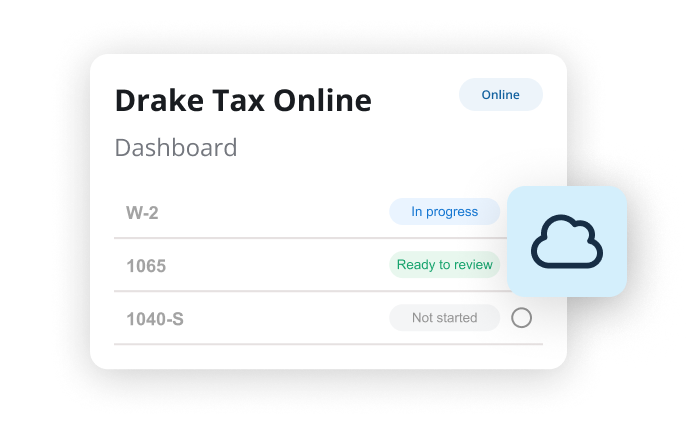
The online product has practical qualifications. Certain functions and return types require its integrated Windows data-entry module; that module does not run on a Mac. Firms should test their actual forms and import routines. The word “online” alone cannot establish whether an entire practice can leave Windows behind.
The economics deserve the same scrutiny. As checked on October 16, tax year 2026 desktop Pay-Per-Return costs $379.99 with ten individual returns included. Online starts at $299.99 for the first user, with returns purchased separately. Hosting and optional services add costs. The sensible comparison is a season’s workload, including users and add-ons, rather than the smallest number on the pricing page.
Keep the shortcut. Keep the judgment.
In July 2026, Drake launched SmartExtract in beta for online users; its current product page also lists desktop availability. It extracts information from supported tax PDFs for preparer verification. Eligible users can try it without an additional beta charge. But document quality affects results, and the beta limits processing to twenty documents per return. Poor scans and handwriting may still require manual entry.
There is a quieter product lesson in Drake’s release notes. Proformas returned for tax year 2025 after customer feedback. Progress sometimes means restoring something customers already knew how to use. The company’s public record also includes a planned Greenville hackathon with Drake engineers mentoring participants, and careers benefits such as tuition reimbursement. Those are specific investments in learning, alongside the daily requirement to keep tax software useful. Anyone copying Drake’s approach should begin by measuring a recurring delay, then check whether the proposed shortcut survives the whole job. The original payroll program had a persuasive result: three days became one morning. Every new feature has to earn its own version of that answer.