Steven Brewer’s problem was the calendar. Clients brought in their monthly accounting work when they brought it in. His firm waited. When the material arrived late, the firm could fall days or weeks behind. In an AccountantsWorld case study, Brewer describes a practice doing desktop write-up work, dependent on other people’s timing. The software could process the numbers. The arrangement made getting ahead of them difficult.
- Cloud accounting and payroll tools sold to professional firms.
- The accountant decides how much work each client can do.
- The commercial bet: deliver more ongoing services to existing clients.
Brewer decided to reduce his reliance on tax returns and move toward bookkeeping and CFO-style Client Accounting Services, or CAS. He chose AccountantsWorld. His published account reports 75% revenue growth over five years without increasing client numbers. It is a vendor-published testimonial, not an independent experiment. Still, the mechanism is interesting: a firm can grow by changing what it does for the people already on its books.
Selling the old business, building the next
AccountantsWorld’s founders, Chandra and Sharada Bhansali, had already built a tax-software business. They sold it in 2003. According to the company’s origin story, friends and family expected retirement. Instead, the founders kept working on an opportunity they saw in the internet: accounting systems that could connect a professional firm and its clients without passing desktop files back and forth.
The company dates its cloud work to 2000. Its argument was about the accountant’s place in the transaction. Small-business software could put business owners in charge of bookkeeping and leave accountants with the consequences. AccountantsWorld wanted the professional to organize the work from the beginning. It also made a commercial promise: it would not sell its products or services directly to those accountants’ clients.
That promise helps explain its market position. AccountantsWorld supplies software to the firm; the firm supplies services to businesses. A business owner can participate, but the professional remains the buyer and organizer. For a firm worried that its software supplier might become a rival for service revenue, the distinction matters.
A permission setting with a point of view
Accounting Power combines professional accounting tools with a general ledger. The feature list includes bank feeds, trial balances, adjusting entries and customizable financial statements. It also handles payables, receivables, job costing and inventory. These are the ordinary, necessary parts of turning business activity into records somebody can use.
The revealing detail is client access. The accountant can give each client only the functions appropriate to that engagement and the client’s ability. One client can enter transactions; another can leave the bookkeeping to the firm. Staff then do the professional work in the same system. Permissions become a way to design the service.
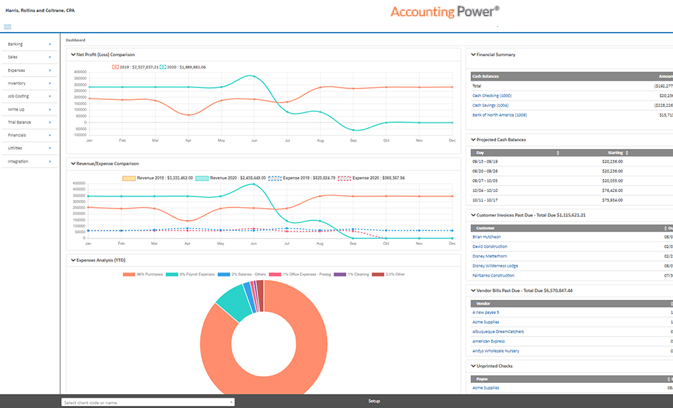
Power CAS builds on this foundation to support outsourced accounting and advisory work. A firm can start with write-up and financial statements, then add bill payment or cash-flow oversight. The software supplies reporting and analysis; the accountant must still explain what the numbers mean. Brewer’s point is that clients also need someone who knows how to interpret the tools.
“most clients want not just the tool, but the knowledge”
Steven Brewer, CPA · company-published case study
The firm’s expertise is the service the software helps it deliver.
Payroll without the handoffs
Payroll Relief applies the same thinking to a deadline that cannot wait for tax season. It automates direct deposits, payroll tax payments and filings, and supports batch processing across clients. The product page specifies federal, state and local US coverage, including all 50 states, and payrolls of up to 1,000 employees. This is professional processing software for firms and payroll providers.
In another company-published case study, Matt Contardi describes the limits of his previous QuickBooks payroll setup: his firm lacked online portals and functions such as pay-as-you-go workers’ compensation and electronic garnishment payments. He credits Payroll Relief with helping his family-run firm compete on both capabilities and personal service. The useful lesson is to find the missing operational capability before buying a replacement system.
Cloud Cabinet handles another source of friction: documents. Payroll reports can be archived after processing, and designated financial reports after closing the books. Clients retrieve material through portals rather than requesting another attachment. The company advertises unlimited client portals without an additional portal charge. Practice Relief turns attention inward, tracking time, expenses, invoices and client realization so smaller firms can examine the economics of their own work.
The price of taking responsibility
The business model is subscription software, purchased by professionals who charge for their own services. A February 2018 CPA Practice Advisor review listed Accounting Power at $1,195 annually and the Power Practice System at $2,195. Those figures describe the historical model, not today’s offer. Current purchasing runs through a sales conversation and quote.
Accounting Power, as listed in a trade review at the time. Not a current quote.
For a firm, the meaningful cost also includes migration, training and onboarding clients into a different division of labor. The approach fits accountants who want to operate recurring services. A business owner seeking an independent, self-directed bookkeeping subscription has a different buying problem. Likewise, a firm that wants to refer payroll elsewhere must weigh that choice against running the service itself.
A bigger owner, the same question
IRIS acquired AccountantsWorld in December 2021. The founders planned to leave operational leadership at the end of January 2022. IRIS subsequently reported that Payroll Relief added employee self-service and achieved SOC 2 Type II compliance during 2022. Today, IRIS’s company directory describes AccountantsWorld as “Now IRIS Payroll,” while the AccountantsWorld website continues to present its accounting and payroll products.
The practical idea is available to any service firm: decide who does each task, remove repeated handoffs, and make room for work clients value enough to buy regularly. AccountantsWorld built software around that arrangement. Its most interesting question remains the one Brewer confronted while waiting for another client’s records: who gets to set the pace?
Follow the work
Company website ↗ · Accounting Power ↗ · Payroll Relief ↗ · Company blog ↗ · IRIS acquisition announcement ↗
LinkedIn ↗ · X ↗ · Facebook ↗
YouTube videos ↗ · Accounting Power video page ↗ · Payroll Relief video page ↗