At Providence Health Plan, the humble ID card had acquired a wardrobe problem. More than 100 designs needed managing. Pre-printed stock created inventory trouble, especially during open enrollment and when new groups wanted their own details. A different web address or logo could become a production complication. The card was small. The operation behind it was getting rather large.
In a historical case study published by Clarity, Providence’s move to the company’s system reduced those designs to fewer than 20. Member data fed an automated daily process. Staff could alter designs themselves, and digital printing removed the need to maintain pre-printed inventory. The useful innovation was a change in where the variation lived: in data and software, rather than stacks of waiting card stock.
- Clarity sells healthcare communication software and fulfillment to health plans and administrators.
- Its work includes ID cards, benefits explanations, member guides, letters and payment documents.
- mPulse acquired it in August 2025 to connect those communications with portals, analytics and outreach.
A hundred designs, and a better question
The tempting question is how to print a hundred designs faster. Providence’s example suggests another: why maintain so many separate designs? There is a quiet commercial advantage in asking that question before buying a faster machine. Every variant has to be controlled, updated and checked. A small difference repeated across a large membership can become a substantial administrative task.
Clarity’s software gives operators control over variable-data templates and production. Cards can be held for review, shipment methods changed, and materials viewed before printing. Its ID-card product also supports electronic access. The appeal is easy to understand: the person responsible for sending the card gets tools to manage the card.
“Two key requirements for success were customer service and an easy to use interface.”Walter Burkhartsmeier, Providence Health Plan
Historical customer case study
Another old customer case, Scott & White Health Plan, describes a related simplification: more than five card-data layouts became one daily file. The reported implementation took ten weeks, two weeks ahead of schedule. These are specific historical examples, rather than a timetable every buyer should expect. Their shared lesson is that reducing the number of moving parts can be as valuable as speeding them up.
The document has a life before the envelope
Clarity occupies the space between a health plan’s information systems and the member who needs to understand what the plan has sent. Its web-based system organizes data, customizes communications and routes them toward delivery. Operations teams can edit templates; approval workflows and previews give reviewers a chance to catch problems before production. Distribution and production reports make the process visible.
This is enterprise software for a particular kind of repetitive work. A welcome kit, an invoice and an Annual Notice of Change have different purposes, yet each must combine the right content with the right person’s details. Clarity offers products across that range, including 1095-B forms and Summaries of Benefits and Coverage. The same underlying challenge keeps returning: personal information, repeated at scale, with limited tolerance for mistakes.
Its EOB product illustrates the idea. Business rules can generate member-specific explanations from a smaller set of templates. Changes have audit trails, while earlier versions can be archived. Members who elect electronic delivery can receive an email directing them to their portal when a new EOB is available. A communication therefore has both a content problem and a routing problem; the workflow has to solve both.
The payment offering extends the task to EOPs and transactions. Clarity describes support for checks, ACH and virtual cards, with access to payment history, settlement details and associated documents. That places the company alongside claims administration rather than in place of it. The claims system and communication system have different jobs, and the connection between them matters.
Make the letter earn its postage
Look at the welcome-letter examples Clarity publishes. The company sets a standard version beside an optimized version, inviting buyers to think about what the document asks the member to do. It is a useful design question even before anyone talks about analytics: does the recipient have a clear next step, or merely another page to file?
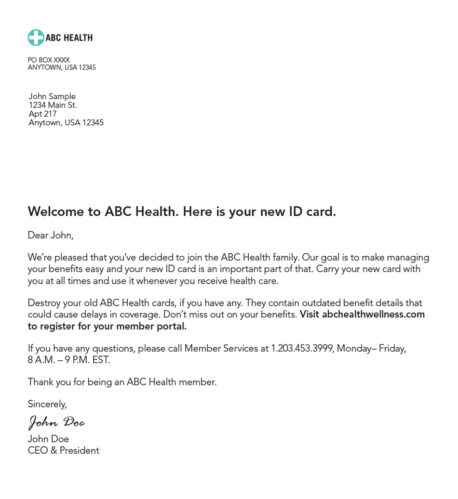
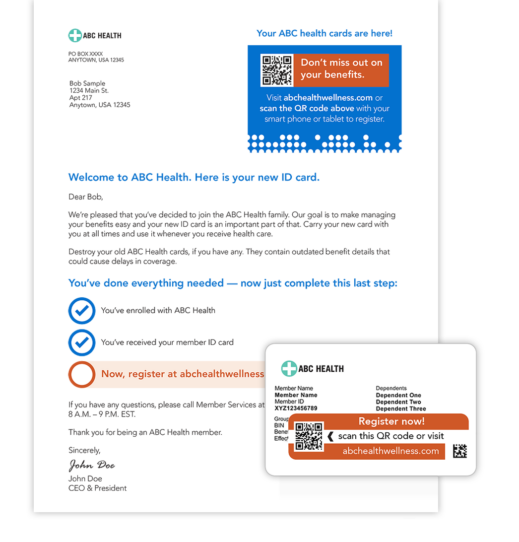
A letter has already earned a moment of attention because it concerns the member’s coverage. The editorial opportunity is to use that moment carefully. This is the logic behind treating transactional communications as engagement touchpoints. A plan need not invent a new occasion to speak if it can make an existing occasion more useful.
The software company that bought its printer
In May 2020, Clarity acquired Premier Graphics, later called Clarity Output Solutions. The production business dated to 1984. Its services include printing, inserting, mailing and fulfillment, with controls such as barcoding, cameras and verification. Buying that operation brought the physical end of the communication closer to the software that created it.
There is something pleasingly unfashionable about the transaction. A digital platform still needs someone to put the right pages into the right envelope. Clarity’s product materials also leave customers a choice: use its fulfillment services, an in-house printer or an outside vendor. Its business combines B2B SaaS with services, rather than requiring every document to travel through one production route.
For a buyer, the cost calculation should follow that whole route. Implementation, data integration, document volume, print production and delivery belong in the comparison with the existing process. The relevant question is whether the proposed workflow reduces enough administration, inventory or rework to justify its contract. Savings in a historical card program provide a useful line of inquiry; they do not establish the price of a new one.
Capital followed the correspondence
Sean Rotermund founded Clarity and led it as CEO before moving to founder and vice chairman in 2020, when Steve Mongelli took the chief executive role. North Bridge supplied growth investment in 2014. Morgan Stanley Capital Partners invested in 2019, partnering with management on organic growth and product development. The founder’s interests also reached beyond documents: he launched Clarity for Charity in 2011.
The company’s 2025 Inc. announcement reported three-year revenue growth of 56% and its tenth appearance on the list. That August brought a more consequential change of ownership: mPulse acquired Clarity. In the acquisition announcement, mPulse described a combined customer base of more than 450 healthcare organizations. That figure belongs to the combined business; Clarity separately reported more than 100 healthcare clients.
The strategic fit is specific. mPulse already offered engagement technology, health portals and predictive analytics. Clarity added core communications, including cards, guides and EOBs. In a September 2026 update, mPulse described the desired connection: an ID-card mailing becomes a portal login, and an EOB becomes a self-service action. That is the parent’s direction of travel, rather than a measured outcome for every Clarity customer.
Paper has competitors, too
Clarity works in an established market. O’Neil Digital Solutions offers ONEsuite for healthcare communications across print and digital channels. Smart Communications serves healthcare payers with member communications, data collection, orchestration and document access. A plan can also assemble its own composition tools and production vendors. Buyers have alternatives with overlapping capabilities.
Clarity’s position combines healthcare-specific document workflows, operator control, physical fulfillment and, now, the wider mPulse portfolio. Its security page reports maintained HITRUST certification and annual SOC 2 Type 2 audits. Those controls belong in procurement discussions alongside integration work and delivery requirements. A workflow is only as useful as the data, people and channel arrangements supporting it.
The idea travels beyond healthcare: count your variants, separate reusable content from variable data, give somebody responsibility for the templates, and preserve a review trail. It is most useful where documents recur at volume and small errors create expensive work. For a one-off letter, the machinery would be excessive. For a poorly maintained data feed, automation can repeat the underlying error with impressive punctuality.
Meanwhile, mPulse announced a Phoenix operating center in August 2026, with western print and mail operations planned for the fourth quarter. The stated purpose includes redundancy and surge capacity. The digital strategy still needs a physical delivery network. There, at the end of a story about software, is an envelope waiting to leave the building.
Follow the paperwork
Explore Clarity’s website, its product suite and news and insights. Read about the mPulse acquisition and the planned Phoenix expansion.
Find Clarity on LinkedIn, X and Facebook. Watch its YouTube channel or the decision-letter webinar.