A pension used to travel in a binder. In Heywood’s account of its beginnings, staff filled in service record cards, packed them into hefty Kalamazoo binders and passed the information to actuaries. Completing those records could take two years. In 1975, Geoffrey Heywood, an actuary, proposed electronic storage and magnetic tape instead. The ambition was wonderfully practical: feed in the information and get calculated results the next morning.
Half a century later, the stationery has changed. The awkward job underneath it has endured. Someone must reconcile employment records, apply pension rules and turn a working life into the right payment. Heywood, based in Altrincham, sells the software that helps pension organisations do that work. Its story is a reminder that a large technology business can grow around a problem most people notice only when something goes wrong.
The paperwork has a software company
Heywood’s central product, Altair, brings together benefit calculations, workflows, documents and bulk processing. An administrator can handle an individual case or an exercise covering many members, such as annual statements or pension increases. The company says the platform serves more than eight million members and is used by over 75% of Local Government Pension Schemes. Those are vendor-reported measures, but they indicate the size of the installed customer base.
The customer is usually an institution: a pension fund, scheme administrator or employer. Heywood’s published customer list includes Tesco, the Scottish Public Pensions Agency, Royal London and Next. Its US website reports more than 180 customers and over 240 employees. A member may encounter the company’s software through their scheme’s portal without having chosen Heywood, or even knowing its name.
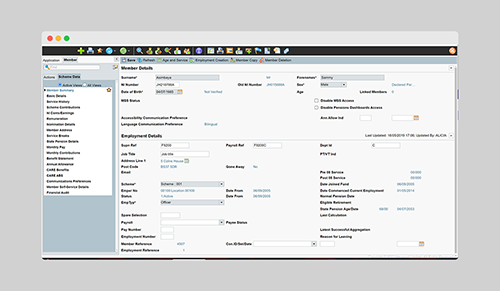
That distance from the end user helps explain the product range. Pension teams need software that understands their calculations and their working routines. Heywood offers a dedicated calculations team, configurable workflows and role-based access with auditability. Its pitch rests on pension expertise and the connections between its products. A polished member screen is useful only if the administration behind it can finish the case.
A PDF is still a form to fill in
Surrey Pension Fund supplies a particularly recognisable example. Its retirement process included a declaration that members downloaded, completed by hand, scanned and returned. The document was online; the work was still a relay race. In Heywood’s Surrey case study, this declaration was identified as a point where applications could stall.
The project used Engage’s online forms and workflows, alongside testing, staff training and member communications. Surrey also wanted its own customer team to learn configuration. The reported outcome was an average twelve days from retirement request to payment, with as many as 75% of retirements initiated online in a quarter. The case study values the staff time released at £80,000. That is a capacity estimate, not a cash rebate or a stated reduction in headcount.
The practical lesson travels beyond pensions: follow a customer task until it is actually complete. Publishing a form does not remove the work of returning it. Surrey’s team used the released capacity for harder cases, including McCloud rectification.
Average from retirement request to payment after implementation.
One customer case study; not a guaranteed service level.Engage also provides planning tools and access to pension information. Video Engage adds personalised video explanations, developed through Heywood’s collaboration with Money Alive. Their joint work received a PMI Pinnacle award in 2025. These products address a different administrative burden: the member who needs somebody to explain what the statement means before deciding what to do next.
Start where the data enters
There is another entrance to the system: the employer. i-Connect takes payroll information and manages its submission to the pension scheme. It identifies changes such as joiners and leavers, supports contribution reconciliation and gives administrators tools to monitor timeliness and accuracy. The point is to reduce repeated handling of the same information.
In its Isle of Wight case study, Heywood reports a 60% year-on-year fall in breaches involving late payments and returns. The fund registered for i-Connect in September 2020. Faster access to employer information also helped deferred-benefit and estimate processing. This is a local result, with its own starting conditions. It nevertheless gives buyers something more useful to ask about than a broad promise of efficiency: which submission errors fell, and which pieces of work stopped waiting?
Insights supplies reporting and analysis around pension data. The wider data-services range includes cleansing, tracing and mortality screening. Taken together, the tools show where Heywood sits in the market: the operational layer of pensions, where keeping records usable is a recurring job. An attractive chart at the end cannot repair an employment change that never entered the system.
£207,000 buys one answer, not a price list
Institutional procurement gives this business a different rhythm from a consumer subscription. Buyers commission software, implementation and continuing support against defined requirements. The modules, migration and service scope matter. A published contract or project cost is therefore evidence about that purchase, rather than a universal price for Altair.
Highland Pension Fund offers a concrete example. Its administration report says Altair pensioner payroll went live in February 2025 with implementation costs of £207,000 against a £210,000 budget. The fund had used Altair administration since July 2019. This was an extension of an existing system relationship, an important condition when considering whether another organisation could repeat the result.
£3,000 below budget. Implementation only; not total lifetime cost.
Heywood faces specialist alternatives, including Civica’s UPM, which also combines pension administration, payroll and member services. Integration itself is therefore not an exclusive selling point. Heywood’s case rests on its specific products, calculation expertise and existing customer relationships. A useful comparison would test the buyer’s actual rules and handoffs, alongside migration demands, rather than award points for a longer feature list.
The interface can still hold up the queue
Public project reports supply a less tidy companion to the case studies. Shropshire’s May 2026 pension-board papers record delays involving Heywood: mortality screening went live after a supplier-side delay, address tracing was affected by staff pressures associated with ISP work, and implementation dates slipped because of issues with the Altair interface for additional voluntary contributions.
These are specific reported delivery problems, not proof that every installation behaves alike. They show the condition attached to automation: interfaces, test files and available people still have to line up. Buying connected products does not eliminate the work of making each connection operate correctly. A sensible buyer can copy the discipline of a project log that names the blocked dependency, the responsible team and the next acceptance step.
Pensions dashboards add another set of handoffs. Heywood’s ISP connects schemes to the dashboards infrastructure, and the company says it works with other administration platforms too. A January 2026 update reports more than 180 connected schemes representing over ten million members. That population is distinct from Altair’s member count; adding the two would manufacture a misleading total.
“The success of the PDP ecosystem depends on ISP providers delivering compliant, secure and scalable solutions”
Chris Connelly, Heywood, on dashboards connectivity, 2022
The same attention to records appears in Passport, Heywood’s pension risk transfer offering. It combines data preparation, benefit checking and member communications for schemes and insurers. The intended benefit is better preparation for a transaction. The software supports that process; a scheme still needs accurate inputs and people responsible for acting on discrepancies.
New owners, older conversations
Heywood acquired New Zealand business-rules specialist Idiom in 2023. Its low-code technology lets experts express and maintain calculation logic with an audit trail. That capability fits work in which a result must be explainable and repeatable. It also provides a route to add calculation capability around existing systems, rather than requiring every customer to replace its whole administration platform.
Ownership has changed too. BlackRock Long Term Private Capital acquired the business in 2021. In December 2025, Heywood announced an agreement to join Keylane, the pension and insurance software group backed by Pollen Street. The announcement said management would remain and the business would retain substantial autonomy. Heywood’s July 2026 CLASS conference account subsequently described the acquisition as completed.

CLASS remains a forum for customer experience and product discussion. Inside the company, Hive Days bring employees together to learn across roles. Sessions have included design systems, trauma-informed practice and a coin game about finishing work already started. It is a pleasingly literal exercise for a business whose customers spend their days trying to clear outstanding cases.
California gets the next chapter
The US expansion makes delivery the next thing to watch. SJCERA’s board records say it signed its Heywood pension administration contract on December 29, 2025. In June 2026, Heywood announced selection by Imperial County Employees’ Retirement Services, or ICERS. That programme is scheduled to introduce Altair, i-Connect, Engage and Insights progressively over two and a half years, using US-based cloud infrastructure.
Heywood’s ICERS announcement identifies integration, security, governance and the team’s pension experience as selection factors. It documents a purchasing decision, with implementation underway, rather than a completed transformation. The distinction matters. Heywood has won the chance to demonstrate that its accumulated expertise can travel. The final test will be familiar to anyone who once waited for a pension form: whether the record is right, the case moves and the payment arrives.
Inside the pension machine
Explore Heywood’s website, its customer stories and news and articles. Follow LinkedIn, Instagram or the legacy Twitter/X account.
Watch the Engage product video, the Pensions Dashboards Programme interview or visit Heywood on YouTube.