Imagine a spare part sitting on a shelf while someone orders another one. The first is recorded under a manufacturer’s description. The second has a local nickname. To the purchasing system, they are strangers. To the mechanic, they are the same thing. This is an illustrative example, but the problem it describes is precisely the territory Utopia Global occupies: the distance between an enterprise’s records and its actual business.
“Master data” sounds like something best left to a committee. It means the durable information that tells a company what its equipment, materials and products are. A transaction says a part was bought. Master data says which part. Confuse the latter and the former can become an expensive exercise in repetition.
- Utopia cleans, enriches, migrates and governs enterprise data.
- Its particular territory is SAP asset management and retail/fashion records.
- Software and services work together: fix the backlog, then govern new changes.
- Prometheus Group acquired Utopia in 2020; the products now sit within its wider maintenance portfolio.
A governor for the equipment record
Utopia’s proposition has two jobs. One is remedial: find duplicate records, fill gaps, reconcile descriptions and prepare information for migration. The other is preventive: decide who may create or change a record, what rules it must meet and who must approve it. A freshly cleaned database without that second job has a remarkably short honeymoon.
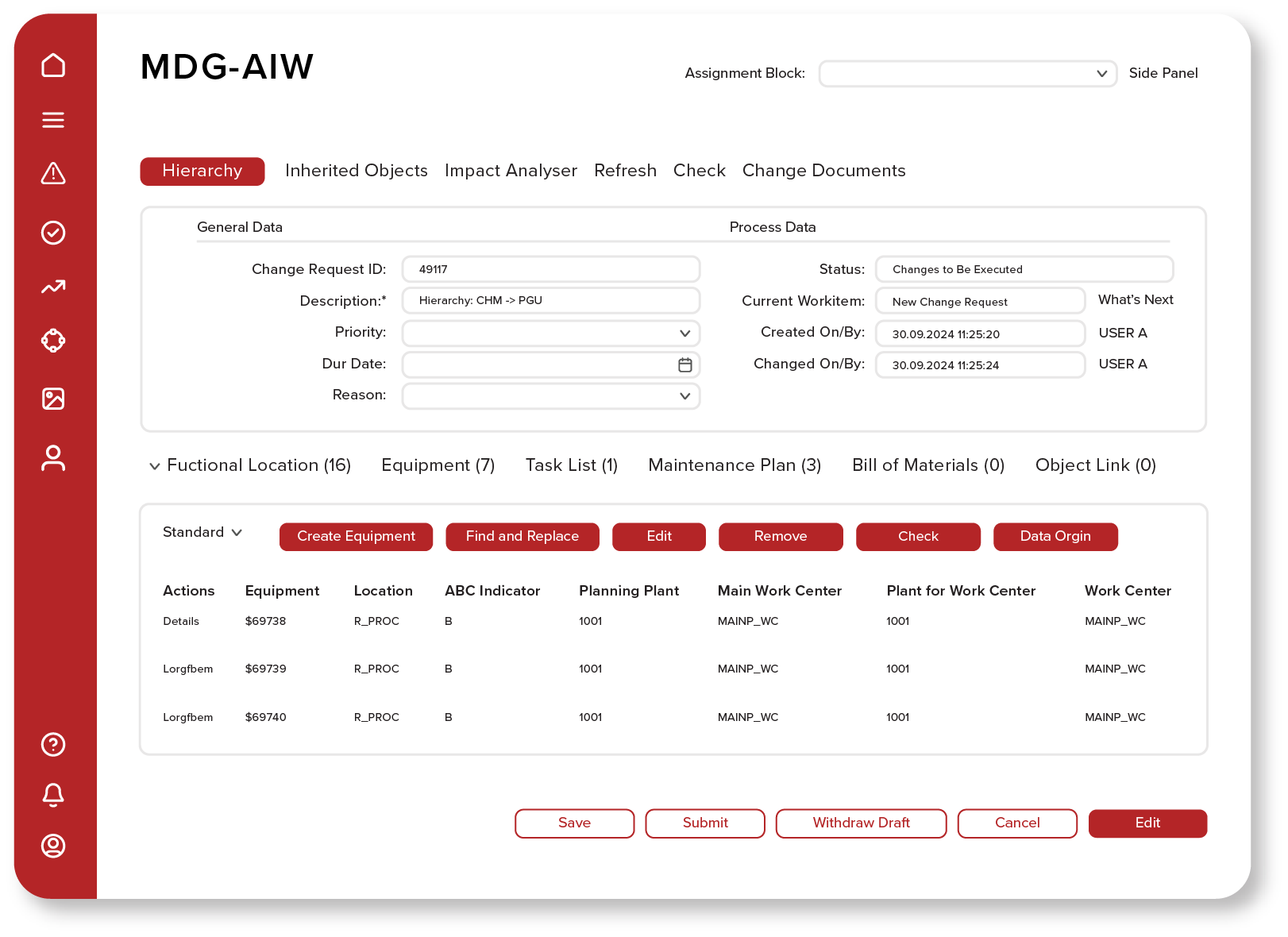
The SAP Master Data Governance enterprise asset management extension, usually shortened to MDG-EAM, gives that preventive work an industrial vocabulary. Equipment, functional locations, work centers, maintenance plans, task lists and bills of materials are governed objects. Utopia’s user documentation describes requesting, approving and executing changes, then replicating them to decentralized systems.
The distinction matters. A generic database can store an equipment number. An asset governance system must also respect the relationships around it: where the equipment sits, what work it needs and which materials belong to it. Those relationships make the record useful to maintenance. Moving a row of text is easier than preserving the meaning attached to it.
“Get it clean, keep it clean.”
Mike Jordan, Utopia/Prometheus Group, 2021 user conference
That little instruction contains the commercial argument. Consultants can repair a backlog. A continuing governance process addresses the next record, and the next person who edits it. Utopia combines services with specialist software rather than asking a customer to treat data quality as a ceremonial project performed once before an ERP launch.
Pumps, drawings and fashion collections
Asset Information Workbench, or AIW, works on a related headache: an asset can have records in several systems, plus drawings and documents that do not politely update themselves together. SAP describes a centralized view, synchronized master data and documents, and a staging area for maintaining and reviewing changes across large projects.
In 2017, Utopia expanded its global reseller agreement with SAP to include the workbench. The announcement described complex changes involving multiple asset objects, with connectors for engineering design, geographic information, reliability and content-management systems. The ambition was to make a change travel with its consequences.
The 2020 Hexagon partnership gives this a concrete shape. Utopia’s Engineering Connector for AIW was linked with HxGN SDx Connector for Plant Maintenance to provide auditable synchronization in both directions. Engineering and maintenance could align their systems of record. A revised drawing and a maintenance record ought to describe the same plant; the connector was built to help them do so.
Then there is fashion. Utopia’s MDG-RFM extension applies governance to retail articles and SKUs. Creation, enrichment, mass processing and retirement all matter when merchandise moves through a business. The object has changed from a pump to an article, but the organizational nuisance is familiar: spreadsheets and email can leave different departments tending different versions of a product.
That pairing is the distinctive detail. Utopia’s expertise sits where industry-specific records meet SAP workflows. Its competition includes the decision to build those models internally, hire an integrator or keep repairing data through consulting projects. The buyer’s comparison should ask how much domain modeling and ongoing stewardship each alternative requires.
The price of keeping it clean
Master Data as a Service, or MDaaS, packages cleansing, enrichment, standardization and sustainment into a subscription. Utopia’s public SAP listing provides an unusually tangible example: 10,000 material records, $100,000 per year, a $22,500 setup fee and a minimum three-year contract. Discounts depend on record volume and subscription period.
At unchanged example rates: $322,500 over three years, before taxes or any additional scope. Arithmetic, not a project quote.
The example is useful precisely because it makes the buyer do arithmetic. It is not the price of every Utopia product or every implementation. It is a way to compare recurring data work with recurring waste: duplicate stock, time spent searching and records that need manual repair. Record count alone cannot tell you whether a purchase pays for itself.
The parent’s current MDaaS offering includes field capture from nameplates and tags, machine-learning enrichment, ongoing governance and migration services. It also offers a Data Health Assessment and business-case analysis. For a customer, the sensible starting point is an inventory of defects and their operational consequences. “Our data is terrible” is a complaint. A measurable queue of duplicate materials is a purchasing case.
Four days became less than one
Chevron’s published Prometheus case shows the wider environment in which this work earns its keep. It describes four disconnected legacy ERP systems, inconsistent asset hierarchies and maintenance schedules exported into spreadsheets. Earlier transformation efforts lacked sufficient input from maintenance end users. A technically busy project could still miss the people who had to live inside it.
Chevron adopted a combined approach involving SAP S/4HANA, master data governance, Prometheus planning and scheduling, and reporting and analytics. The case reports a scheduling process reduced from four days to less than one. That result belongs to the combined implementation. It is not evidence that Utopia data software alone cut scheduling time by 75%.
The case’s useful lesson is the sequence. Standardize the information, connect the tools and involve maintenance users. Governance supplied a foundation; scheduling supplied capabilities the native ERP did not fully meet. Cleaning data cannot substitute for understanding the work that data is supposed to support.
The data layer gets a new owner
Utopia’s acquisition announcement dates its founding to 2003 and names Arvind J. Singh and Narinder J. Singh. The earlier investor account also names Andres Martin as a founder. In May 2012, FTV Capital led a $50 million growth investment with Liberty Mutual Insurance. Utopia described plans for international expansion, local training through Utopia University and research through Utopia Labs.
Prometheus announced the acquisition in October 2020. The strategic fit was straightforward: its maintenance and asset-management software depended on the quality of the information underneath. Arvind Singh also pointed to pandemic disruption across supply chains, manufacturing and logistics as a reason customers felt greater urgency about digital transformation.

The selling arrangement is now changing too. Historically, SAP sold Utopia’s EAM, AIW and RFM offerings as Solution Extensions. Prometheus’s current transition webinar describes a move toward direct engagement, including licensing implications and support phases. Existing customers have a practical task: check their own contracts, compatibility and support arrangements as that model evolves.
Start with one troublesome record
A reader can borrow the approach without buying anything. Choose one material or asset that repeatedly causes confusion. Trace its names across purchasing, engineering and maintenance. Establish an agreed description, required fields and a person responsible for approval. Then follow the next change. The real test is whether the repaired record stays useful.
As a buying judgment, this approach makes most sense where complicated assets or large article catalogs create costly disagreement and SAP is central to the operation. A small, simple catalog may not justify enterprise governance overhead. A company unwilling to assign ownership or agree on standards will still have unresolved arguments, however capable the software.
The spare part on the shelf offers a modest test of an ambitious system. Can the business recognize what it already owns? Utopia’s work begins there, in the records people overlook until the day they need them.
Follow the records
- Explore the current master-data offering ↗
- See EAM, AIW and retail products ↗
- Read Chevron’s implementation story ↗
- Review the SAP MDaaS example ↗
- Engineering synchronization with Hexagon ↗
- Watch the SAP channel-transition webinar ↗
- Browse product webinars and demonstrations ↗
- Watch the Prometheus Group YouTube channel ↗
- Utopia on LinkedIn ↗
- Utopia on X ↗
- Utopia website ↗
- The 2012 investment announcement ↗
- The 2020 acquisition announcement ↗